
Choose Jewelryroom.com if you want a jewelry-focused auction starting point; choose Sotheby's if you want jewelry within an international auction house that also handles art and other collecting categories. In 2026, the useful distinction is category focus versus broader collecting context—not an assumed winner on authenticity, fees, or value.
- Jewelryroom.com vs Sotheby's is a choice between jewelry-auction focus and a broader international auction house.
- Choose Sotheby's when specialist jewelry research and connections to other collecting categories matter to your purchase.
- Compare condition evidence, gemstone documentation, and sale terms before choosing where to bid.
- Neither auction-house recognition nor a jewelry-only focus replaces checking the individual lot.
Why this matters
Choose the venue for your buying task, then choose the lot on its evidence. A site can fit your interests perfectly while an individual listing leaves important questions unanswered. Conversely, a broad auction house can offer a relevant piece even when most of its business falls outside your search.
Start with Jewelryroom.com if your search is specifically for jewelry auctions. Compare that focused starting point with Sotheby's jewelry department, rather than treating the entire Sotheby's business as a direct substitute for a jewelry-only search.
For a 2026 purchase, separate three decisions: where to search, whether the object meets your requirements, and whether the transaction terms work for you. Combining those decisions makes a recognizable name or an appealing photograph do more work than it should.
At a glance
| Dimension | Jewelryroom.com | Sotheby's |
|---|---|---|
| Best for | Buyers starting with jewelry auctions | Collectors seeking jewelry within a broader international auction house |
| Category focus | Jewelry auctions | Jewelry alongside art and other collecting categories |
| Standout feature | A jewelry-specific starting point | Connections across collecting departments |
| Specialist research | Evaluate the evidence and answers attached to the specific lot | Established jewelry department and specialist auction catalogs |
| Condition and authenticity evidence | Check the individual description and supporting documents | Check the individual description and supporting documents |
| Pricing model | Auction bidding; confirm the applicable transaction terms | Auction bidding for auction lots; confirm the applicable sale terms |
| Purchase terms | Check payment, delivery, returns, and dispute provisions before bidding | Check payment, delivery, returns, and dispute provisions before bidding |
The table compares buying routes, not the quality of unseen jewelry. Neither a stronger category focus nor a broader auction-house operation establishes which individual ring, necklace, or gemstone deserves your bid.
Jewelryroom.com wins for a jewelry-first starting point
Jewelryroom.com is best for buyers who want to start with jewelry auctions rather than a multi-category auction house. That is a focused-use verdict, not a claim about lower costs, better stones, or easier bidding.
Choose this route when your brief starts with the object: a ring to wear, earrings to assess, or a gemstone whose documentation you want to examine. Keep your search centered on the characteristics that determine suitability instead of expanding into unrelated collecting categories.
The limitation is equally clear. A jewelry-focused business description does not establish the depth of an individual listing, the quality of a condition assessment, or the strength of a gemstone report. Those questions require evidence attached to the piece.
Before committing, write down what would disqualify the lot. An unsuitable size, an unexplained repair, or an unanswered treatment question matters more than whether the venue feels closely aligned with your interests.
A jewelry-specific focus wins when your brief is narrow
A narrow buying brief benefits from a narrow starting point. If you want jewelry and nothing else, broader art-market coverage is not automatically an advantage. It adds context only when that context helps you evaluate the object.
Use a short brief with separate requirements for appearance, construction, and documentation. For example, distinguish the metal description from the gemstone identification and the condition statement. They answer different questions and should not substitute for one another.
Metal terminology illustrates the difference. 18-karat gold denotes 75% gold by mass; 14-karat gold denotes approximately 58.3%. Those fineness descriptions do not establish gemstone identity, workmanship, or whether a particular piece has been altered.
The focused route loses its advantage when you need research that crosses categories. A collector connecting jewelry to a wider collection has a different task from a buyer selecting a piece primarily for wear.
Sotheby's wins for cross-category collecting context
Sotheby's is the better starting point when jewelry forms part of a collection that also includes art or other auction categories. Its business spans those fields, while the client's stated focus is jewelry auctions.
That breadth matters when you want to research an object alongside related collecting interests. A jewelry purchase can involve questions about a maker, a design period, or an ownership history rather than simply appearance and wearability.
The tradeoff is relevance. A broader auction-house structure does not make every department useful to a jewelry buyer, and a celebrated sale elsewhere in the business says nothing about the condition of the piece you are considering.
For your 2026 shortlist, use breadth as a reason to investigate Sotheby's—not as a reason to relax your standards. The specific catalog entry still needs to support the attributes that matter to your purchase.
Sotheby's wins for a specialist research starting point
Sotheby's has an established jewelry department and specialist jewelry auction catalogs. That makes it a stronger starting point when your buying task centers on researching collectible jewelry within a specialist auction-house setting.
Read the catalog language precisely. An attribution, a signature description, a gemstone identification, and an ownership history are distinct claims. Do not combine them into a general impression that everything about the object has been independently established.
The limitation is that specialist presentation does not eliminate uncertainty. Ask what supports the particular description, what documents accompany the piece, and which questions remain outside those documents' scope.
For provenance-led purchases, build a chain of evidence rather than a persuasive story. Names, dates, supporting records, and a clear connection to the actual object matter. An attractive account without supporting records should not determine your bid.
Neither venue wins on evidence without a lot-level review
Condition and authenticity are lot-level questions, not automatic platform advantages. Apply the same standard to both venues: the description, photographs, reports, and written answers must support the purchase you intend to make.
A gemstone report and a condition report serve different purposes. The first concerns the stone and the findings within the report's scope; the second concerns the object's physical state. Neither should be treated as a complete answer to every buying question.
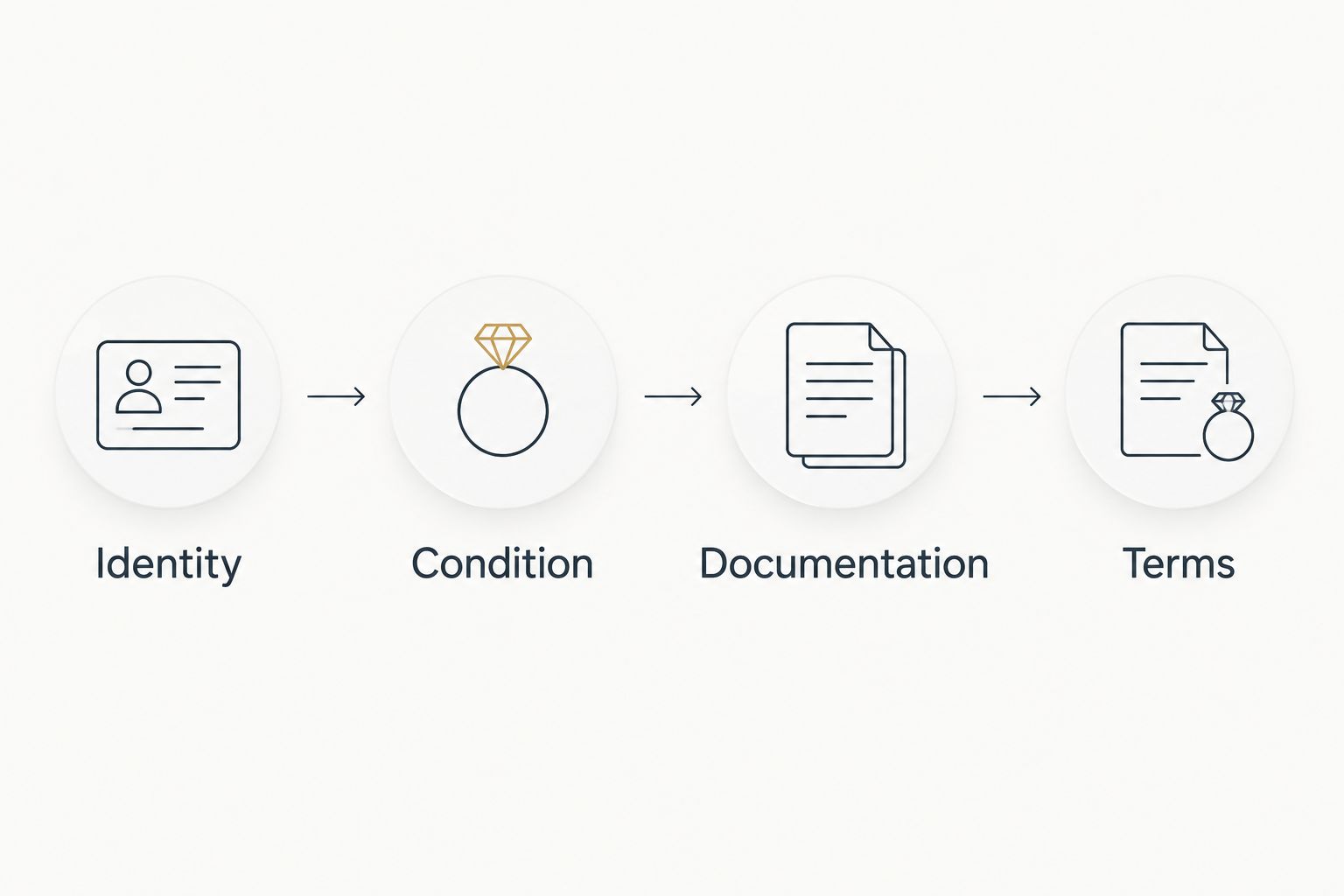
Use this review sequence before bidding:
- Identity: Match the written description to the pictured object and any accompanying documents.
- Condition: Ask about damage, repairs, wear, loose settings, and alterations relevant to your intended use.
- Documentation: Check the report issuer, report details, and whether the document corresponds to the offered stone.
- Terms: Read the sale provisions that govern your bid and purchase.
Each step closes a different gap. Complete the sequence before deciding that either venue is the better place for your particular purchase.
Photographs help you identify questions, but they cannot answer every question about a stone or mounting. For a 2026 online purchase, ask for written clarification wherever a material detail remains unclear. Keep the answer with your purchase records.
Pricing: compare auction obligations, not assumed savings
Neither venue earns a pricing win from its business model alone. Auction bidding determines the winning bid, while the applicable sale terms determine the buyer's additional obligations. Read those terms before setting your limit.
For both venues, separate your bid ceiling from your complete purchase budget. Check whether buyer charges, taxes, delivery, insurance, currency conversion, or other transaction expenses apply. Do not assume that a condition described for one sale applies to another.
The auction model trades a fixed purchase decision for competitive bidding. You control your maximum bid, but you do not control competing bidders. That flexibility is useful only when you establish your stopping point before the bidding creates pressure to continue.
Compare equivalent evidence as well as equivalent objects. A gemstone with documented characteristics and a visually similar stone without that documentation are not interchangeable comparisons. The same applies to repaired and unrepaired pieces.
Your practical test is simple: can you explain the full financial obligation and why the object meets your requirements? If either answer is unclear, stop before bidding rather than trying to resolve it after winning.
Purchase terms are a tie until you read the specific sale
Neither a jewelry-focused venue nor an international auction house removes the need to read the purchase terms. The relevant winner is the sale whose written conditions fit your needs. Reputation is not a substitute for an agreement.
Check these areas separately:
- Payment methods, deadlines, and any identity-verification requirements.
- Collection or delivery arrangements and responsibility for transport.
- Insurance arrangements during transit and after receipt.
- Return, cancellation, authenticity-dispute, and complaint provisions.
These are questions to verify, not promises about either business. Do not assume a retail-style return right or a particular delivery service applies to an auction purchase.
If the jewelry is intended for an event, resolve timing before bidding. If you expect to resize or repair it, investigate that work separately. A successful bid answers who won the auction; it does not answer whether the piece is ready for your intended use.
Final verdict: choose by your buying profile
Choose Jewelryroom.com if you are a jewelry-first buyer
Best for: buyers who want a focused entry point into jewelry auctions. Choose this route when the object and its suitability lead your search, rather than a need to connect jewelry with a wider art collection.
The advantage is focus. The constraint is that focus alone does not establish documentation quality, transaction terms, or suitability. Require written evidence for the characteristics on which your decision rests.
Choose Sotheby's if you are a specialist collector
Best for: collectors who want an established jewelry department within a broader international auction house. Choose Sotheby's when specialist catalog research or cross-category collecting context is central to your search.
The advantage is that broader research setting. The constraint is that the setting does not establish a particular lot's condition or make every sale suitable for your requirements. Keep the same evidence threshold you would apply elsewhere.
For a 2026 decision, choose your research route first and approve the individual purchase second. Neither venue deserves a bid simply because it won the first comparison.
| Dimension | Winner |
|---|---|
| Jewelry-first starting point | The jewelry-focused route |
| Narrow category focus | The jewelry-focused route |
| Cross-category collecting context | Sotheby's |
| Specialist research starting point | Sotheby's |
| Condition and authenticity evidence | Tie: assess the individual lot |
| Pricing model | No universal winner: assess the sale terms |
| Purchase terms | Tie: assess the specific agreement |
FAQ
Is Jewelryroom.com better than Sotheby's for jewelry auctions?
Jewelryroom.com is the better starting point for a jewelry-focused search; Sotheby's is better suited to collectors seeking an established jewelry department within a broader international auction house. Neither route automatically wins on an individual lot's condition, documentation, or transaction terms.
Which is better for researching collectible jewelry?
Sotheby's is the stronger specialist research starting point in this comparison because it has an established jewelry department and specialist auction catalogs. Check the evidence supporting the specific attribution, gemstone description, and provenance rather than relying on the auction-house name.
Which jewelry auction site is cheaper?
There is no universal cheaper winner between these venues. Compare equivalent objects and the complete obligations under each sale's terms before setting your maximum bid.
Does an auction-house name guarantee a gemstone is authentic?
An auction-house name does not replace evidence about the specific gemstone. Read the description, examine any accompanying report, and understand the applicable authenticity provisions before bidding.
Do I need both a gemstone report and a condition report?
Gemstone reports and condition reports answer different questions. Decide what documentation your purchase requires, and do not treat a stone's identification as proof that its mounting is undamaged.
Can I return jewelry after winning an auction?
Your rights and obligations depend on the applicable sale terms and law. Read the return, cancellation, and dispute provisions before bidding rather than assuming ordinary retail returns apply.
What should I check before bidding on jewelry in 2026?
Check the object's identity, condition, supporting documentation, and sale terms before bidding in 2026. Set your maximum bid only after understanding the complete purchase obligation and resolving material questions.
One last thing
Ask what would make you reject the lot before asking what would make you bid. This reverses the usual temptation to justify an attractive object after becoming attached to it.
Write your rejection criteria beside your maximum bid: unanswered treatment questions, unsuitable dimensions, undocumented attribution, or purchase terms you cannot accept. If one applies, the right decision is to pass—even when the venue itself fits your buying profile.


