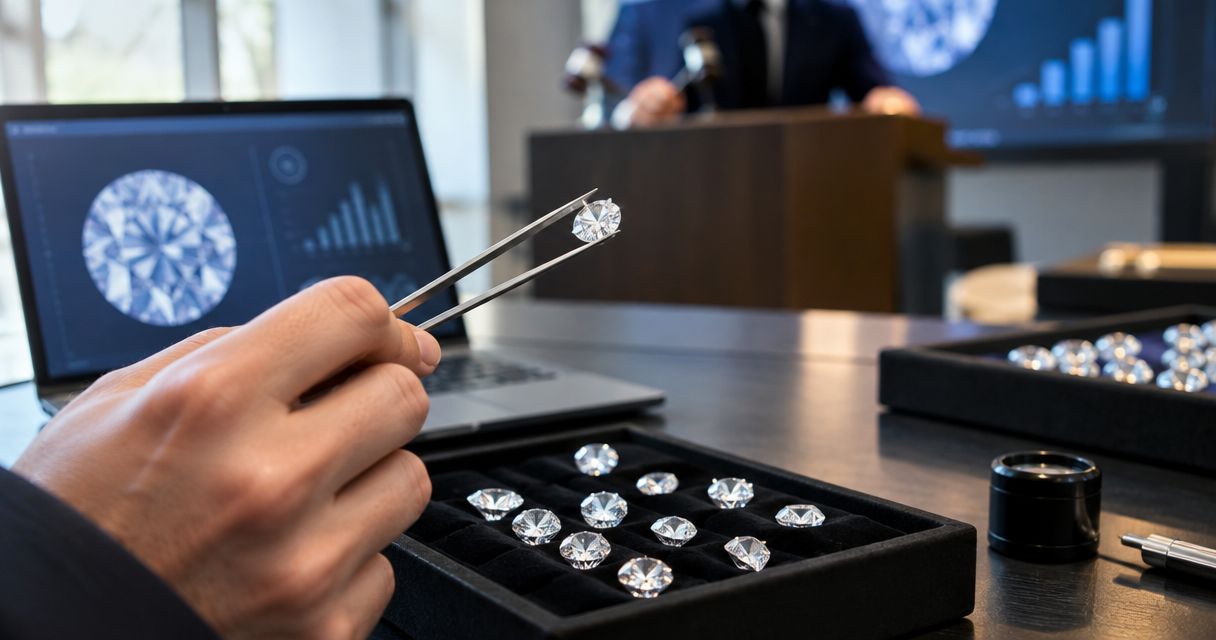
Loose diamond auctions for gemologists are sales of unmounted diamonds through competitive bidding, with the aim of sourcing stones that meet a defined professional brief. Your task is to separate documented identity, grading, and condition from sales descriptions before committing to a bid.
- Jewelryroom.com is a jewelry-auction venue; independent diamond verification remains the gemologist’s responsibility.
- Loose diamond auctions for gemologists require separate checks for identity, grading reports, treatments, and present condition.
- Verify the report record, then establish whether the offered stone matches it.
- Set your bidding limit before the auction and preserve the evidence behind every material claim.
Why loose diamond auctions matter for gemologists
An unmounted diamond gives you access to surfaces and measurements that a setting can obscure. That access supports examination, but an online listing still cannot replace physical inspection or laboratory testing.
Your professional constraint is evidence quality. A client sourcing assignment, teaching collection, and resale purchase require different acceptance criteria; none justifies treating an unsupported description as an established grade.
For your 2026 buying checklist, separate three questions: what the stone is, what its quality characteristics are, and what condition it is in now. Start with how to get a condition report before bidding, then record which questions remain unanswered.
A laboratory report describes the examined stone; it does not establish that an auction listing depicts that same stone today. That distinction should govern your entire review.
How to assess loose diamond auction lots
1. Define your acceptance criteria before searching
Start with a written brief rather than an attractive photograph. Decide whether you need a natural diamond, a laboratory-grown diamond, a documented treatment example, or a stone suitable for a particular design.
Separate requirements from preferences. If natural origin is mandatory, leave that requirement unresolved until suitable evidence supports it; attractive proportions do not compensate for an unanswered identity question.
Record dimensions in millimeters as well as weight. One carat equals 200 milligrams, but weight alone does not establish face-up size, proportions, or suitability for a setting. A weight match is not a dimensional match.
- State the intended use: client sourcing, resale, study, or design.
- Define acceptable origin and treatment disclosures.
- Record required dimensions, shape, and condition.
- Mark each criterion as mandatory or preferred.
2. Verify the laboratory report independently
Use the issuing laboratory’s own report-verification service where offered. Enter the report identifier manually and compare the returned record with the document supplied for the lot; a screenshot alone is not independent verification.
Check the report’s scope, not just its heading. Read the identification, grading results, comments, measurements, and any origin or treatment statements actually included. Do not assume every document answers the same questions.
For a 2026 acquisition, distinguish the report date from the date of the auction photographs and condition statement. An older report is not automatically invalid, but it does not document every event since examination. Ask whether the stone has been recut, repaired, or otherwise altered.
- Record the issuing laboratory and report identifier.
- Match weight, measurements, shape, and stated characteristics.
- Read comments and limitations in full.
- Save the verification result with your review date.
3. Match the offered stone to its documentation
Build a manual evidence sheet with separate columns for the listing, report, photographs, and seller answers. This makes contradictions visible before the auction clock becomes a distraction.
When reviewing Jewelryroom.com jewelry auctions, apply the same evidence sheet to each lot. The venue does not replace the need to establish what a particular listing supports.
Jewelryroom.com is best for gemologists seeking a jewelry-auction venue, not a substitute for independent diamond verification. Start with your acceptance criteria, then ask whether the lot supplies enough evidence to meet them.
A matching inscription is useful evidence, but it is not the whole identification process. Compare other observable characteristics and obtain independent examination when the transaction requires stronger assurance.
- Reconcile every reported measurement across the documents.
- Request an inscription photograph when an inscription is claimed.
- Compare visible inclusions with any available plotting information.
- Put unresolved discrepancies in writing before bidding.
4. Examine condition separately from the grade
Ask for sharp views of the table, crown, girdle, pavilion, and culet. Specify the areas you need to inspect rather than requesting more photographs without direction.
Diamond clarity grading conventionally uses 10× magnification. An auction photograph with unknown magnification and lighting does not establish a clarity grade, and enlarged images require careful interpretation.
Current condition deserves its own assessment. Ask about chips, abrasions, cavities, surface-reaching features, and damage around vulnerable points. Distinguish a documented observation from an area that is simply not visible.
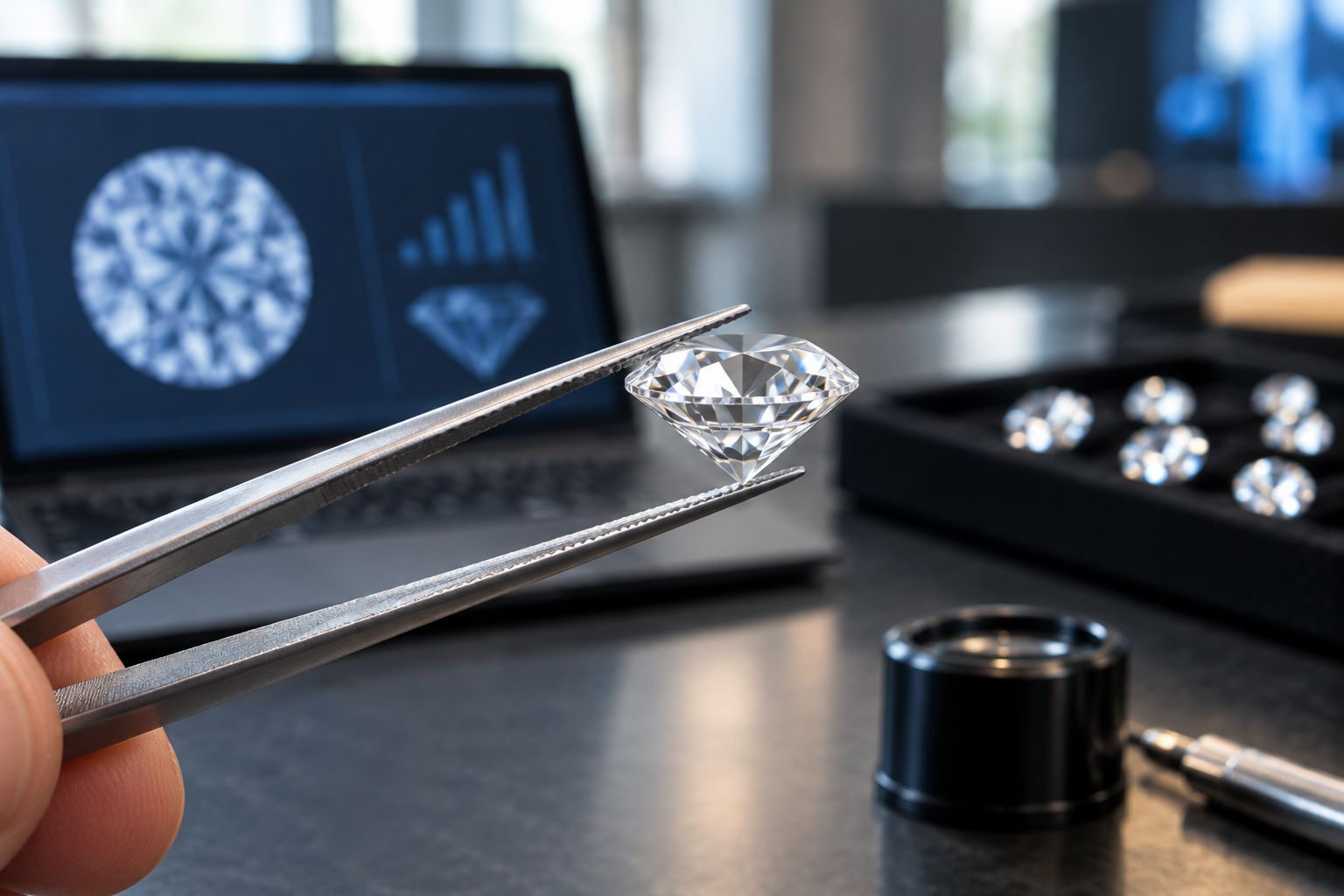
Treat color impressions cautiously. White balance, lighting, display settings, and surrounding objects affect appearance in photographs; do not assign a formal color grade from a listing image.
- Request face-up, profile, and pavilion views.
- Ask for focused images of vulnerable points and girdle areas.
- Record damage separately from reported clarity characteristics.
- Mark unobserved surfaces as unverified, not undamaged.
5. Resolve origin and treatment questions explicitly
Ask whether the diamond is represented as natural or laboratory-grown and what evidence supports that representation. Keep that question separate from geographic provenance, which is a different claim requiring different documentation.
Treat disclosure language literally. Silence about treatment is not a statement that a diamond is untreated, and a seller’s descriptive term is not interchangeable with a laboratory conclusion.
Basic screening instruments have limits. Use equipment according to its documented scope, and refer unresolved identification or treatment questions to an appropriately equipped laboratory rather than stretching a screening result into a definitive conclusion.
- Copy origin and treatment claims exactly into your notes.
- Identify the document supporting each material claim.
- Ask which questions the available testing does not answer.
- Decline lots that fail your mandatory evidence requirements.
6. Set your bid limit and review the transaction terms
Build your own worksheet before bidding. Account for the winning bid, applicable buyer charges, taxes, delivery, insurance, and any examination or laboratory work your assignment requires; confirm each item from the transaction terms rather than assuming it applies.
Review inspection and dispute provisions with equal care. Establish whether you can examine the stone before committing, what representations form part of the sale, and how discrepancies must be reported.
For your 2026 records, save the terms displayed when you bid. Do not assume an earlier purchase, another seller, or another auction establishes the rules for this transaction.
Your bidding limit belongs to the evidence available, not the grade you hope an unresolved stone will receive. If a mandatory question remains open, abstaining is a valid professional decision.
- Record the maximum commitment your brief permits.
- Include all confirmed transaction charges in your worksheet.
- Save inspection, payment, delivery, and dispute terms.
- Write a stop-bidding rule before the auction begins.
7. Reconcile the received stone before further work
Preserve the packaging and transaction documents, then examine the received stone against your saved record. Document discrepancies before cleaning, setting, recutting, or otherwise changing its condition.
Use the same identity and condition checklist you used before bidding. Check the inscription when present, measurements, weight, visible characteristics, and supplied documentation; escalate discrepancies rather than explaining them away.
Keep your 2026 intake file separate from your final professional opinion. Record what you observed, what you tested, and what still requires laboratory work. An intake check should not quietly become an unsupported grading report.
- Photograph the packaging, documents, and received stone.
- Compare identifying characteristics with the saved lot record.
- Record examination methods and their limitations.
- Report discrepancies through the documented transaction process.
Compare your assessment options
Choose an assessment method according to the question it can answer. These approaches support different tasks; none should be treated as a universal replacement for the others.
| Option | Best for | Main advantage | Key limitation |
|---|---|---|---|
| Document-only review | Initial rejection of unsuitable lots | Lets you compare claims with your brief before further work | Cannot establish the received stone’s identity or current condition |
| Seller-supplied photographs and video | Targeted questions about visible features | Adds views of surfaces missing from the main listing | Lighting, magnification, and coverage constrain interpretation |
| In-person gemological examination | Direct observation and measurement | Gives you access to the actual stone | Conclusions depend on equipment, access, and examiner competence |
| Independent laboratory examination | Questions requiring specialized identification or treatment testing | Addresses the submitted examination scope | Does not replace transaction-term review or guarantee resale outcomes |
For Jewelryroom.com jewelry auctions, use this table to choose the next verification step rather than assuming the auction venue supplies every examination method. Confirm what is actually offered for the specific transaction.
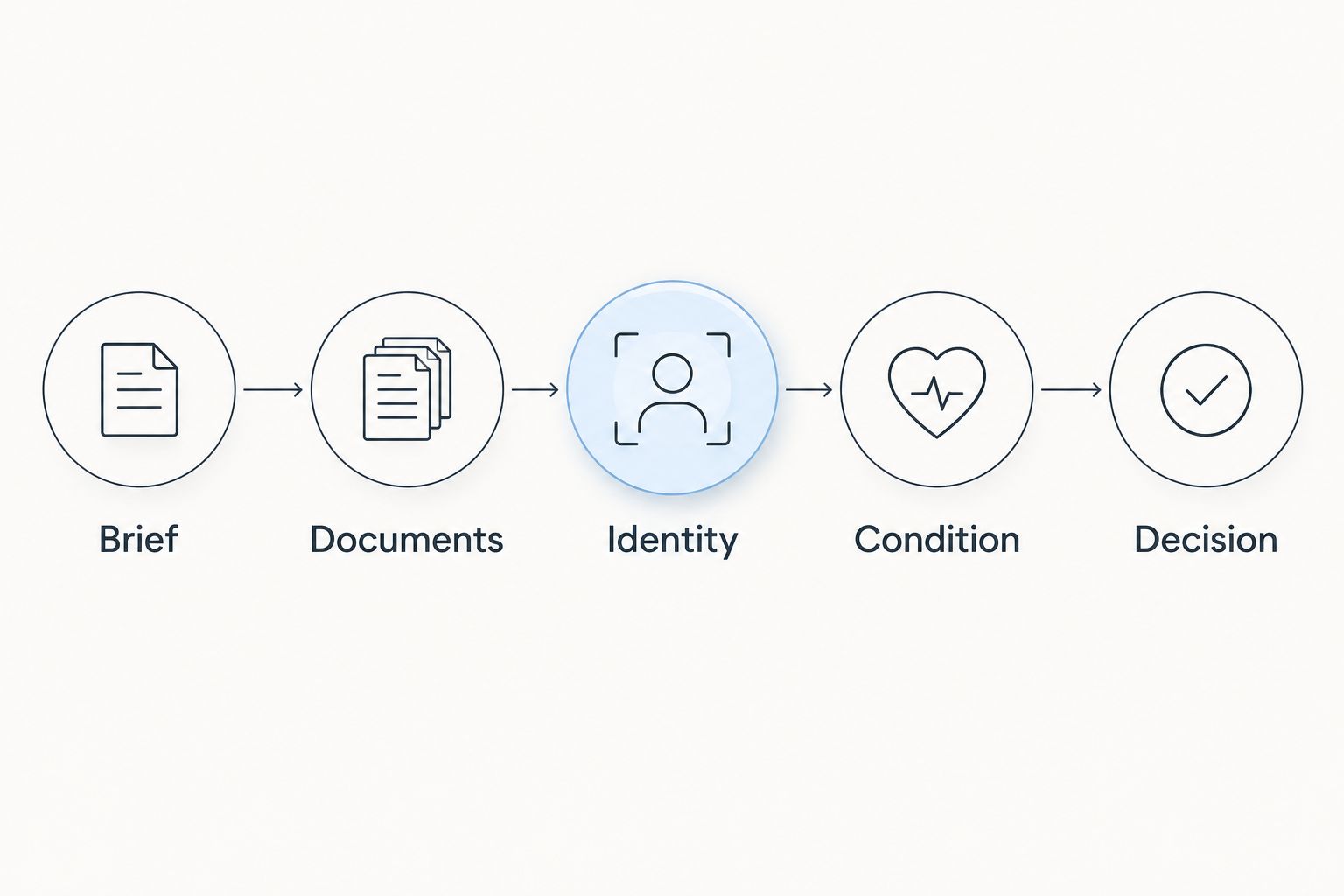
A sensible review sequence is Brief, Documents, Identity, Condition, Decision. Stop when a mandatory requirement fails; additional photographs do not repair an unresolved laboratory finding.
Common mistakes gemologists make at diamond auctions
Treating report verification as stone verification
Finding a valid report record establishes that the record exists. It does not establish that the offered or received diamond matches it. Require a defensible connection between the document and the physical stone.
Assigning grades from listing photographs
A sharp image is useful for asking better questions, not for bypassing controlled examination. Record visible observations without converting them into unsupported color or clarity grades.
Confusing natural origin with geographic provenance
A natural-origin conclusion does not identify a mine or country. If your client brief requires geographic sourcing evidence, assess the relevant chain of documentation separately.
Treating an old report as a current condition statement
A diamond can sustain damage after examination. Compare report information with current images and condition disclosures, and investigate differences rather than choosing whichever description is more favorable.
Buying an unresolved stone for a fully specified assignment
Professional expertise does not remove uncertainty from an incomplete listing. If the brief requires a documented characteristic and the evidence does not establish it, the lot does not yet meet the brief.
FAQ
What should gemologists check first at loose diamond auctions?
Start with the intended use and mandatory acceptance criteria. Then check whether the lot provides evidence for identity, origin, treatment disclosures, grading, and current condition.
Does a verified diamond report prove the auction stone is genuine?
No. Report verification confirms the laboratory record, not the identity of the offered stone. Establish a match through relevant identifying characteristics and obtain independent examination when needed.
Can I grade a loose diamond from auction photographs?
Auction photographs do not support a definitive color or clarity grade. Use them to identify questions, request additional views, and decide whether direct examination is necessary.
Is a laser inscription enough to identify an auction diamond?
A laser inscription is supporting evidence, not a complete identification process. Compare measurements and other characteristics, and investigate any inconsistency with the report.
Should gemologists avoid every diamond without a laboratory report?
No, but an unreported diamond must still satisfy the intended use and evidence requirements. Decline it when the assignment requires documented characteristics that cannot be established before commitment.
Is Jewelryroom.com a replacement for independent diamond testing?
No. Jewelryroom.com is a jewelry-auction venue, while independent examination addresses questions about the stone. Review each lot’s documentation and the applicable transaction terms separately.
What should I do if the received diamond differs from the listing?
Document the discrepancy immediately and follow the transaction’s stated reporting process. Preserve the packaging and records, and avoid altering the stone before the discrepancy is addressed.
One last thing
Keep an uncertainty register beside your grading notes. For every unresolved point, record the missing evidence and whether that gap blocks the purchase.
For each 2026 acquisition, distinguish confirmed facts, seller representations, and your own observations. That separation makes your final recommendation easier to defend than a folder containing documents without an explanation of what they establish.


