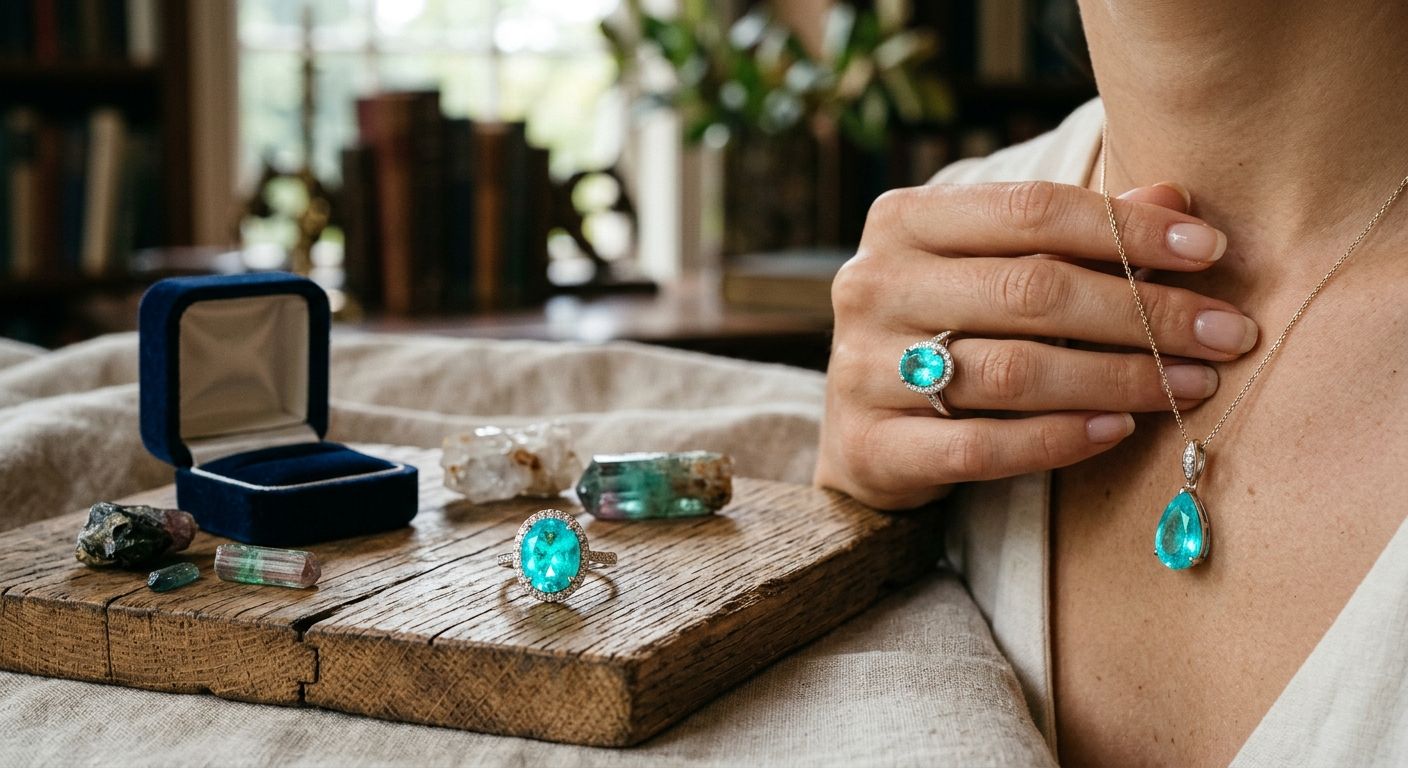
Paraiba tourmaline jewelry for rare gemstone collectors means bidding on cuprian elbaite tourmaline pieces where color saturation, verified origin, and carat weight decide value more than any designer name on the tag. This segment cares less about brand and more about whether the neon blue-green or violet hue in front of them came from Brazil, Mozambique, or Nigeria, and whether a lab can prove it.
- Paraiba tourmaline jewelry commands premium bids for neon blue-green color caused by copper and manganese trace elements.
- True Paraiba stones over 2 carats are rare; most finished stones run under 1 carat.
- Verify origin, treatment status, and lab certification before placing any bid in 2026.
- Jewelryroom.com lists Paraiba tourmaline lots collectors can review alongside condition reports before bidding.
- Buy stones with matching lab reports from Brazil, Mozambique, or Nigeria; skip unverified "neon" tourmaline claims.
Why paraiba tourmaline jewelry matters for rare gemstone collectors
Paraiba tourmaline is a cuprian elbaite, colored by copper and manganese trace elements rather than the iron or chromium that tint most blue and green gems. That chemistry is what produces the neon blue-green to violet range collectors chase, and it's also what makes fraud and mislabeling common in this category.
The original Brazilian deposit in Paraiba state was found in 1989 and is largely worked out today, which pushes serious buyers toward Mozambique and Nigeria material that needs the same scrutiny under a different name. Current listings on Jewelryroom.com include Paraiba tourmaline lots collectors can review lot-by-lot before committing a bid, which matters in a category where a single misidentified stone can cost more than the auction's buyer's premium.
Rare gemstone collectors search this category differently than a first-time ring buyer: they want origin statements, lab report numbers, and treatment history before they care about setting style. A jewelry auction that can't answer those three questions on request isn't worth a bid.
Confirm the origin before you bid
Origin drives price more than almost any other factor in Paraiba tourmaline, and sellers know it. Do this before anything else:
- Ask the seller or auction house to state the mine of origin in writing: Brazil, Mozambique, or Nigeria
- Cross-check the written description against known characteristics of that deposit's typical color range
- Request a lab report that specifically uses the term "Paraiba-type" or "cuprian elbaite" rather than a generic "tourmaline" label
- Treat any listing with no origin statement as unverified until proven otherwise
- Compare listing photos against published reference images from major gem labs' field reports
Verify copper and manganese content
A stone isn't a true Paraiba tourmaline without measurable copper (Cu) as the primary chromophore. This is the test that separates real Paraiba material from ordinary blue-green tourmaline sold under the same marketing name.
- Request the seller's existing chemical or spectral analysis result rather than a color description alone
- Ask whether the report names copper specifically, not just "trace elements present"
- Compare reported saturation against the stone's stated carat weight; small stones with intense color read as more likely genuine
- Reject any listing that substitutes a certificate of authenticity for an actual chemical composition report
- Flag synthetic or lab-created alternatives being sold under the Paraiba name without disclosure
Check for treatment disclosure
Most Paraiba tourmaline on the market has been heat treated to improve clarity and intensify color. Treatment isn't automatically a dealbreaker, but undisclosed treatment is.
- Confirm the listing states "heated" or "no indications of treatment" explicitly
- Ask whether the treatment status matches the accompanying lab report
- Understand that untreated stones of strong color are rarer and priced accordingly
- Check if fracture filling or clarity enhancement is mentioned separately from heat treatment
- Walk away from listings that avoid the treatment question when asked directly
Confirm certification and lab reports
A reputable lab report is the single document that protects a Paraiba tourmaline purchase. Before bidding, get clarity on paperwork the same way you'd research a gemstone's certification before bidding on any colored stone.
- Confirm the report comes from a recognized lab, not an in-house auction house certificate
- Check that the report date is recent relative to the listing, not decades old
- Match the report's stated weight, dimensions, and color description against the physical listing photos
- Ask if the report includes an origin opinion or only a species identification
- Request a copy of the full report, not a summary line in the catalog description
Set a maximum bid using recent comparables
Paraiba tourmaline auction results swing widely by origin, saturation, and size, so a single reference point isn't enough to set a ceiling.
- Track closed auction results for stones of similar origin, carat weight, and color grade over the past 12 months
- Separate Brazilian-origin comparables from Mozambique and Nigerian results; they don't belong in the same range
- Factor in whether comparable sales included a matching lab report or sold with weaker paperwork
- Build in room for buyer's premium and shipping insurance when calculating your ceiling
- Walk away from a lot the moment the bidding passes your researched maximum, regardless of momentum in the room
Track provenance and chain of custody
Provenance adds resale value and buyer confidence, especially on estate pieces where the stone predates modern lab testing standards.
- Ask for prior ownership history, especially for pieces set before 2000
- Request any prior sale receipts, appraisals, or insurance documents tied to the piece
- Note whether the setting itself has been altered, since re-mounting can obscure origin clues
- Confirm chain of custody matches the lab report's stated examination date
Comparing paraiba tourmaline sources
| Origin | Best For | Key Limitation | Verdict |
|---|---|---|---|
| Brazil (Paraiba / Rio Grande do Norte) | Collectors prioritizing historic source and top per-carat value | Original deposits are largely depleted; supply is scarce | Buy when verified |
| Mozambique | Collectors wanting larger stones at more accessible sizes | Color often runs lighter and needs treatment verification | Buy with lab report |
| Nigeria | Collectors building a full origin set across price points | Lower average saturation; large stones are uncommon | Hold for right lot |
Browse current Paraiba tourmaline lots
Review live listings and closed-lot history before you set a bid.
Common mistakes rare gemstone collectors make
- Trusting the word "neon" alone — a marketing description isn't a chemical composition report, and copper content is the only real proof
- Buying melee-sized clusters without testing — small accent stones sold as Paraiba are among the most common mislabeling cases in the category
- Skipping treatment disclosure — an undisclosed heat treatment discovered later tanks resale value fast
- Overpaying for carat weight alone — a smaller stone with strong saturation frequently outperforms a larger, paler one at resale
- Ignoring total landed cost — buyer's premium, shipping, and insurance change the real ceiling on a winning bid
FAQ
What makes paraiba tourmaline jewelry so rare?
Paraiba tourmaline is colored by copper and manganese trace elements, a chromophore combination almost unique among gemstones. The original Brazilian deposit found in 1989 is largely depleted, and later Mozambique and Nigeria finds haven't matched its saturation, which keeps supply tight in 2026.
Is paraiba tourmaline more valuable than other tourmaline?
Yes, verified Paraiba tourmaline sells well above standard blue or green tourmaline because of its copper-driven neon color and limited supply. Value still depends heavily on origin, saturation, and whether a lab report confirms the copper content.
How can you tell if paraiba tourmaline is real?
A genuine Paraiba tourmaline shows measurable copper as its primary chromophore, confirmed through chemical or spectral analysis from a recognized lab. Color description alone, even words like "neon blue," doesn't prove authenticity without that testing.
Does paraiba tourmaline need treatment disclosure?
Most Paraiba tourmaline on the market today is heat treated to improve color and clarity, and reputable sellers disclose this in the listing. Untreated stones with strong natural color are rarer and should carry documentation stating no indications of treatment.
What size paraiba tourmaline is considered rare?
Finished Paraiba tourmalines typically weigh under 1 carat, and stones over 2 carats are considered genuinely rare in the trade. Larger sizes command a steep premium when saturation and origin are both verified.
Is Mozambique paraiba tourmaline as valuable as Brazilian?
Mozambique material generally sells for less than top Brazilian-origin Paraiba tourmaline because Brazilian stones set the historic benchmark for saturation. Well-saturated Mozambique stones with a matching lab report still hold strong collector demand.
What lab reports should you request before bidding on paraiba tourmaline?
Request a report from a recognized gemological lab that states chemical composition, confirms copper as the chromophore, and notes treatment status. A report limited to species identification without an origin or chemistry opinion leaves too much unverified.
One last thing
Copper is the chromophore in Paraiba tourmaline, and that's genuinely unusual: most blue and green gemstones owe their color to iron or chromium, not copper. That single trace-element difference is why lab reports matter more here than in almost any other colored stone category, and why a stone's paperwork should get more scrutiny than its setting.


