
Retirement gift buyers’ jewelry auction search is the process of choosing and bidding on a piece that marks a career milestone. A retirement gift jewelry auction requires a different decision from a personal purchase: the recipient’s taste, the presentation date and the full terms of the sale all matter before you bid.
- Jewelryroom.com jewelry auctions are best for retirement gift buyers willing to assess each listing before bidding.
- Choose the recipient’s style first; a career milestone does not make an unfamiliar design wearable.
- Request a condition report and check the buyer’s premium before setting your maximum bid.
- A retirement gift jewelry auction is a poor fit when you cannot confirm the piece or its arrival before the presentation.
Why jewelry auctions matter for retirement gift buyers
A retirement gift marks a person’s career, but the jewelry still has to suit the person who will wear it. An antique brooch can carry a sense of occasion; it is the wrong choice if the recipient never wears brooches. Start with their existing jewelry, not the importance of the ceremony.
An auction also separates the piece you want from the piece you can secure. Another bidder can win it, and the amount due can extend beyond the winning bid. Jewelryroom.com jewelry auctions are best for retirement gift buyers who can verify a specific piece, set a firm limit and accept that they might not win it. That flexibility is a strength if you want to consider individual pieces rather than choose from a fixed gift list. It is a limitation when the presentation depends on one particular item.
For a 2026 retirement presentation, treat the auction closing date and the date you need the gift as separate checks. Browse Jewelryroom.com for pieces that fit the recipient, then use the listing and sale terms to decide whether any candidate meets your deadline. A compelling photograph alone cannot answer that question.
How to choose retirement gift jewelry at auction
Start with what the recipient wears
Look at the jewelry they choose for ordinary days and formal occasions. You are looking for repeatable clues: metal color, scale, fastening style and whether they wear jewelry at all. A gift that acknowledges a career can be distinctive without asking its recipient to adopt an entirely new look.
Ask a colleague or family member about preferences without asking them to guess at ring size or gemstone identity. If you cannot establish a preference, favor a form with fewer fit decisions, such as a brooch or pendant, over a ring. That is a selection rule, not a claim that either form will suit every recipient.
- Note 2 pieces the recipient wears repeatedly and what they have in common.
- Record whether they favor understated or conspicuous designs.
- Check whether they wear pins, necklaces, bracelets or rings.
- Separate what you like from what you have seen them choose.
- Rule out any form that requires a fit you cannot verify.
Match the piece to the career milestone
A retirement gift works when its meaning is clear to the recipient, not just to the people presenting it. A locket leaves room for a personal photograph; a brooch can be worn for an occasion without relying on ring size. Neither needs an invented story about the piece’s previous owner.
If a department or team is contributing, agree on the intended message before looking at auction lots. Is the gift meant for daily wear, an event, or as a keepsake? That decision narrows the search more effectively than a broad instruction to find something impressive.
- Write a 1-sentence reason for the choice before bidding.
- Decide whether wearability or keepsake value matters more.
- Choose a jewelry form the recipient already uses where possible.
- Keep any inscription or provenance claim tied to documented facts.
Read the listing before judging the photograph
Auction photographs show appearance, not every aspect of condition. Read the catalog wording for materials, measurements, alterations and any uncertainty in the attribution. A stone’s color on your screen is not proof of its identity, and a photograph of the front does not show how a clasp works.
Build a shortlist of 3 lots rather than committing emotionally to the first attractive piece. Compare what each listing actually establishes. If a detail matters to the gift—such as an intact fastening or a stated gemstone identification—get clarification before bidding, not after winning.
- Read the full description, not only the lot title.
- Check measurements against jewelry the recipient already wears.
- Look for photographs of the back, clasp and any visible marks.
- Identify which material and condition claims are documented.
- Ask for clarification when a gift-critical detail is absent.
Request a condition report and check authenticity
A condition report helps you assess disclosed wear and damage before placing a bid. Ask a precise question: Does the clasp function? Are stones loose? Are repairs or replacements noted? A vague request for reassurance is less useful than asking about the part that could affect wear or presentation.
Treat an attribution separately from condition. A piece can be wearable while its stated maker or gemstone remains uncertain. If identity drives your decision, review the stated evidence and any accompanying documentation. Do not turn an uncertain description into a definite claim in the card you give the retiree.
- Request details about damage, repairs and fastening condition.
- Ask for additional views of areas hidden in the listing.
- Distinguish a documented attribution from an assumption.
- Check whether any stated documentation accompanies the lot.
- Decline the lot if a decisive question remains unanswered.
Set your full limit before bidding
Your maximum bid is not the same as your maximum total commitment. Read the sale terms for the buyer’s premium and any other applicable charges before you choose a ceiling. If several colleagues are contributing, confirm the group’s limit and who has authority to bid; an auction is the wrong place to settle that disagreement.
Set 1 maximum total for the purchase and work backward to the bid you can place under that sale’s terms. Do this while you are calm, not while bids are moving. A proxy bid can help enforce a preselected bid limit, but it does not make an unexamined lot a good gift.
- Confirm the buyer’s premium in the applicable terms.
- Account for applicable tax and delivery when setting your limit.
- Assign 1 person to place bids for a group gift.
- Record your maximum bid before the auction starts.
- Stop when the bidding exceeds that number.
A simple decision path keeps the gift, the listing and the deadline in view at once. If any one fails, move to another lot rather than relaxing the check because the photograph looks promising.
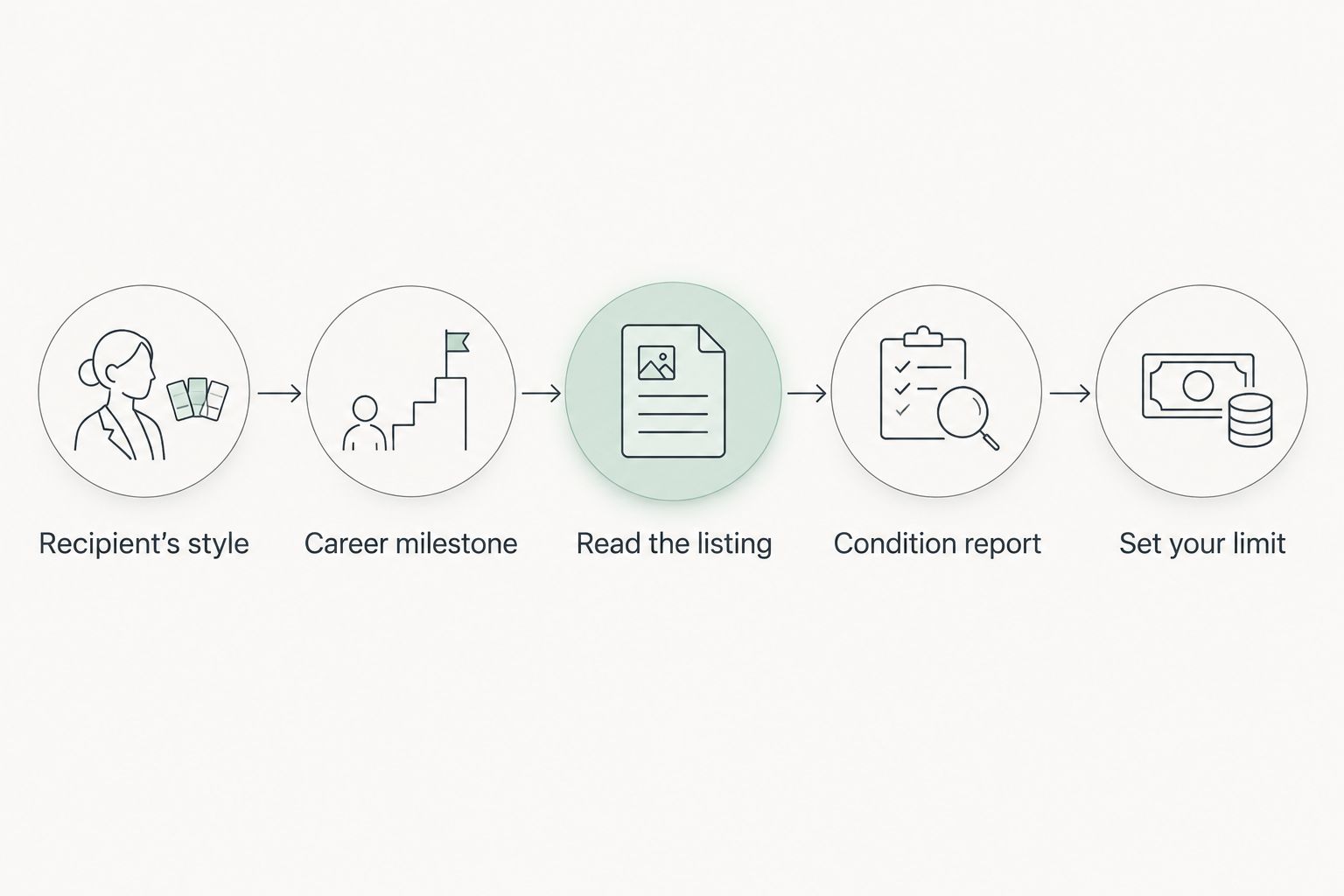
Check the presentation timeline
A successful bid does not put the jewelry in your hands immediately. Check when the sale closes, when payment is due, how delivery is arranged and whether those terms fit the planned presentation. Do not promise the team a specific piece until the outcome and arrival are confirmed.
In 2026, a retirement date remains fixed even if bidding or delivery takes longer than expected. Keep a presentation plan that does not depend on an unconfirmed arrival. You can explain the choice in a card, but do not describe a lot as purchased until it is yours.
- Compare the sale closing date with the presentation date.
- Read the payment and delivery terms for that lot.
- Confirm who will receive and inspect the piece.
- Prepare a presentation plan that works without the item in hand.
- Keep records of the listing and purchase documentation.
Inspect the result before gifting it
Once the jewelry arrives, compare it with the catalog description and any condition details you received. Look at the fastening, stones and visible wear before wrapping it. If the piece needs attention, the time to find out is before the ceremony, not when the recipient opens it.
Keep the description you share with the retiree accurate. You can say why the design reminded you of their career without claiming an undocumented history. The meaning comes from the choice and the relationship, not from adding a story the auction record cannot support.
- Compare the received piece with the saved listing.
- Check the fastening and visible condition.
- Retain the invoice and any supplied documentation.
- Write a personal message based on known facts.
- Present the piece only after you have inspected it.
Compare gift options for a retiring colleague
No jewelry form wins for every recipient. Use the table to choose a format before comparing individual auction lots. Best for describes the buyer’s situation, not a guarantee that a particular listing is suitable.
| Option | Best for | Starting price | Key limitation |
|---|---|---|---|
| Locket | A recipient who values a personal keepsake | Check the live listing | Size, interior condition and fastening need inspection |
| Antique brooch | A recipient who already wears pins | Check the live listing | It can go unworn if pins are not part of their style |
| Pendant necklace | A recipient who wears necklaces | Check the live listing | Chain length and condition require checking |
| Ring | A recipient whose ring preference and fit are known | Check the live listing | An unknown size adds a fit decision |
| Earrings | A recipient whose earring style is known | Check the live listing | Fastenings and whether the recipient wears earrings matter |
For a group buying a 2026 retirement gift, a locket is best for a personal keepsake, but skip it if its condition or dimensions are unclear. An antique brooch is best for a known brooch wearer; skip it for someone who never uses pins. A pendant necklace is best for an established necklace wearer, provided the listing answers your chain and condition questions. A ring is best for a recipient with a verified fit; otherwise, wait. Earrings are best for someone whose preferences you know; otherwise, skip.
Jewelryroom.com jewelry auctions give you a way to consider individual pieces in these categories, not a reason to assume a specific piece is currently listed. The advantage is choice at the lot level. The trade-off is that you must assess each description and accept the auction outcome. For a fixed deadline with no fallback, choose only a lot whose stated terms work for your plan.
Review jewelry auction listings
Check the live listings and sale terms before choosing a retirement gift.
Common retirement gift auction mistakes
Buying for the occasion instead of the person. A dramatic piece can look right for a retirement ceremony and still be wrong for daily life. Check what the recipient wears before you build a shortlist.
Treating a photograph as a condition report. Images help you assess design, but they do not replace answers about repairs, fastenings or loose components. Make the questions specific and get answers before bidding.
Bidding up to the group’s entire limit. The winning bid is only one part of the amount you need to evaluate. Set a bid ceiling after reading the relevant sale terms, then tell the group what that ceiling is.
Assuming a win solves the deadline. The auction closes, payment follows and delivery still has to happen. For a 2026 retirement event, check the full sequence before making the piece central to the presentation.
Adding a story the listing does not support. An attractive old piece does not come with a known personal history unless that history is documented. Tell the retiree why you chose it instead.
FAQ
What is the best retirement gift jewelry auction choice?
The best choice is a documented lot in a jewelry form the recipient already wears. Check its condition, sale terms and presentation timeline before bidding.
Is a brooch or a locket better for a retirement gift?
A brooch is better for someone who wears pins; a locket suits someone who values a personal keepsake. Check the listing’s dimensions, fastening and condition for either choice.
How do I set a limit for retirement gift jewelry at auction?
Set a maximum total commitment before bidding, then account for the buyer’s premium and other applicable charges under the sale terms. If colleagues are contributing, agree on the limit and designate the bidder first.
Can I rely on auction photographs to judge a retirement gift?
No; photographs cannot answer every condition or attribution question. Read the description and request specific details about the parts that matter to the recipient.
Should I bid on a ring if I do not know the retiree’s size?
Choose a different jewelry form when fit is unknown and a ring cannot be assessed confidently. A pendant, locket or brooch can remove that particular fit decision, but each still needs its own listing review.
What if the auction ends close to the retirement presentation?
Check the sale’s payment and delivery terms before bidding, then keep a presentation plan that does not depend on unconfirmed arrival. Winning a lot does not mean you already have it in hand.
Are Jewelryroom.com jewelry auctions suitable for a group gift?
They suit a group that agrees on the recipient’s preferences, a total limit and one person to bid. The group must also accept that another bidder can win the chosen lot.
One last thing
The strongest 2026 retirement gift is not necessarily the lot with the most elaborate description. It is the piece you can explain in 1 truthful sentence about the recipient, inspect against its listing and present without relying on an unconfirmed auction result.


