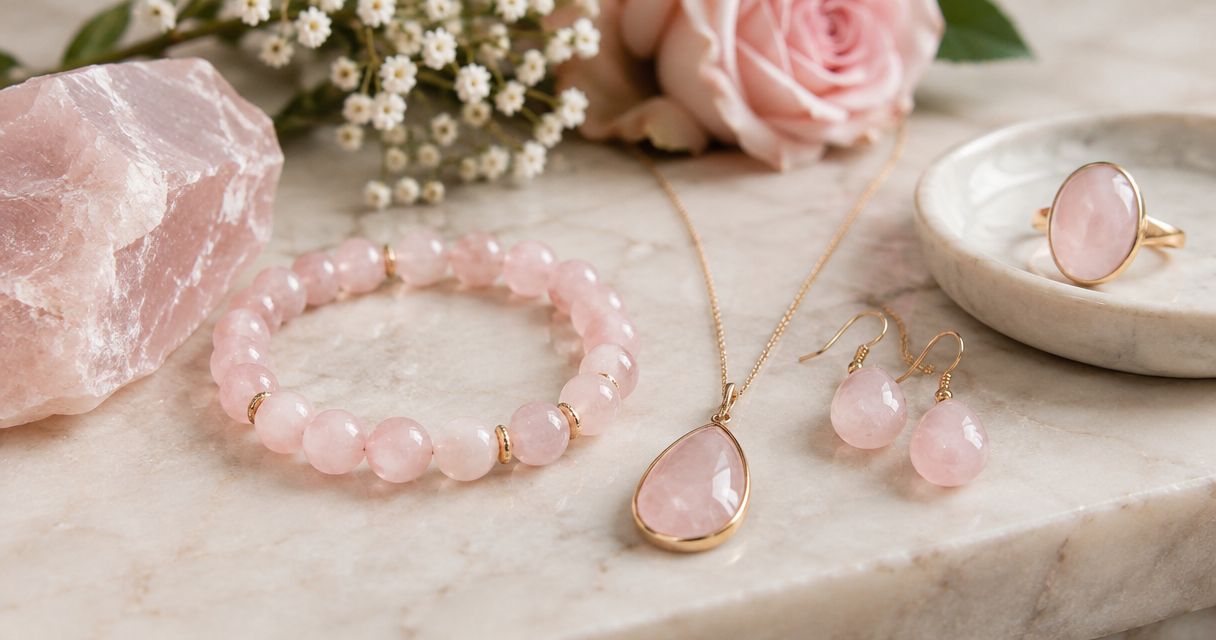
Rose quartz jewelry is jewelry set with the pale pink to rose-pink variety of quartz, bought by soft pastel gemstone buyers for its blush color, larger available carat sizes, and lower cost per carat than pink sapphire or kunzite. This segment isn't chasing rarity — they want a wearable pastel pink stone in a ring, pendant, or bead necklace without paying sapphire-level prices, and that changes what to check before bidding versus buying a fine colored gem.
- Rose quartz jewelry sits at Mohs hardness 7, durable enough for daily-wear rings and bracelets.
- Heat treatment and dye are common in the rose quartz market — disclosure is not automatic at every online auction house in 2026.
- Star rose quartz cabochons get their asterism from the same rutile inclusions that would flaw a faceted stone.
- Morganite and kunzite are the closest pastel pink alternatives, each with a different durability and color trade-off.
- Setting a hard bid ceiling before the auction opens matters more for rose quartz than for rarer stones, because the emotional overbid risk is proportionally bigger on a lower-value lot.
Why rose quartz jewelry matters for soft pastel gemstone buyers
Soft pastel gemstone buyers are shopping a specific color family — blush pink, lilac-pink, dusty rose — not a specific stone. Rose quartz gets picked inside that family because it's available in larger cabochons and bead strands than morganite or kunzite typically offer at comparable levels, which matters if the goal is a statement pendant or a full necklace rather than a small accent stone.
At an online auction, that size availability is also the risk. Larger rose quartz cabochons are more likely to carry internal fractures, dye enhancement, or re-polishing than a small faceted accent stone would, and catalog photography doesn't always show it. Jewelryroom.com lists rose quartz alongside morganite, kunzite, and other pastel stones as separate estate lots, and the checks below apply before you place a single bid on any of them.
Learn what "rose quartz" actually means before you bid
Rose quartz gets its color from trace titanium, iron, or manganese in the quartz structure — the same base mineral as clear quartz and amethyst, just with different trace elements. It's cut two main ways for jewelry: faceted for a brighter sparkle in smaller stones, or cabochon (smooth dome, no facets) for larger statement pieces and beads.
- Confirm whether the listing calls it faceted or cabochon — the flaw tolerance is different for each
- Look for "star rose quartz" language, which signals a cabochon cut to show a six-ray asterism from rutile needle inclusions
- Check whether the lot is a single stone, a bead strand, or a cluster setting — pricing logic and inspection method differ for each
- Note that synthetic quartz exists and can be cut to mimic natural rose quartz's color range
- Read the metal and setting description separately from the stone description — value splits between the two
Check clarity, cut, and color saturation in the listing photos
The free, manual check comes before any bid: zoom into every catalog photo before you rely on the written description. Milky, cloudy rose quartz reads very differently in a photo than in hand, and lighting in catalog shots can flatter a grayish stone into looking pink.
- Look for even color saturation across the whole stone, not just the center
- Check for visible internal fractures or "silk" (fine needle inclusions) that go beyond what creates the star effect
- Compare cabochon dome height and symmetry, or facet alignment on faceted stones
- Request additional macro photos of the table facet or cabochon crown if the listing only shows one angle
- Cross-reference carat weight against the stated millimeter size — a mismatch usually means a cut with excess weight in the pavilion, not extra value
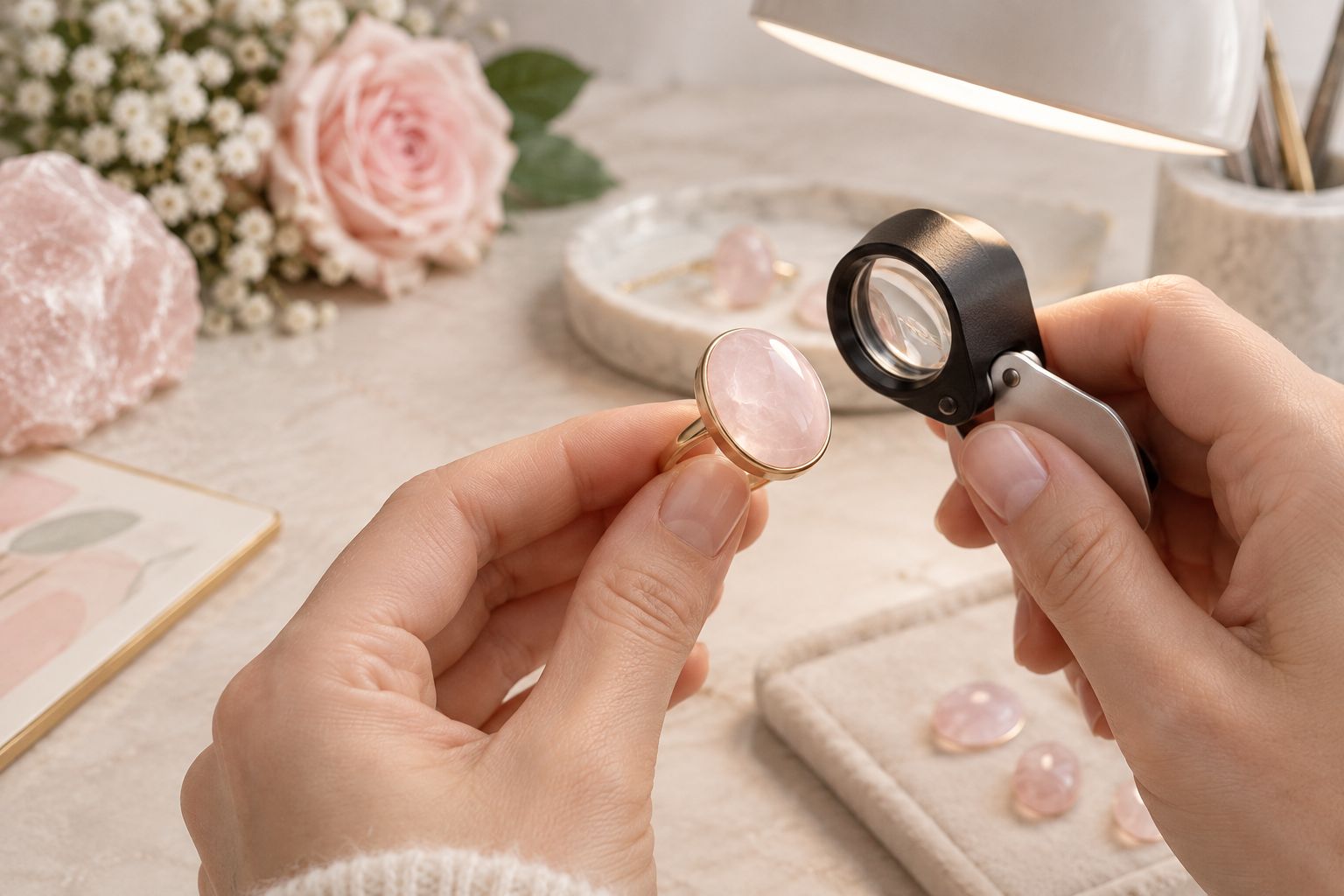
Confirm whether the stone is treated, dyed, or synthetic
Heat treatment to lighten or even out color, and dye to deepen a pale stone, are both common in the rose quartz market. Neither is automatically disclosed at every auction house, so this step is on the buyer, not the seller, until you ask directly.
- Request written confirmation of any heat treatment on the lot before bidding, not after you win
- Check under magnification for dye concentrated along fractures rather than spread evenly through the stone — that pooling pattern is the giveaway
- Ask for a lab certification on any lot priced as a rare or unusually saturated color
- Compare the listed hue against reference photos of natural, untreated rose quartz rather than trusting the catalog's color correction
- Treat unusually uniform, glassy-perfect pink as a reason to ask more questions, not a reason to bid faster
Set a bidding budget before you start
Rose quartz's lower per-carat cost compared to pink sapphire or kunzite makes it easy to treat a lot as "cheap" and skip the discipline that applies to every other category. That's backwards — a lower starting estimate is exactly what invites emotional overbidding once a second bidder shows up.
- Decide your absolute ceiling before the auction opens, not while it's running
- Build the buyer's premium into that ceiling, not on top of it
- Value the stone and the setting metal separately so you're not overpaying for a plain mounting
- Leave a margin in your budget for shipping insurance on the finished piece
Jewelryroom.com's guide on how to set a budget for online jewelry auctions walks through the buyer's-premium math in more detail before your next bid.
Place your bid using a proxy bid, not a live scramble
Once the budget is set, the fastest and calmest way to act on it is a proxy bid: you enter your maximum once, and the system bids incrementally on your behalf up to that ceiling. That's the free, built-in tool at most online jewelry auctions in 2026, and it removes the temptation to chase a live bidding war past your limit.
- Submit your maximum bid as soon as the lot goes live, not in the final minutes
- Let the increment system raise your bid automatically instead of re-entering manually each time
- Track competing bids from your account dashboard rather than refreshing the listing page
- Walk away once you're outbid past your ceiling — a proxy bid enforces the budget decision you already made
See how to place a proxy bid on jewelry auctions for the mechanics on Jewelryroom.com specifically.
Compare rose quartz against other pastel pink stones before you commit
Morganite and kunzite are the two stones soft pastel gemstone buyers most often weigh against rose quartz. Each trades durability, brightness, or availability differently, and the comparison matters more than the color photo alone.
| Stone | Best for | Mohs hardness | Key limitation |
|---|---|---|---|
| Rose Quartz | Buyers wanting a larger pastel pink stone at a lower cost per carat | 7 | Color can read flat or gray without even saturation; heat and dye treatment are common |
| Morganite | Buyers wanting brighter sparkle and stronger pink-to-peach saturation | 7.5–8 | Larger stones trend peachy rather than true pink; less available in oversized sizes |
| Kunzite | Buyers chasing a stronger lilac-pink with more fire | 6.5–7 | Fades with prolonged light exposure; brittle enough to be a poor daily-wear ring choice |
| Pink Sapphire | Buyers wanting the most durable, most saturated pastel pink available | 9 | Smaller carat sizes carry a far higher cost per carat than any quartz-family stone |
Rose quartz wins on size-for-cost among pastel pink stones — but pink sapphire wins on durability, and kunzite wins on saturation if you're not putting it in a daily-wear ring.
Care for rose quartz jewelry once it ships
At Mohs 7, rose quartz holds up fine to daily wear, but treated or dyed material needs gentler handling than natural, unenhanced stone.
- Skip ultrasonic cleaners on any stone with disclosed dye or fracture-filling
- Keep dyed rose quartz out of direct, prolonged sunlight, since some dye treatments can lighten over time
- Store separately from harder stones and other jewelry to avoid surface scratching
- Clean with mild soap, warm water, and a soft cloth rather than solvents
- Remove before high-impact activity — a Mohs 7 hardness resists scratching, not chipping on a hard blow
Ready to bid on rose quartz?
New pastel gemstone lots list on Jewelryroom.com regularly in 2026.
Common mistakes soft pastel gemstone buyers make
- Assuming "rose quartz" means untreated color by default. Heat treatment and dye are routine in this market, and disclosure isn't automatic — ask before you bid, not after you win.
- Bidding on star rose quartz expecting facet-grade clarity. The rutile inclusions that create the asterism are the same inclusions that would be graded a flaw in a faceted stone — they're not a defect on a cabochon, they're the point.
- Confusing rose quartz, morganite, and kunzite from catalog photos alone. Studio lighting flattens the color differences between all three pastel pink stones — check the listed material name, not just the pink cast in the photo.
- Skipping a condition report because the stone reads as "affordable." Large cabochons and bead strands still show cracks, chips, and re-drilling that a $200 lot deserves the same scrutiny as a $2,000 one.
- Forgetting buyer's premium and shipping insurance in the budget. A rose quartz lot's low hammer estimate disappears fast once premium and insured shipping get added on top.
FAQ
Is rose quartz a good stone for an engagement ring?
Rose quartz sits at Mohs 7, which is durable enough for daily wear but softer than pink sapphire's Mohs 9. It works for an engagement ring if the buyer wants pastel pink at a lower cost per carat and accepts more careful handling than sapphire requires.
What's the difference between rose quartz and morganite?
Rose quartz is a quartz mineral at Mohs 7; morganite is a beryl mineral at Mohs 7.5-8 with typically brighter sparkle and stronger saturation. Morganite is harder and generally brighter, while rose quartz is more available in larger cabochon sizes.
Does rose quartz jewelry fade over time?
Natural, untreated rose quartz is stable under normal wear. Dyed or heat-enhanced rose quartz can lighten with prolonged sun exposure, which is why treatment disclosure matters before bidding.
Is rose quartz jewelry always natural, or is it treated?
No — heat treatment to even out color and dye to deepen pale stones are both common in the rose quartz market. Confirm treatment status directly with the seller or auction house before bidding.
How can you tell if rose quartz is real at an online auction?
Check catalog photos for even color saturation and request macro shots of any fractures under magnification, since dye often pools along cracks rather than spreading evenly. Ask for a lab certification on higher-value lots before you bid.
What is star rose quartz?
Star rose quartz is a cabochon-cut stone that shows a six-ray asterism, caused by rutile needle inclusions reflecting light. The same inclusions that create the star would be considered a flaw in a faceted stone.
Is rose quartz jewelry durable enough for daily wear?
Yes, at Mohs 7 rose quartz resists scratching well enough for daily-wear rings and bracelets. It's less resistant to chipping from a hard direct blow than harder stones like sapphire.
How do you clean rose quartz jewelry safely?
Clean with mild soap, warm water, and a soft cloth, and skip ultrasonic cleaners on any stone with disclosed dye or fracture-filling. Store it separately from harder stones to avoid surface scratches.
One last thing
The detail most soft pastel gemstone buyers skip is checking whether a "star rose quartz" listing is being priced as if it were flawless faceted material — those are two different quality standards, and pricing one against the other's benchmark is how buyers overpay on 2026 auction lots. Check which standard the listing is actually claiming before you compare the price to anything else.


