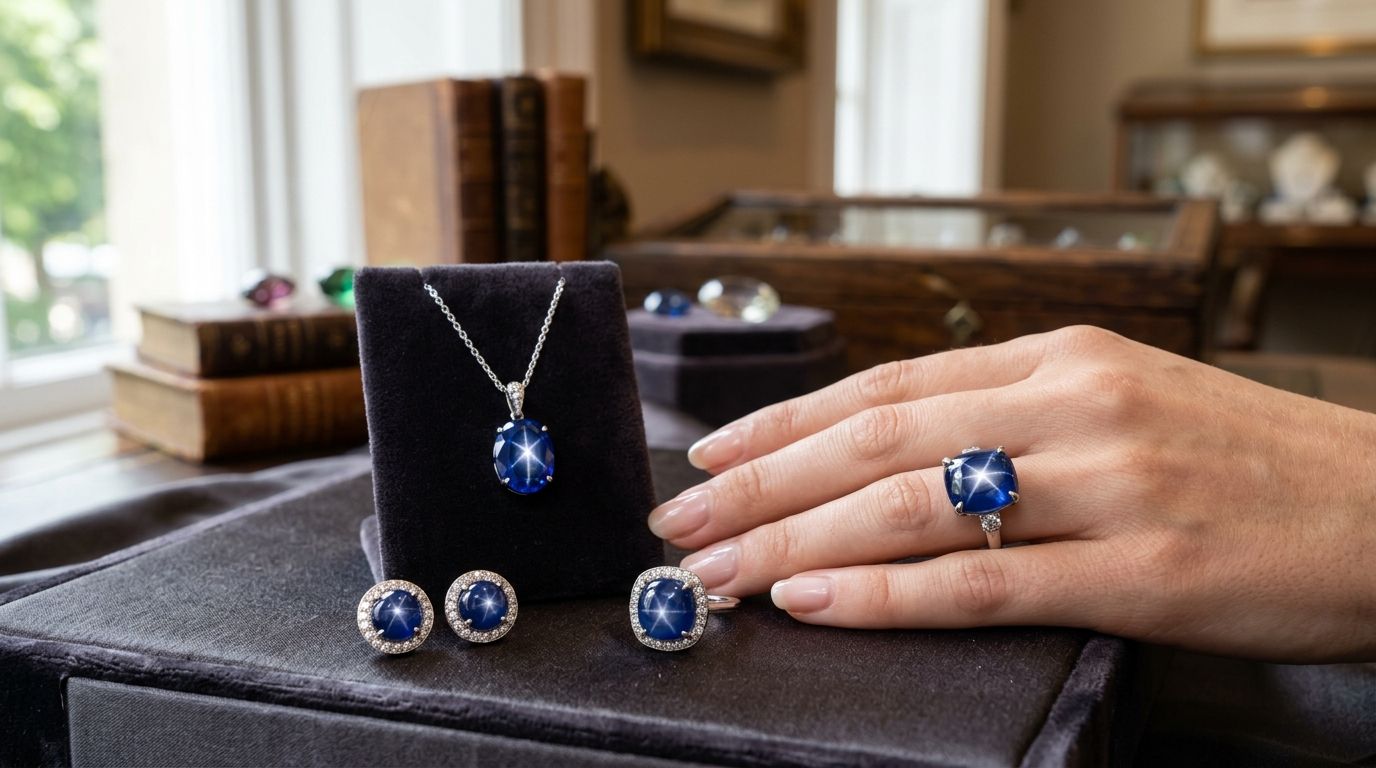
Star sapphire jewelry for phenomenal gem collectors is jewelry featuring cabochon-cut corundum that shows asterism — the moving star of light caused by rutile silk inside the stone — bought to add optical rarity to a collection rather than to grade color on a faceted stone. This segment needs different due diligence than diamond or emerald buyers: ray count, centering, and treatment disclosure matter more than clarity charts or carat-weight math.
- Star sapphire jewelry rewards ray sharpness and centered asterism over carat weight — verify with a lab report before bidding.
- Natural, untreated star sapphires from Sri Lanka and Myanmar command the highest premiums among phenomenal gem collectors in 2026.
- Jewelryroom.com lists star sapphire jewelry lots with condition reports and certification research tools for auction bidders.
- Skip listings claiming a '12-ray star' without lab verification — most natural star sapphires show six rays from rutile silk.
- Set a hard per-lot ceiling before bidding; buyer's premium adds to the hammer price on every winning bid.
Why star sapphire jewelry matters for phenomenal gem collectors
Retail jewelers rarely stock genuine star sapphires because cutting a cabochon to show sharp asterism wastes rough material that could otherwise be faceted for color grading and a higher per-carat price. That scarcity pushes serious phenomenal gem collectors toward auction houses, where estate and consignment lots surface stones cut decades ago under different economics. Jewelryroom.com lists star sapphire lots alongside condition reports and certification research tools, which matters because a cabochon can't be judged the way a round brilliant diamond is judged.
Star sapphires are corundum, the same mineral family as ruby, and they rate 9 on the Mohs hardness scale — hard enough for daily-wear rings and bracelets in 2026 collections. The star comes from needle-like rutile inclusions arranged in three directions at 120 degrees to each other, which is why most natural star sapphires show a six-ray star. A true 12-ray star requires a second set of inclusions and is rare enough that any listing claiming one deserves a lab report before you bid a dollar.
Build a star sapphire collection that survives resale
Check the asterism first, not the carat weight
Carat weight tells you almost nothing about a star sapphire's quality on its own — a heavy stone with a weak or off-center star is worth less than a smaller stone with a crisp one.
- Hold the cabochon under a single point-source light (a flashlight beam, not overhead fluorescents) and rotate it slowly.
- Confirm the star stays centered and intact as you tilt the stone; a star that breaks apart or drifts off-center signals a cutting flaw.
- Count the rays: six is standard for natural stones, twelve is rare and needs verification.
- Compare catalog photos taken at different angles — a single glamour shot under raking light hides weak asterism.
- Check that the star's legs run edge to edge across the dome instead of stopping short.
Confirm natural origin before you trust the listing description
A star effect can be manufactured. Diffusion treatment and synthetic growth both produce a visible star on stones that would show nothing natural.
- Ask the auction house whether the stone has been diffusion-treated, which can create or intensify a star on a low-grade base stone.
- Look for uneven color zoning under magnification — natural stones show it, Verneuil-grown synthetic star sapphires usually don't.
- Be skeptical of a razor-sharp, perfectly symmetrical star; natural asterism typically has some softness at the ray tips.
- Cross-check the lot against the guidance in how to spot fake gemstones at online auctions before placing a bid.
- Request additional photos under both diffuse and direct light if the listing only shows one lighting condition.
Research the gemstone's certification before bidding
A lab report is the only thing standing between you and a listing that oversells a stone's rarity.
- Confirm the report names the stone "natural corundum" and states treatment status explicitly.
- Verify the report number directly on the issuing lab's website rather than trusting a PDF attached to the listing.
- Check whether origin is claimed — Sri Lanka, Myanmar, Madagascar, Thailand — and whether the lab supports that claim or only confirms species and treatment.
- Read how to research a gemstone's certification before bidding if the lot has no report attached and you're deciding whether that's a dealbreaker.
- Flag any listing that calls a stone "no-heat" or "unenhanced" without a lab report backing the claim.
Evaluate body color against the cabochon's cut
Color and cut interact more directly on a star sapphire than on a faceted stone, because the dome height controls how visible the star is at any given angle.
- Cornflower blue commands the highest premiums among natural star sapphires; gray and black stars sell for less per carat.
- A dome cut too high buries the star and darkens the stone at the edges.
- A flat, well-polished base helps the star stay visible across more viewing angles.
- Thick, heavy bases waste carat weight without improving the visual star — ask for total depth in millimeters if it's not listed.
- Pink and purple star corundum, sometimes marketed as star ruby at higher saturation, is rarer and priced on a different scale than blue.
Set your ceiling before the bidding opens
Star sapphire jewelry for phenomenal gem collectors is a category where marketing language moves faster than certification, and live bidding pressure erodes discipline fast.
- Decide your maximum hammer price in advance and write it down before the session starts.
- Add the buyer's premium on top of the hammer price when calculating your real cost, not after you've already won.
- Budget separately for post-auction insurance and shipping, since a won lot isn't covered until it's physically in your hands.
- If you're choosing between two similar lots, set a ceiling for each rather than one blended number.
Track the lot after you win
Winning the bid is the easy part; protecting the stone through shipping is where collectors lose value.
- Confirm shipping insurance covers full purchase value, not just a declared minimum.
- Request the physical lab report and any condition report ship with the stone, not by separate email.
- Re-inspect the star under your own light source the day it arrives and compare it against the catalog photos.
- Store cabochon-set pieces separately from faceted stones in your collection to avoid surface abrasion on the dome.
Ways to buy star sapphire jewelry in 2026
| Option | Best for | Key limitation | Verdict |
|---|---|---|---|
| Certified natural, untreated star sapphire | Collectors prioritizing rarity and long-term value | Scarce supply, highest competition at auction | Buy |
| Heat-treated star sapphire (disclosed) | Buyers wanting stronger color at a lower entry point | Slightly lower resale ceiling than untreated stones | Buy |
| Diffusion-treated star sapphire | Budget buyers wanting a visible star regardless of depth | Artificial or intensified asterism, weakest resale value | Skip |
| Vintage or estate star sapphire jewelry | Collectors who want period design plus the stone | Older cuts may show lower dome quality or old repolishing | Hold |
| Lab-created (synthetic) star sapphire | Buyers who want the look without paying for rarity | Not a phenomenal gem in the collector sense, minimal resale value | Skip |
Verdict: a certified, untreated natural star sapphire with a centered six-ray star is the only option that holds resale value in a phenomenal gem collection.
Common mistakes phenomenal gem collectors make
- Judging by carat weight alone. A large, low-domed stone with a diffuse star loses to a smaller stone with sharp asterism every time it changes hands.
- Treating perfect symmetry as a quality signal. A star sapphire with a razor-sharp, dead-centered star and zero softness at the ray tips is more likely synthetic than exceptional.
- Skipping the condition report. Cabochons hide old repolishing and surface pitting that a faceted-stone buyer would never think to check for.
- Blurring treatment categories. Heat-treated and diffusion-treated are not the same disclosure, and pricing them the same way costs collectors money on both sides of a trade.
- Chasing marketing language over lab reports. "AAA star sapphire" is not a certification grade — it's copywriting, and it should never substitute for a verifiable report.
Browse current star sapphire lots
Check open auction lots and condition reports on Jewelryroom.com.
FAQ
What is star sapphire jewelry?
Star sapphire jewelry is jewelry set with cabochon-cut corundum that displays asterism, a moving star of light caused by rutile silk inclusions inside the stone. It's judged by ray sharpness and centering rather than the clarity and cut grades used for faceted gems.
Is a 6-ray or 12-ray star sapphire more valuable?
A 12-ray star sapphire is rarer than the standard six-ray pattern because it requires two overlapping sets of rutile inclusions. Rarity alone doesn't guarantee value — a weak 12-ray star can be worth less than a sharp, centered six-ray star.
How can you tell if a star sapphire is natural or synthetic?
Natural star sapphires usually show uneven color zoning under magnification and some softness at the ray tips, while synthetic Verneuil-grown stones often have an unnaturally perfect, razor-sharp star. A gemological lab report is the only reliable confirmation.
What's the best origin for star sapphires?
Sri Lanka (Ceylon) and Myanmar (Burma) produce some of the most sought-after star sapphires, prized for cornflower blue body color. Origin claims on a listing should be backed by a lab report that specifically addresses geographic origin, not just species and treatment.
Do star sapphires need certification before bidding at auction?
Yes, for any lot claimed to be natural, untreated, or from a specific origin. A lab report verifying "natural corundum" and treatment status protects you from paying natural-stone prices for a treated or synthetic piece.
How hard is star sapphire and is it durable for daily wear?
Star sapphire is corundum, rated 9 on the Mohs hardness scale, making it durable enough for rings and bracelets worn daily. The cabochon cut is also more chip-resistant at the edges than many faceted cuts.
Can star sapphires be treated, and does that affect value?
Yes — heat treatment is common and generally disclosed, while diffusion treatment artificially creates or intensifies a star and carries the lowest resale value. Treatment status should always appear on the lab report, not just in the listing description.
Is a diffusion-treated star sapphire worth buying?
Only as a decorative piece, not as a collector-grade phenomenal gem. Diffusion-treated stones show an artificial or exaggerated star and carry minimal resale value compared to natural or simply heat-treated stones.
One last thing
Most loose "star sapphire" cabochons sold cheaply online are Verneuil-process synthetic boules cut to mimic Ceylon asterism, and the giveaway is almost always the same: a perfectly centered star with zero softness at the ray tips, something natural stones rarely produce. Before you fall for a sharp, symmetrical star at a bargain price in 2026, ask for the lab report first.


