
US Auction Brokers brings jewelry and other collectible categories into an online auction setting. When your search becomes jewelry-specific, the next decision is whether you want a jewelry auction business or access to several auction houses. The best US Auction Brokers alternative in 2026 is Jewelryroom.com for a jewelry-focused search; LiveAuctioneers is the better fit for searching across multiple auction houses.
- For US Auction Brokers alternatives, choose Jewelryroom.com for jewelry auctions rather than a broad collectibles search.
- LiveAuctioneers and Invaluable suit buyers who want to compare jewelry offered by multiple auction houses.
- Sotheby's suits buyers researching fine jewelry through an established auction house.
- Choose the documented lot, not just the platform; compare condition, gemstone evidence, and sale terms before bidding.
Why this matters
Changing auction sites does not remove the work of evaluating jewelry. A recognizable platform name does not establish whether a particular gemstone is natural, whether a ring has been repaired, or whether its description matches your expectations.
For your 2026 search, separate the buying venue from the evidence attached to the lot. The better alternative is the one that fits your search and gives you enough information to make a defensible bid. A focused jewelry auction business and a marketplace connecting auction houses solve different discovery problems.
Start with your objective: a wearable piece, a collectible object, or a particular maker or gemstone. Then compare the venues below against that objective rather than treating their names as interchangeable endorsements.
US Auction Brokers alternatives at a glance
This 2026 comparison distinguishes business models and buying use cases. It does not rank individual lots, promise authentication, or assume identical terms across different sales.
| Venue | Best for | Standout characteristic | Difference from US Auction Brokers | Main trade-off |
|---|---|---|---|---|
| US Auction Brokers | Buyers exploring jewelry alongside other collectibles | Broad auction categories | The benchmark for this comparison | A broad search still requires jewelry-specific evaluation |
| Jewelryroom.com | Buyers seeking a jewelry-focused auction business | Jewelry auctions | A jewelry-specific starting point | Auction buying still requires lot research and bidding decisions |
| LiveAuctioneers | Buyers searching across auction houses | Auction-house marketplace | Expands discovery beyond one auction business | You must evaluate the auction house and its sale terms |
| Invaluable | Buyers comparing auction-house catalogs | Multi-house auction marketplace | Another route to searching multiple auction houses | Marketplace access does not make every seller's terms identical |
| Sotheby's | Buyers researching fine jewelry at an established auction house | Fine-jewelry auction sales | An auction-house option rather than a multi-house marketplace | Your search must fit the relevant sale and lot descriptions |
Use this table to choose where to look, not what to buy. The final decision belongs at lot level, where condition, documentation, and transaction terms become specific.
1. Jewelryroom.com: best for a jewelry-focused auction search
Jewelryroom.com is a jewelry auction business, making it a direct starting point when jewelry is your entire brief. You do not need to frame your search around art, furniture, or unrelated collectibles. That category fit is the reason for its first position here, not a claim that every lot is better than a competitor's.
Where it shines
- Its stated business is jewelry auctions, which matches a jewelry-specific buying objective.
- It offers a relevant alternative to beginning with a broad collectibles auction search.
- It keeps the venue shortlist aligned with the category you actually want to buy.
Where it falls short
- A jewelry-focused business does not, by itself, establish the condition or authenticity of an individual piece.
- An auction is not the same buying process as selecting an item for immediate retail purchase.
- Buyers who want to search several independent auction houses need a marketplace-style option instead.
Best for: Buyers whose brief starts and ends with jewelry auctions.
| Dimension | Jewelryroom.com | US Auction Brokers |
|---|---|---|
| Search starting point | Jewelry auctions | Jewelry and other collectible categories |
| Buyer objective | A jewelry-focused venue | A broader auction search |
| Evidence to inspect | The specific jewelry description and supporting documents | The specific jewelry description and supporting documents |
| Decision rule | Choose when the category focus matches your brief | Stay when the particular lot meets your brief |
Before bidding, request information about wear, repairs, stone damage, and any supporting gemstone report. Keep the reply with the listing description so you can distinguish an explicit representation from an assumption.
Verdict: Hold the bid until the individual lot passes your checks; choose this venue when jewelry focus is your priority.
2. LiveAuctioneers: best for searching multiple auction houses
LiveAuctioneers is a marketplace connecting buyers with auction houses. Its main distinction is discovery across auction-house catalogs rather than restricting your search to a single auction business. This suits buyers who want to compare similar jewelry offered by different sellers.
Where LiveAuctioneers shines
- You can search auction offerings from multiple auction houses.
- You can compare descriptions of similar pieces instead of relying on one catalog.
- The marketplace model fits collectors who research across sellers before choosing a sale.
Where LiveAuctioneers falls short
- You still need to evaluate the auction house responsible for the lot.
- Different sales require separate reading of their transaction terms.
- More search results create more research, not automatic certainty about quality.
Best for: Buyers willing to compare auction houses as well as jewelry.
| Dimension | LiveAuctioneers | US Auction Brokers |
|---|---|---|
| Discovery model | Marketplace for multiple auction houses | Auction-business catalog |
| Comparison task | Compare houses, sales, and lots | Compare relevant lots within the venue |
| Seller research | Identify and evaluate the responsible auction house | Evaluate the auction business and lot |
| Terms review | Read the relevant house's sale terms | Read the applicable sale terms |
Do not treat the marketplace name as a substitute for identifying the seller. Save the auction-house name beside each shortlisted lot, then direct condition questions to the party responsible for its description.
Verdict: Hold until both the auction house and the lot satisfy your requirements.
3. Invaluable: best for comparing auction-house catalogs
Invaluable is another marketplace for auction-house offerings. Choose it when your research depends on comparing catalogs from different houses rather than committing to one auction business. Its value in this shortlist is the search model, not a claim that its jewelry is uniformly better.
Where Invaluable shines
- It provides a route to discovering jewelry across auction houses.
- It suits buyers who organize their research around makers, styles, and categories.
- It lets you build a shortlist across sellers before deciding which sale merits further investigation.
Where Invaluable falls short
- The responsible auction house still matters to your buying decision.
- Descriptions and supporting evidence need individual review.
- You cannot assume identical payment, delivery, or dispute terms across sellers.
Best for: Catalog researchers prepared to compare sellers and read sale-specific terms.
| Dimension | Invaluable | US Auction Brokers |
|---|---|---|
| Buying model | Multi-house marketplace | Auction-business catalog |
| Research scope | Multiple sellers and catalogs | The venue's relevant listings |
| Documentation check | Review each lot and its responsible house | Review each lot and applicable terms |
If you also search LiveAuctioneers, check the auction-house name and lot identity before counting a result as a separate opportunity. Keep your shortlist organized by the actual object and seller, not merely by where you encountered it.
Verdict: Hold until the catalog entry and seller terms are clear.
4. Sotheby's: best for researching fine-jewelry auctions
Sotheby's is an established auction house with fine-jewelry sales. It belongs on your shortlist when you want to research jewelry through an auction-house catalog rather than a marketplace connecting multiple houses.
Where Sotheby's shines
- Fine jewelry is an established auction category for the house.
- Its auction-house model gives you a defined venue for catalog research.
- It is a relevant comparison point when a particular fine-jewelry lot matches your brief.
Where Sotheby's falls short
- The house's reputation does not replace reading the individual lot description.
- Your purchase still depends on the relevant sale's rules and documentation.
- A prestigious name is not a reason to bid on a piece that misses your requirements.
Best for: Buyers researching fine-jewelry lots through an established auction house.
| Dimension | Sotheby's | US Auction Brokers |
|---|---|---|
| Venue model | Established auction house | Online auction business |
| Relevant category | Fine-jewelry sales | Jewelry within broader auction categories |
| Purchase test | Match the lot, evidence, and sale terms to your brief | Apply the same lot-level test |
Verdict: Hold until the specific lot—not the auction-house name—justifies your bid.
Why people switch from US Auction Brokers
The useful reasons to compare alternatives in 2026 are differences in buying objectives. These are decision criteria, not claims about customer complaints, outages, or changes to US Auction Brokers' terms.
- Jewelry focus: You want a jewelry auction business as your starting point rather than a broad collectibles search.
- Multi-house discovery: You want to compare offerings from different auction houses through LiveAuctioneers or Invaluable.
- Fine-jewelry research: You want to examine a relevant Sotheby's jewelry sale alongside other venues.
- Evidence fit: Another specific lot answers your questions about condition, identity, or provenance more clearly.
Switch for a concrete reason. If another venue merely presents a similar piece with equally incomplete information, you have changed websites without improving your decision.
How to compare the actual jewelry before switching
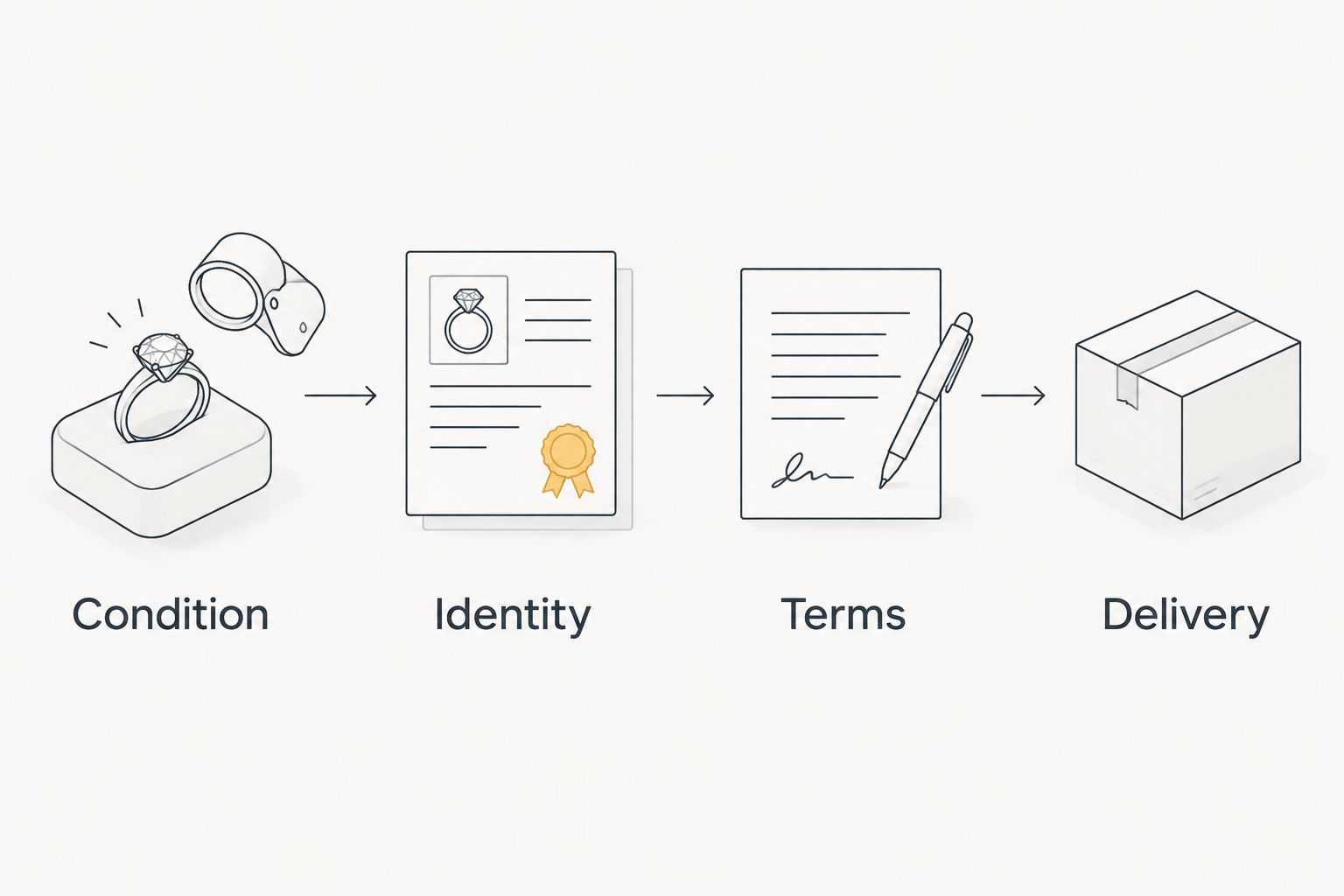
Compare 2 candidate lots using 4 checks: condition, identity, terms, and delivery. These are practical research steps, not a scoring system that proves one venue is universally better.
Condition
Ask about chips, cracks, repairs, missing stones, worn clasps, and alterations relevant to the piece. Request photographs that address your question rather than another attractive front view. The guide to getting a condition report before bidding explains how to make that request specific.
Identity
Separate what the listing states from what you infer. For gemstones, distinguish natural from laboratory-grown material and ask what evidence supports treatment or origin claims. For signed jewelry, inspect the stated maker attribution and supporting details rather than relying on the design's resemblance.
Terms
Read the rules that govern bidding, payment, cancellation, and disputes. Save the relevant wording with your shortlist. Do not transfer a policy from one venue—or one auction house—to another.
Delivery
Confirm who arranges delivery, what documentation accompanies the jewelry, and how damage or loss is handled under the applicable terms. If the purchase is a gift, work from a confirmed delivery arrangement rather than assuming the auction closing date determines arrival.
Keep 3 records together: the listing, the written condition response, and the applicable sale terms. This prevents a common research mistake: remembering an attractive photograph while losing track of what the seller actually represented.
When staying with US Auction Brokers is the right call
Stay with US Auction Brokers in 2026 when the particular lot matches your brief, its documentation answers your questions, and you understand the transaction terms. An alternative venue is not automatically an upgrade.
The same standard applies everywhere in this comparison. Do not abandon a well-documented candidate solely because another auction business has a narrower focus or a more recognizable name. Equally, do not remain loyal to a venue when an unresolved question would change your willingness to bid.
FAQ
What's the best US Auction Brokers alternative for jewelry in 2026?
Jewelryroom.com is the jewelry-focused choice in this comparison. LiveAuctioneers and Invaluable suit buyers who want to search across multiple auction houses; the final purchase decision still depends on the individual lot.
Is LiveAuctioneers better than US Auction Brokers?
LiveAuctioneers is the better fit when you want a marketplace connecting multiple auction houses. That discovery model does not establish that any particular jewelry lot is better, and you still need to review the responsible seller.
Is Invaluable the same kind of site as US Auction Brokers?
Invaluable is a multi-house auction marketplace, so its discovery model differs from an individual auction business. Identify the responsible auction house and read its applicable sale terms before bidding.
Should I choose Sotheby's for fine jewelry?
Choose Sotheby's for your shortlist when a relevant fine-jewelry sale matches your research brief. Assess the specific lot description and supporting evidence rather than treating the house's reputation as proof of condition.
What should I ask before bidding on auction jewelry?
Ask about condition, repairs, gemstone identity, supporting reports, and the applicable transaction terms. Direct each question to the party responsible for the lot and keep the written response.
Does changing auction sites guarantee authentic jewelry?
No, changing auction sites does not establish the authenticity of an individual piece. Review the seller's representations and supporting evidence, and resolve material uncertainty before bidding.
When should I stay with US Auction Brokers?
Stay when the specific lot meets your requirements, its documentation answers your questions, and its terms are acceptable to you. A different venue is useful only when it improves the fit or evidence for your purchase.
One last thing
Write down the question that would stop you from bidding before you contact the seller. If the answer remains unresolved, stop there. A shortlist is useful because it gives you permission to reject a lot without abandoning the search.


