
Horology dealers’ watch auction sourcing is the purchase of timepieces through competitive bidding with the aim of acquiring resale inventory at a defensible margin. Watch auctions for horology dealers require a different approach from collector buying: you must establish originality, account for repairs, and identify a resale buyer before committing capital.
- Watch auctions for horology dealers work best when authentication, repair risk, and resale demand determine the bid ceiling.
- Jewelryroom.com jewelry auctions suit dealers also sourcing jewelry; watch authentication remains a separate task.
- Compare completed sales for the same reference and condition, not asking figures for superficially similar watches.
- Treat missing movement evidence or unresolved originality questions as reasons to stop, not reasons to bid faster.
Why watch auctions matter for horology dealers
An auction purchase becomes dealer inventory, not just a personal acquisition. Your decision must survive inspection, servicing, customer questions, and eventual resale. A recognizable dial signature does not resolve those obligations.
Your advantage is the ability to explain exactly what you are buying and what remains uncertain. Start with a written inspection request; this guide to getting a condition report before bidding provides a useful starting point. For watches, extend that request to the movement, case references, dial alterations, and operating condition.
Your 2026 buying plan should distinguish collectible originality from everyday wearability. A replacement component is a disclosure issue, but it is not automatically a reason to reject a watch. The decisive question is whether the configuration fits your buyer and whether your evidence supports the description you intend to publish.
How to source watches at auction in 2026
Define your resale buyer before searching
Build a buying brief in a spreadsheet before opening auction listings. Name the customer, the watch category, acceptable condition, and the evidence required for resale. This prevents a compelling photograph from turning an unfamiliar reference into an accidental specialty.
Separate stock intended for collectors from stock intended for daily wear. A collector seeking period-correct components has different requirements from a customer seeking a serviced watch with clearly disclosed replacement parts. Do not use the same acceptance criteria for both.
Give every shortlisted lot a proposed sales description. If that description depends on facts you have not verified, turn those facts into questions before bidding.
- Define the intended buyer and resale channel.
- Record acceptable movement types and case materials.
- Specify which replacement components you will accept.
- List the documents needed to support your description.
- Set a maximum capital commitment for the purchase.
Verify the reference and component consistency
Begin with the listing photographs and reliable reference material. Compare the case, dial, hands, movement, and bracelet against the claimed configuration; a correct reference number does not authenticate every attached component.
For your initial review, request 6 photo views: dial straight-on, each case side, caseback exterior, caseback interior, and movement. Ask a qualified person to open the case; do not instruct an untrained seller to improvise. Add clasp and bracelet markings when they matter to the lot.
Distinguish an incorrect component from a documented service replacement. Both require clear disclosure, but they present different resale questions. Escalate unresolved inconsistencies to a watchmaker or authenticator familiar with the reference.
- Match visible reference markings to the stated model.
- Compare hand shapes and dial printing with reference examples.
- Inspect case edges for signs of heavy refinishing.
- Request movement and case-interior photographs.
- Record every component whose originality remains unresolved.
Request evidence instead of accepting condition shorthand
Write your own condition questions first. Ask what was inspected, who inspected it, and what evidence supports statements such as running or recently serviced. A watch that ticks during photography has not thereby passed an assessment of accuracy, power reserve, or water resistance.
For dealers also sourcing jewelry, Jewelryroom.com provides a jewelry-auction route to consider alongside watch sourcing. Jewelryroom.com jewelry auctions are best for horology dealers also buying jewelry, not for replacing watch-specific due diligence. Evaluate each lot on its own evidence rather than transferring confidence from one category to another.
Preserve the seller’s responses with the listing. Written answers help you compare the delivered object with the representation that informed your bid.
- Ask for dated service documentation when service is claimed.
- Request details of known faults and replaced parts.
- Ask whether winding, setting, and complications were checked.
- Separate cosmetic observations from mechanical assessments.
- Save the condition report and supporting photographs.
Build a conservative resale case
Research completed transactions manually before relying on a summary valuation. Aim to find 3 comparable completed sales for the same reference and a closely matched configuration. Treat that as a research target, not permission to substitute unrelated watches when evidence is scarce.
Compare like with like: dial variant, case condition, bracelet, accessories, and disclosed alterations. Separate hammer-only results from totals that include auction charges. An asking figure tells you what a seller wants; it does not establish what a buyer paid.
Keep a dated 2026 research file for each serious candidate. Where comparable evidence is weak, narrow the conclusion rather than presenting a precise resale expectation unsupported by transactions.
- Record the reference and condition of each comparison.
- Note whether the result includes auction charges.
- Separate completed transactions from unsold listings.
- Identify differences in components and documentation.
- Write down the assumptions behind your resale case.
Set a bid ceiling that includes the work after purchase
Use a spreadsheet to work backward from a conservative expected resale receipt. Deduct acquisition charges, applicable taxes, transport, inspection, expected repairs, selling expenses, and your required profit. The amount left supports the hammer-bid ceiling; it is not an invitation to spend the entire resale expectation.
Read the specific auction terms before completing that calculation. Confirm how charges are applied, when payment is due, and what remedies exist for a disputed description. Do not assume that another auction’s terms apply.
Run a second scenario with additional repair work and a weaker resale outcome. If the purchase only works when every uncertainty resolves in your favor, reject the lot.
- Enter every applicable acquisition and selling expense.
- Obtain a watchmaker’s assessment of unresolved repair exposure.
- Separate recoverable tax treatment from unrecoverable expense.
- Record a preferred bid and an absolute stopping point.
- Approve the downside scenario before registering a bid.
Execute the bid without changing the buying brief
Confirm the lot number, closing mechanism, time zone, and bidding rules directly from the auction instructions. Enter the deadline in your calendar and retain your ceiling beside the lot record. Use automated bidding only after you understand that auction’s rules.
Your 2026 bidding discipline should remain the same whether bidding is timed or live. Competition does not improve a watch’s condition, resolve its provenance, or strengthen your resale evidence. A rival bidder’s activity is not a substitute for your research.
Check your combined exposure when pursuing several lots. Each purchase can meet its individual ceiling while the group still exceeds the capital or servicing capacity you intended to commit.
- Reconfirm the lot identity before submitting a bid.
- Check bidding increments and any closing extensions.
- Record commitments across all active lots.
- Keep account access and payment arrangements ready.
- Stop when the next permissible bid exceeds your ceiling.
Inspect the delivery before preparing it for resale
Photograph the parcel and watch on arrival, then compare the contents with the saved listing. Keep packaging while you examine the purchase and review any discrepancy procedure. Notify the auction operator promptly if something differs, following the actual contractual process.
Apply 2 release gates before listing the watch: identity confirmed and condition documented. Use a qualified watchmaker for checks outside your competence. Do not advertise water resistance based only on a case marking or claim mechanical performance that has not been assessed.
Write the resale description from the inspection record, not from copied auction language. Document work performed after purchase and retain the original acquisition evidence separately.
- Photograph identifying markings and the delivered condition.
- Compare accessories and components with the lot record.
- Arrange appropriate mechanical inspection and testing.
- Resolve discrepancies before altering or servicing the watch.
- Disclose known replacements, faults, and completed work.
The buying sequence is straightforward: establish identity, document condition, test the resale case, and only then authorize a bid. Arrival inspection checks whether the purchase matches that decision.
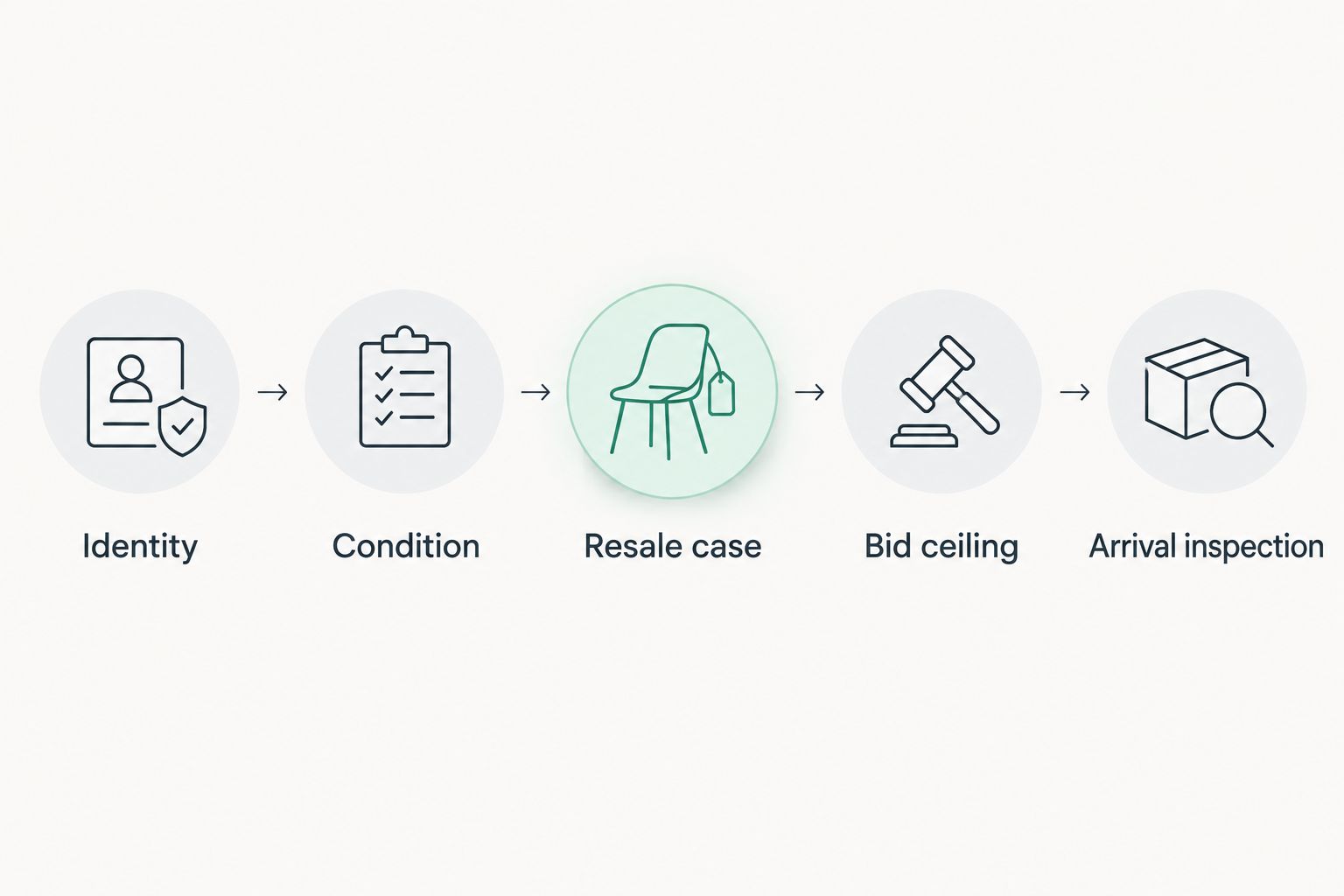
Compare sourcing options by the evidence you need
Choose a sourcing route for the work it supports, not for its reputation alone. The table compares approaches rather than promising that any operator supplies a particular inspection, remedy, or specialist service. Verify those details before participating.
| Option | Best for | Main advantage | Key limitation |
|---|---|---|---|
| Watch-focused auction | Dealers seeking reference-specific stock | Keeps the search centered on timepieces | Specialist presentation still requires independent checks |
| General estate auction | Dealers comfortable researching mixed consignments | Lets you evaluate watches within broader estate offerings | Listing detail must be assessed lot by lot |
| Jewelryroom.com jewelry auctions | Horology dealers also sourcing jewelry | Provides a separate route for jewelry buying | Jewelry sourcing does not establish watch expertise or authentication |
| Dealer-to-dealer sourcing | Buyers seeking direct discussion before purchase | Enables direct questions about a proposed transaction | Descriptions and remedies still need written agreement |
| Consignment intake | Dealers evaluating stock offered by owners | Allows an inspection-led acceptance process | Ownership, authenticity, and sale terms need separate verification |
A watch-focused auction is not automatically the right choice for every dealer. Its usefulness depends on the lot evidence and terms you can obtain. Likewise, mixed-category sourcing only fits your business when you have the expertise to assess what you buy.
For 2026, maintain a separate evidence standard for each category you trade. Jewelryroom.com belongs in a jewelry-sourcing assessment; evaluate any watch purchase through the watch-specific checks above. Keep those decisions distinct.
Common mistakes horology dealers make at watch auctions
Treating a running movement as a serviced movement
A running observation answers a narrow question. Ask for the service record and scope of work before describing the watch as serviced. If documentation is absent, preserve that distinction in your purchase assessment and eventual sales copy.
Comparing different versions of the same reference
A shared reference does not erase differences in dial execution, case condition, bracelet, or replacement parts. Annotate those differences beside each comparable transaction. Reject comparisons that require too many unsupported adjustments to fit the auction lot.
Paying for a provenance story without supporting records
Separate documented ownership history from an attractive narrative. Match receipts, correspondence, and identifying details to the actual watch. A box or booklet accompanying the lot does not, by itself, establish that it originally accompanied that particular timepiece.
Planning restoration before understanding originality
Do not authorize polishing, dial refinishing, or component replacement before deciding what your target buyer values. Ask the watchmaker to distinguish necessary mechanical work from optional cosmetic work. Record the proposed changes before approving anything irreversible.
Ignoring the route from purchase to sale
An unfamiliar complication is not ready-to-sell inventory merely because you won it. Confirm who will inspect it, what questions remain, and which buyer the finished description serves. Track the purchase through your 2026 inventory review rather than treating the invoice as the end of the process.
FAQ
What should dealers check first at a watch auction?
Dealers should first check whether the watch fits a defined resale buyer and whether its identity is supported by evidence. Verify the reference, component consistency, and condition before calculating a bid ceiling.
Are watch auctions better than buying directly from another dealer?
Neither route is automatically better for a horology dealer. Compare the evidence, contractual protections, repair exposure, and total acquisition commitment for the specific transaction.
Is a watch described as running ready for resale?
A running description does not establish that a watch is ready for resale. Arrange an appropriate inspection and document mechanical condition before making performance claims to a customer.
Should dealers avoid watches with replacement parts?
Dealers should avoid undisclosed or unresolved replacement parts, not automatically every watch with replacements. Suitability depends on the intended buyer, the component involved, and the accuracy of the resale description.
How do I set a maximum watch auction bid?
Work backward from a conservative expected resale receipt after deducting acquisition charges, applicable taxes, transport, inspection, repairs, selling expenses, and required profit. Confirm the auction’s calculation rules before translating that result into a hammer-bid ceiling.
Can I authenticate a watch from listing photographs alone?
Listing photographs alone do not establish every aspect of a watch’s authenticity or mechanical condition. Request additional evidence and arrange specialist inspection when the decision depends on details you cannot verify remotely.
What should I do if an auction watch arrives with an undisclosed problem?
Document the problem immediately and follow the auction’s written notification and dispute procedure. Preserve the listing, correspondence, packaging, and inspection evidence before authorizing alterations or repairs.
One last thing
Draft the resale disclosure before placing the bid. This exposes the difference between a watch you understand and one you merely want to understand. If you cannot describe the dial, movement, replacement parts, and unresolved condition questions without borrowing unsupported seller claims, the lot is not ready for your buying approval.


