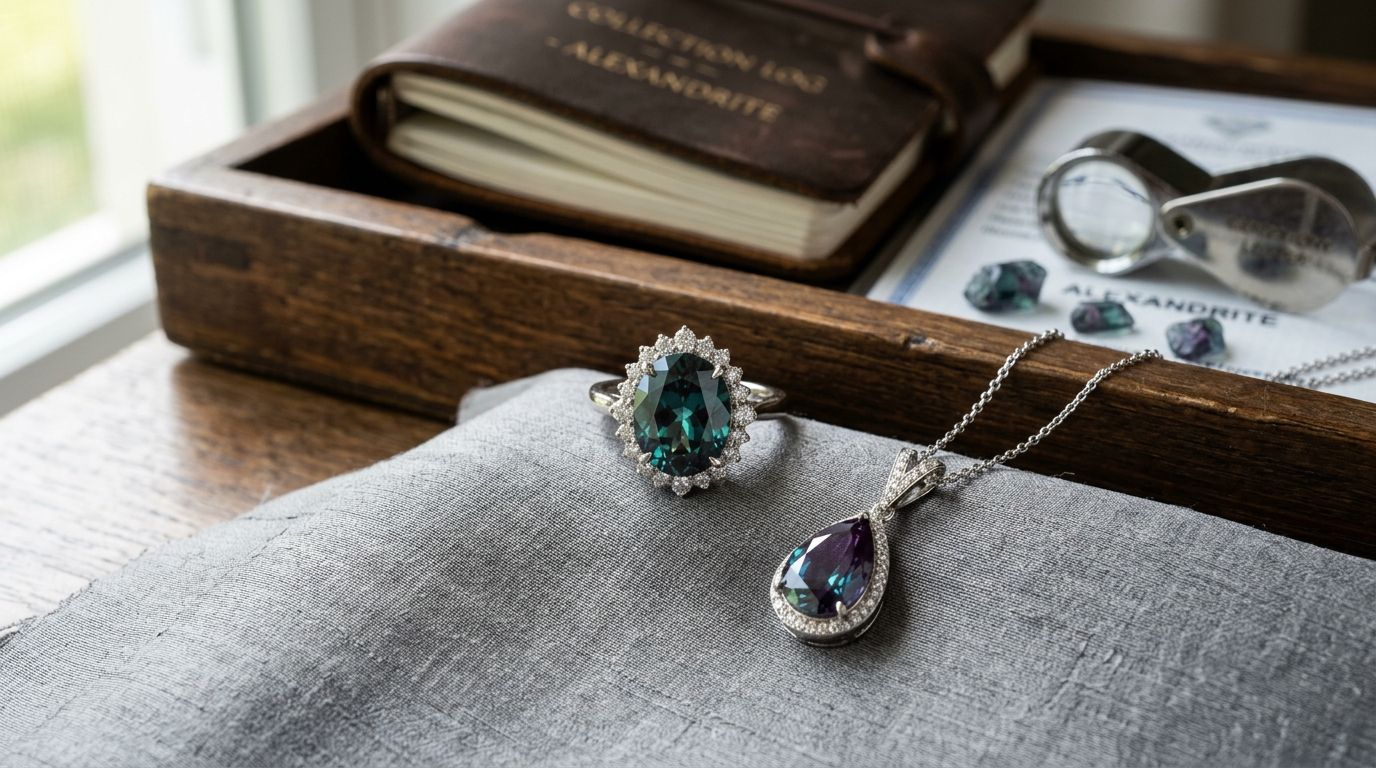
Alexandrite jewelry for color-change gemstone collectors means one thing above all else: a stone that reads green to bluish-green in daylight and shifts to red or purplish-red under incandescent light. Collectors in this segment aren't buying alexandrite for size or brilliance the way a diamond buyer would — they're buying the optical effect itself, and that changes what to check before bidding.
- Alexandrite jewelry is judged on color-change strength first, carat weight second - test under two light sources before bidding.
- Natural Russian alexandrite is the rarest form and mostly trades under 1 carat; Brazilian and Sri Lankan material runs larger but shows weaker contrast.
- Lab-created alexandrite delivers the same color shift at a fraction of the rarity - it is a real gemstone, just not a natural one.
- Color-change garnet and synthetic corundum are the two most common alexandrite substitutes at online auctions.
- A GIA or AGL report naming the stone as natural chrysoberyl alexandrite is the only reliable proof of origin.
Why alexandrite jewelry matters for color-change gemstone collectors
Alexandrite is a variety of chrysoberyl, first documented in the Ural Mountains in the 1830s, and it remains one of the few gemstones where the entire market is built around a single measurable trait: the strength of the color change under different light. That narrow focus is exactly why this segment behaves differently from other colored-stone buyers.
A sapphire collector cares about hue and saturation. An emerald buyer weighs clarity against inclusions. An alexandrite collector cares almost entirely about contrast — how dramatically the stone flips from green to red — and that single variable drives price, demand, and fraud risk more than carat weight does. Before bidding on any lot described as alexandrite jewelry in 2026, run through the gemstone's certification history, because unverified alexandrite listings are one of the most misrepresented categories in colored-stone auctions.
Check the color-change effect yourself
Don't take a listing photo's word for it. A genuine alexandrite jewelry piece needs to be evaluated under two distinct light sources, not one.
- View the stone under daylight or daylight-balanced LED — expect green to bluish-green
- View the same stone under incandescent or candlelight — expect red to purplish-red
- Ask the seller for video, not just still photos, since stills can be color-corrected
- Compare the contrast strength against known Russian-material references
- Reject any listing that only shows one lighting condition
Confirm the species and origin before bidding
Alexandrite is chrysoberyl. Anything else showing a color shift — garnet, sapphire, spinel — is a different mineral wearing alexandrite's name loosely.
- Look for the word chrysoberyl on any accompanying lab report
- Treat alexandrite-like or color-change wording without the chrysoberyl designation as a red flag
- Ask directly whether the origin is Russian, Brazilian, Sri Lankan, or Madagascar
- Note that Russian material commands the strongest collector interest due to scarcity
- Confirm the seller discloses lab-created origin if applicable — non-disclosure is a dealbreaker
Read the lab report line by line
A report is only useful if you read past the headline gem name. This is where most misrepresented alexandrite gets caught before a bid, not after.
- Match the carat weight and measurements on the report to the actual stone
- Check the report date — older reports on resold pieces deserve a fresh opinion
- Look for an explicit color-change description, not just a species name
- Verify the issuing lab is GIA, AGL, or another recognized gemological lab
- Cross-reference the report number directly with the lab's own database when possible
Set a carat-based budget before you start bidding
Alexandrite pricing scales sharply with size because larger natural stones with strong contrast are genuinely rare. Decide your ceiling before emotions take over mid-auction, and use a written budget for online jewelry auctions rather than a number you hold in your head.
- Decide your maximum bid in advance and write it down
- Separate your budget for natural stones from your budget for lab-created alternatives
- Factor in a buyer's premium on top of the hammer price
- Leave room for insurance and appraisal costs after the win
- Walk away from bidding wars that push past your ceiling — another lot will surface
Inspect the setting, not just the stone
A spectacular color-change stone in a damaged or low-quality mount is still a compromised purchase. Settings tell you how the piece was actually worn and maintained.
- Check prongs for wear, especially on rings meant for daily use
- Look for solder repairs around the stone that could signal a replaced center
- Confirm metal purity markings match the listing description
- Ask whether the mounting is original to the era claimed or a later reset
- Request photographs of the setting from multiple angles before the auction closes
Vet the seller before you place a bid
Color-change gemstones attract misrepresentation more than most categories, so seller history matters as much as the lab report. Spend time here before you're emotionally invested in a specific lot.
- Read the seller's return and authenticity policy in full
- Search for prior complaints tied to gemstone misidentification
- Confirm the auction house discloses lab-created stones as a matter of policy
- Check whether the seller offers independent appraisal after the sale
- Cross-reference listing language against known patterns for spotting fake gemstones at online auctions
Place your bid with a hard ceiling
Once you've verified the stone, the report, and the seller, bidding itself should be mechanical, not emotional.
- Use proxy or maximum bidding rather than live incremental bidding when possible
- Set your ceiling below your true walk-away number to leave a margin
- Track the lot in the final hour, since colored-stone auctions often see late jumps
- Confirm shipping and insurance terms before, not after, you win
- Document the final sale price and lab report together for insurance purposes
Comparing your alexandrite options in 2026
| Option | Best for | Key limitation |
|---|---|---|
| Natural Russian alexandrite | Collectors prioritizing provenance and rarity | Extremely scarce, mostly under 1 carat |
| Natural Brazilian, Sri Lankan or Madagascar alexandrite | Collectors wanting natural stones at larger sizes | Weaker color-change contrast than Russian material |
| Lab-created alexandrite | Buyers who want the color-change effect at real chrysoberyl composition | Not a natural gemstone — resale value differs sharply |
| Color-change garnet or synthetic corundum | Buyers testing the look before committing | Not alexandrite at all — must be disclosed as a substitute |
Natural Russian alexandrite is the benchmark the entire color-change gemstone market is measured against, and it's best for collectors who value provenance over size. Lab-created alexandrite is a legitimate buy for wearers who want the effect without chasing rarity — as long as the listing discloses it honestly.
“If a stone does not shift under both daylight and incandescent light, it is not alexandrite - it is a color-change substitute.”
Common mistakes color-change gemstone collectors make
- Trusting a single photo for the color-change claim. Listing photos are frequently shot under one light source only, which hides whether the shift is real or exaggerated in editing.
- Assuming any color-change stone is alexandrite. Color-change garnet, sapphire, and synthetic corundum all shift color and get mislabeled, intentionally or not.
- Ignoring the difference between natural and lab-created material. Both are legitimate purchases in 2026, but conflating them at bid time leads to overpaying for a lab-created stone priced as natural.
- Skipping the lab report because the seller seems reputable. Reputation doesn't substitute for a report naming the species as chrysoberyl with an explicit color-change description.
- Bidding past a set ceiling because the contrast is strong. Dramatic color change triggers emotional bidding — fix your maximum before the lot opens, not during the final minutes.
Browse current jewelry auctions
See active lots across gemstone and estate jewelry categories.
FAQ
What is the best light to see alexandrite's color change?
Daylight or daylight-balanced LED shows green to bluish-green, while incandescent or candlelight shows red to purplish-red. Test both before bidding on any alexandrite jewelry lot in 2026.
Is lab-created alexandrite worth buying?
Yes, if it is disclosed honestly - lab-created alexandrite is real chrysoberyl with the same color-change chemistry, grown rather than mined. It will not hold the resale premium natural material commands.
How rare is natural alexandrite jewelry?
Natural alexandrite above one carat is uncommon in the trade, and Russian material with strong color-change contrast is the rarest tier of all. Rarity is the primary price driver in this category.
How do I tell real alexandrite from color-change garnet?
Check the lab report for the word chrysoberyl - garnet will never carry that designation. Color-change garnet typically shifts blue-green to purplish-red rather than alexandrite's green-to-red range.
Does GIA certify alexandrite?
Yes, GIA and AGL both issue reports identifying natural versus lab-created chrysoberyl alexandrite and describing the color-change strength. Always request the report number and verify it independently.
Is alexandrite a good investment gemstone?
Natural Russian alexandrite with strong contrast holds collector demand because of genuine scarcity, but any investment claim depends on independent lab verification. Treat undocumented alexandrite as a wearable purchase, not an investment.
Can a jeweler identify synthetic alexandrite?
A qualified gemologist can separate synthetic from natural alexandrite using standard lab equipment, including inclusion patterns and trace-element testing. A retail jeweler without gemological training may not catch it on sight.
What carat sizes are typical for natural alexandrite?
Most natural alexandrite set in jewelry runs well under one carat, with anything above one carat considered scarce and priced accordingly. Larger natural stones with strong contrast are the exception.
One last thing
The biggest tell separating a well-documented alexandrite lot from a risky one isn't the price or the seller rating — it's whether the listing shows the stone under two different light sources on its own, before you ever have to ask. Sellers confident in their alexandrite jewelry photograph the color change proactively in 2026; sellers hoping you won't check usually don't.


