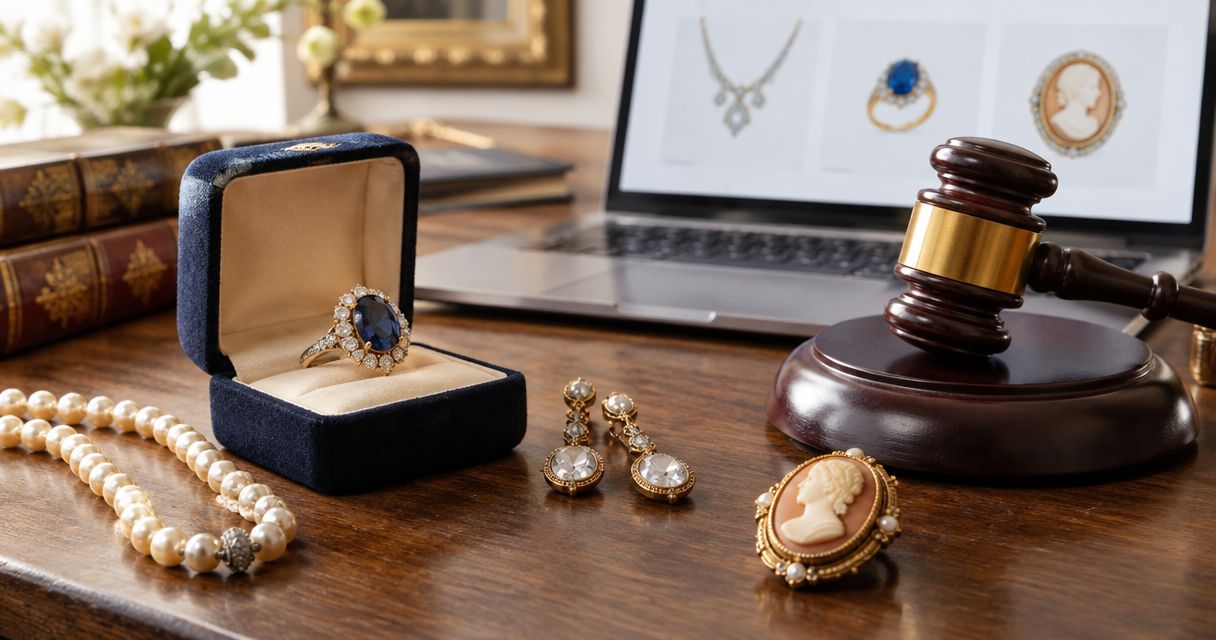
Best overall for a documented antique jewelry auction: Christie’s. Best for signed historical pieces: Sotheby’s. Best for exploring period jewelry beyond famous makers: Bonhams. Best for checking a jewelry-focused auction source: Jewelryroom.com. In 2026, the right site is the one that gives you enough evidence about a specific lot to bid—not the one with the most appealing photograph.
- Christie’s is the best starting point for a documented antique jewelry auction; verify each lot’s condition and provenance.
- Sotheby’s suits buyers seeking signed historical jewelry, while Bonhams suits buyers exploring period pieces beyond famous makers.
- Jewelryroom.com is a jewelry-auction option to check, but confirm antique listings and lot details before bidding.
- In 2026, request a condition report and calculate the full invoice before setting a maximum bid.
Why this matters
An antique jewel can look persuasive in a photograph while leaving the decisive questions unanswered: Has its setting changed? Is the clasp original? Does the stated period describe the whole piece or only one component? A site ranking cannot answer those questions for a particular lot. Its catalog and specialists have to give you a way to investigate them.
Jewelryroom.com is best for buyers who want to check a jewelry-focused auction source, not for buyers who need a guaranteed selection of antique lots. Its suitability depends on what is listed and documented when you search. The same lot-by-lot test applies to the established auction houses in this guide.
A useful 2026 shortlist starts with your buying goal. A signed jewel calls for close attention to marks and attribution. An unsigned period piece calls for even more scrutiny of construction and alterations. Neither is authenticated by appearing on a familiar auction site.
What makes the best antique jewelry auction site?
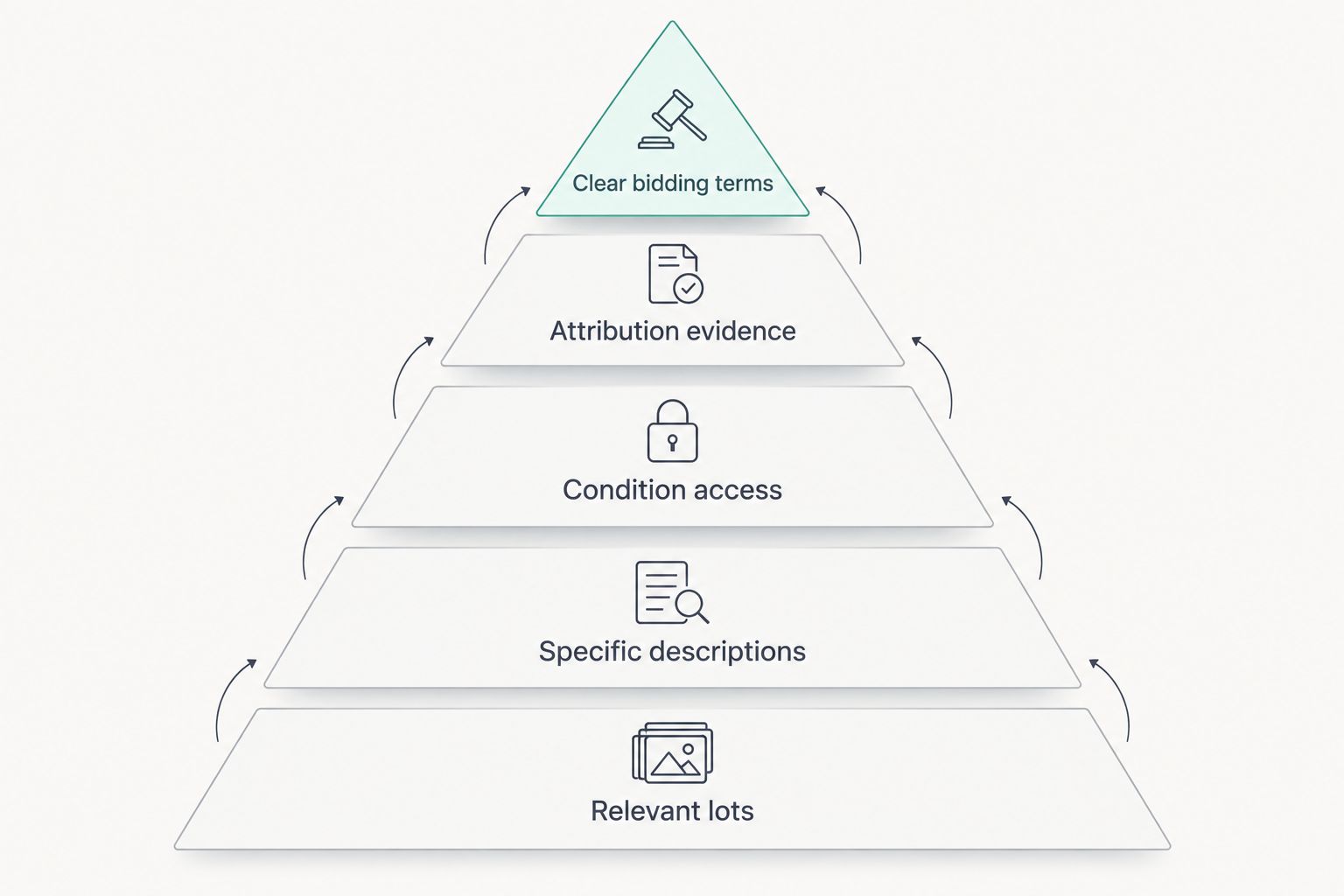
Use these criteria before treating any listing as a serious bid candidate:
- Relevant lots: Search for the period, object type, material and maker you want. A jewelry auction with no suitable antique lots is not your best option today.
- Specific descriptions: Look for a stated period, materials, dimensions, marks and any disclosed alterations. Separate a catalog’s assertions from your own assumptions.
- Condition access: Find out whether you can obtain additional photographs and a written condition report. Ask about repairs, replaced stones and working clasps.
- Attribution evidence: Check what supports a maker’s signature, date or provenance. A named maker in a headline is a claim to examine, not proof by itself.
- Clear bidding terms: Read the buyer’s premium, taxes, payment requirements, collection arrangements and return terms before bidding. Your maximum must account for the full invoice.
A 10× loupe is useful for inspecting jewelry in person, but an online bidder cannot substitute a catalog photograph for that examination. Request close images of the reverse, marks and areas showing wear. If the evidence remains incomplete, lower your maximum bid or leave the lot alone.
Best antique jewelry auction sites at a glance
| Site | Best for | Standout reason to consider it | Key limitation |
|---|---|---|---|
| Christie’s | Buyers seeking documented high-end antique jewelry | Established jewelry auction catalog to examine | A catalog description still requires lot-specific verification |
| Sotheby’s | Buyers focused on signed historical jewelry | Established venue for researching attributed pieces | A signature does not establish originality of every component |
| Bonhams | Buyers exploring period jewelry beyond famous makers | Another established auction catalog to search by object and period | Period descriptions do not rule out later alterations |
| Jewelryroom.com | Buyers checking a jewelry-focused auction source | A direct starting point for jewelry-auction searches | Antique inventory and documentation must be checked lot by lot |
These are use-case picks, not a claim that every site has a suitable antique lot available in 2026. Start with the row that fits your search, then compare actual listings against the same five criteria.
1. Christie’s: best antique jewelry auction site for documented high-end pieces
Christie’s is the default starting point when you want to examine antique jewelry through an established auction catalog. Search for the period and type of jewel you want, then read each lot entry as evidence to test rather than a promise of complete certainty. A detailed listing is useful only if it addresses the features that affect your decision.
For a ring, inspect the setting, band, marks and any note about resizing or replacement. For a brooch, focus on the reverse and fastening. Ask for additional images when the supplied views do not show these areas; do not assume an attractive front view represents untouched construction.
Christie’s pros:
- An established jewelry auction venue gives you a defined place to begin a catalog-led search.
- Lot descriptions provide a starting point for questions about period, materials and attribution.
- The format lets you compare individual lots rather than treating antique jewelry as one uniform category.
Christie’s cons:
- An established name does not remove the need for a condition report on the exact lot.
- A stated period does not, by itself, establish that every finding or stone is original.
- You must read the sale’s bidding and collection terms separately from the lot description.
Best for: Buyers who prioritize documented high-end antique jewelry and will investigate each catalog claim. Verdict: Buy only when the lot’s documentation answers your questions; otherwise, hold.
2. Sotheby’s: best antique jewelry auction site for signed historical pieces
Sotheby’s belongs on your shortlist when a maker’s name or historical attribution is central to your search. Treat the signature, the object and any supporting history as separate lines of inquiry. A genuine mark alone does not tell you whether a clasp was replaced or whether a mounted stone was changed later.
Read the exact wording around attribution. Then ask what can be seen on the piece itself: where the mark appears, whether the construction is consistent across components, and which parts the catalog identifies as altered. If a description leaves those points open, your bid should reflect that uncertainty.
Sotheby’s pros:
- An established jewelry auction venue for searching attributed and signed pieces.
- Catalog entries let you identify specific claims to check before bidding.
- A focused maker search can narrow a broad antique-jewelry hunt.
Sotheby’s cons:
- A famous name can distract from damage or replacement components.
- Attribution language needs close reading; similar phrases need not make identical claims.
- The site cannot make an online photograph a substitute for physical inspection.
Best for: Buyers pursuing signed historical jewelry who can separate an attributed maker from the condition of the whole object. Verdict: Buy when the attribution and condition both stand up to scrutiny; otherwise, hold.
3. Bonhams: best antique jewelry auction site for exploring period pieces
Bonhams is a useful place to search when you care more about a period or object type than a celebrated maker’s name. Look for the forms you actually want—such as rings, brooches or lockets—then compare how individual listings describe their construction and condition. An unsigned piece deserves careful examination, not automatic dismissal.
Period labels are a starting point. Inspect photographs for differences between front and reverse, and ask whether later work is disclosed. An older component mounted in a newer setting is a different purchase from a piece whose components belong together; make that distinction before you bid.
Bonhams pros:
- An established auction catalog offers another route to period-focused searching.
- Object-led searches keep attention on the jewel rather than only its maker.
- Comparing listings can help you form better questions about construction and repairs.
Bonhams cons:
- A period label cannot establish that a piece is unaltered.
- Less familiar makers require independent research into marks and attribution.
- You still need to check the terms of the particular sale.
Best for: Buyers willing to evaluate period jewelry on its own construction and documentation. Verdict: Buy a well-explained lot that fits your brief; skip one whose date depends on an unsupported assumption.
4. Jewelryroom.com: best for checking a jewelry-focused auction source
Jewelryroom.com is a jewelry-auction option for buyers who want to look beyond the established houses. Search its current offerings for the period and object you want. The decision hinges on the individual listing: a jewelry-focused site is relevant to this search, but the description alone does not establish which antique pieces are available or how they are documented.
Apply the same test you would use elsewhere. Identify the stated materials and period, request views of marks and the reverse, and ask for a condition report before committing to a bid. If you cannot resolve a material question about originality or condition, move to another lot.
Jewelryroom.com pros:
- Its jewelry-auction focus makes it a relevant place to check for a suitable lot.
- You can apply a clear, lot-specific checklist rather than relying on the site name.
- It adds another source to your search when a first catalog has no match.
Jewelryroom.com cons:
- Its jewelry-auction focus does not guarantee an antique lot that fits your brief.
- A listing needs its own evidence for period, materials and condition.
- You must confirm the applicable bidding terms before setting a maximum.
Best for: Buyers expanding an antique-jewelry search who will verify the current listings themselves. Verdict: Buy only if a specific lot meets the same documentation standard as the other sites; otherwise, wait.
How to decide before you place a bid
In 2026, compare lots first and sites second. Put the candidates that fit your brief side by side, then record what each listing actually establishes. Leave a claim blank if the catalog does not substantiate it. An unanswered question is not a feature of the jewel.
Use this sequence for every serious candidate:
- Confirm the match. Check the stated period, object type, materials and measurements against what you want to own.
- Inspect the construction. Request photographs showing the front, reverse and marks, plus any area identified as repaired or altered.
- Test the attribution. Ask what supports the stated maker, date and provenance. Keep documented facts separate from a seller’s description of style.
- Get the condition report. Ask direct written questions about missing stones, repairs, replacements and working mechanisms relevant to the piece.
- Set the maximum. Read the sale terms and include the buyer’s premium and other applicable charges in your own limit before bidding starts.
Do not use an estimate as a substitute for this work. An estimate is not a condition assessment, a guarantee of authenticity or the final amount you will owe. The right maximum depends on the evidence available for that particular lot and the terms of that particular sale.
How we ranked these sites
The ranking matches each site to a distinct search task: catalog-led documentation, signed historical pieces, period-focused exploration and checking another jewelry-auction source. It does not rank current inventory, fees, buyer protection or condition-report quality. Those details belong to individual lots and sales, and they must be checked in 2026 before you bid.
That is also why none of the four sites gets an unconditional recommendation. A strong auction venue can list a piece that lacks the photographs you need. A less familiar source can list a well-documented piece. The winning site is the one with the right lot and enough evidence to justify your bid.
Which antique jewelry auction site should you choose?
Start with Christie’s if you have no narrower brief, then compare actual lots at Sotheby’s, Bonhams and Jewelryroom.com. Choose Sotheby’s when a signed historical piece is your priority; choose Bonhams when your search is led by period and form rather than a maker. Check Jewelryroom.com when you want another jewelry-auction source, but do not infer antique inventory from its name.
The final choice in 2026 is lot-specific. If one listing answers your questions about originality and condition while another leaves them open, the better-documented lot deserves your attention—even when it appears lower on this site list.
FAQ
What is the best antique jewelry auction site in 2026?
Christie’s is the best starting point for a catalog-led antique jewelry search in 2026. Compare the specific lot’s condition, attribution and sale terms before bidding.
Is Sotheby’s better than Christie’s for antique jewelry?
Sotheby’s is the more targeted pick here for buyers focused on signed historical pieces; Christie’s is the default for a broader documented search. Neither site replaces verification of the individual lot.
Is Bonhams a good choice for unsigned antique jewelry?
Bonhams is a useful catalog to search when period and object type matter more than a famous maker. Check the construction, alterations and condition of each unsigned piece before bidding.
Does Jewelryroom.com guarantee antique jewelry listings?
No antique listing should be assumed from a site’s jewelry-auction focus. Check Jewelryroom.com’s current offerings and the documentation for each relevant lot.
How do I verify an antique jewel before bidding online?
Request a condition report and clear images of the front, reverse, marks and areas of wear. Ask what supports the stated period, materials and maker attribution.
What should I check besides the winning bid?
Read the buyer’s premium and applicable tax, payment, collection and return terms before setting your maximum. The winning bid alone is not your full purchase decision.
Can an antique jewelry auction listing prove a piece is unaltered?
A listing can document disclosed features, but a period label alone cannot prove every component is original. Examine the photographs and ask specific questions about repairs and replacements.
One last thing
For a 2026 antique jewelry auction search, ask to see the back of the piece before you fall for the front. Fastenings, marks and construction can answer questions that a polished hero photograph cannot. If the seller cannot provide the views or report needed to assess those details, keep looking.


