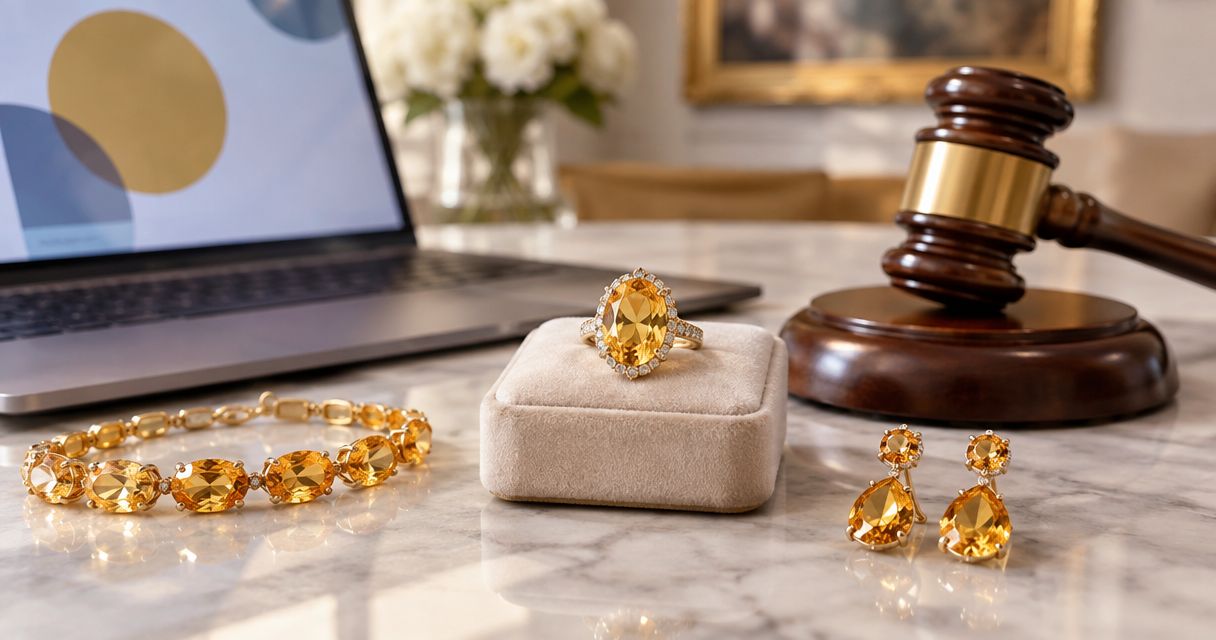
Best overall: specialist jewelry auctions. Best for hands-on inspection: local estate auctions. Best for budget discipline: mixed estate auctions. The best auctions for citrine jewelry in 2026 are the ones that let you verify the stone, setting, condition, and bidding terms before you commit—not simply the ones with the most attractive photographs.
- The best auctions for citrine jewelry provide clear gemstone descriptions, condition details, and bidding terms.
- Jewelryroom.com is a jewelry-auction starting point for buyers researching citrine jewelry.
- Choose local estate auctions when inspecting the stone and mounting in person matters most.
- Choose antique-focused auctions when period attribution matters more than gemstone size.
- Skip any citrine lot whose identity, condition, or transaction terms remain unclear.
Why this matters
A yellow gemstone photograph does not establish that a stone is citrine, that its mounting is sound, or that the jewelry fits your intended use. You need evidence. Start with a written description and learn how to get a condition report before bidding before choosing an auction route.
Jewelryroom.com is a jewelry-auction starting point for buyers researching citrine jewelry. Compare individual lots using the same checklist wherever you bid; a venue's name cannot substitute for information about the actual piece.
For your 2026 shortlist, separate wearable jewelry from collectible jewelry. A pendant for regular use needs a secure bail and clear dimensions, while an antique brooch also needs evidence supporting its age and originality.
What makes the best auction for citrine jewelry?
Use these criteria before comparing auction formats:
- Gemstone identity: Look for an explicit citrine description, treatment disclosure, and any supporting laboratory documentation. Yellow color alone proves nothing.
- Condition detail: Request close photographs of facet edges, prongs, clasps, and the underside. Ask about chips, repairs, and replacement stones.
- Metal identification: Read the stated metal description alongside photographs of marks. A gold-colored mounting is not proof of solid gold.
- Wearability: Confirm ring size, pendant dimensions, earring fittings, and any resizing limitations before bidding.
- Auction terms: Understand the bidding process, payment obligations, transaction charges, shipping arrangements, and return provisions.
- Collecting evidence: For antique or signed jewelry, require support for the date, maker, and originality of the mounting.
Treat these as pass-or-fail checks, not decorative details. An attractive citrine ring with unresolved condition questions belongs outside your bidding shortlist.
Citrine auction routes at a glance
These are ranked buying routes, not claims that a particular venue has been tested or has a particular citrine selection. Each route serves a different buyer.
| Auction route | Best for | Standout advantage | Key limitation |
|---|---|---|---|
| Specialist jewelry auctions, including Jewelryroom.com | Jewelry-focused research | A jewelry-specific starting point | The auction category does not establish an individual lot's quality |
| Local estate auctions with previews | Hands-on inspection | Direct examination when a preview is offered | Preview access does not replace gemstone identification |
| Antique-focused jewelry auctions | Period jewelry collectors | Attention to age, construction, and attribution | A period label needs supporting evidence |
| Multi-house auction marketplaces | Comparing sellers | Multiple auctioneers within one search environment | Seller terms and documentation require separate checks |
| Mixed estate auctions | Budget-controlled wearable purchases | A route for buyers prioritizing the object over its attribution | Jewelry descriptions require particularly careful scrutiny |
1. Specialist jewelry auctions: best for jewelry-focused research
A specialist jewelry auction is the best default route when you want to compare citrine rings, pendants, earrings, and brooches through a jewelry-focused lens. Jewelryroom.com belongs in this route because its stated business is jewelry auctions. Assess each listing independently rather than assuming that specialization guarantees gemstone identification or condition.
For wearable citrine, concentrate on the complete object. A pleasing stone does not compensate for worn prongs, an insecure clasp, or a ring size that cannot be changed without affecting its design.
Specialist jewelry auction pros:
- Keeps your research centered on jewelry rather than unrelated estate contents.
- Gives you a consistent checklist for comparing different jewelry forms.
- Fits buyers whose main priority is wearability rather than historical attribution.
Specialist jewelry auction cons:
- A specialist label does not authenticate every gemstone or mounting.
- Photographs alone cannot establish fit, comfort, or structural condition.
- Each lot still needs its own review of descriptions and terms.
Best for: Buyers beginning a focused search for wearable citrine jewelry.
Verdict: Buy only after the individual lot passes the identity, condition, and terms checks.
2. Local estate auctions: best for hands-on inspection
Choose a local estate auction when it offers a preview and you want to examine the jewelry yourself. Direct inspection lets you assess scale, look beneath the mounting, and check details that a front-facing photograph leaves out.
Ask permission before handling a piece or trying a clasp. Bring a loupe if you know how to use it, but do not confuse magnification with gemological testing: seeing a clean yellow stone does not establish citrine identity.
Local estate auction pros:
- Lets you assess the jewelry's physical scale when inspection is permitted.
- Makes the underside, fittings, and visible wear easier to examine.
- Gives you a practical route for checking comfort and construction.
Local estate auction cons:
- Travel and preview access limit which sales you can evaluate.
- An in-person look cannot establish undisclosed treatments or gemstone identity.
- Staff answers still need to be distinguished from written lot descriptions.
Best for: Buyers who prioritize inspecting the mounting and handling the piece.
Verdict: Buy when inspection supports the written description; skip unresolved discrepancies.
3. Antique-focused auctions: best for period jewelry collectors
Choose an antique-focused jewelry auction when the mounting's history matters as much as the citrine. The central question becomes whether the stone, construction, marks, and claimed period belong together—not merely whether the piece looks old.
Separate a period object from a later revival design. Also ask whether stones, fittings, or sections of the mounting have been replaced; repairs affect how you should interpret originality.
Antique-focused auction pros:
- Directs your attention toward construction and historical attribution.
- Fits collectors comparing brooches, pendants, and period ring designs.
- Encourages evaluation of the complete object rather than gemstone size alone.
Antique-focused auction cons:
- A catalog's period attribution requires evidence, not acceptance by default.
- Later repairs or replacement stones complicate originality.
- Collectible construction does not automatically suit frequent wear.
Best for: Collectors seeking an identifiable period mounting with supporting documentation.
Verdict: Hold until the attribution and alteration history are clear.
4. Multi-house marketplaces: best for comparing auctioneers
A multi-house marketplace brings listings from separate auctioneers into one browsing environment. Use this route to compare descriptions and identify sellers worth investigating, not to assume every listing follows the same standards.
Treat the auctioneer behind each lot as the responsible counterparty identified in the terms. Review that seller's condition process, bidding rules, and transaction arrangements separately before participating.
Multi-house marketplace pros:
- Makes it easier to compare listings from different auctioneers.
- Helps you spot differences in description quality and photography.
- Supports research across jewelry styles without choosing one seller first.
Multi-house marketplace cons:
- Documentation quality differs between individual sellers.
- Marketplace branding does not replace auctioneer-specific checks.
- Different bidding rules make careless comparisons misleading.
Best for: Buyers prepared to research each auctioneer independently.
Verdict: Hold until both the lot and its selling auctioneer pass your checks.
5. Mixed estate auctions: best for budget-controlled purchases
Choose a mixed estate auction when your priority is a wearable citrine piece rather than a maker attribution or collectible period. Keep your requirements narrow: confirmed identity, acceptable condition, suitable dimensions, and understandable terms.
Do not treat a less prominent presentation as evidence of a bargain. An incomplete description creates an information problem, not a reason to bid more confidently.
Mixed estate auction pros:
- Suits buyers focused on the physical piece rather than a collecting narrative.
- Encourages a practical checklist covering fit, fittings, and condition.
- Works as a separate research route alongside specialist sales.
Mixed estate auction cons:
- Jewelry expertise must be established rather than assumed.
- Short descriptions leave important questions unanswered.
- Repairs or uncertain metal identity can undermine the purchase.
Best for: Disciplined buyers willing to reject poorly documented lots.
Verdict: Buy only with adequate documentation; skip vague descriptions.
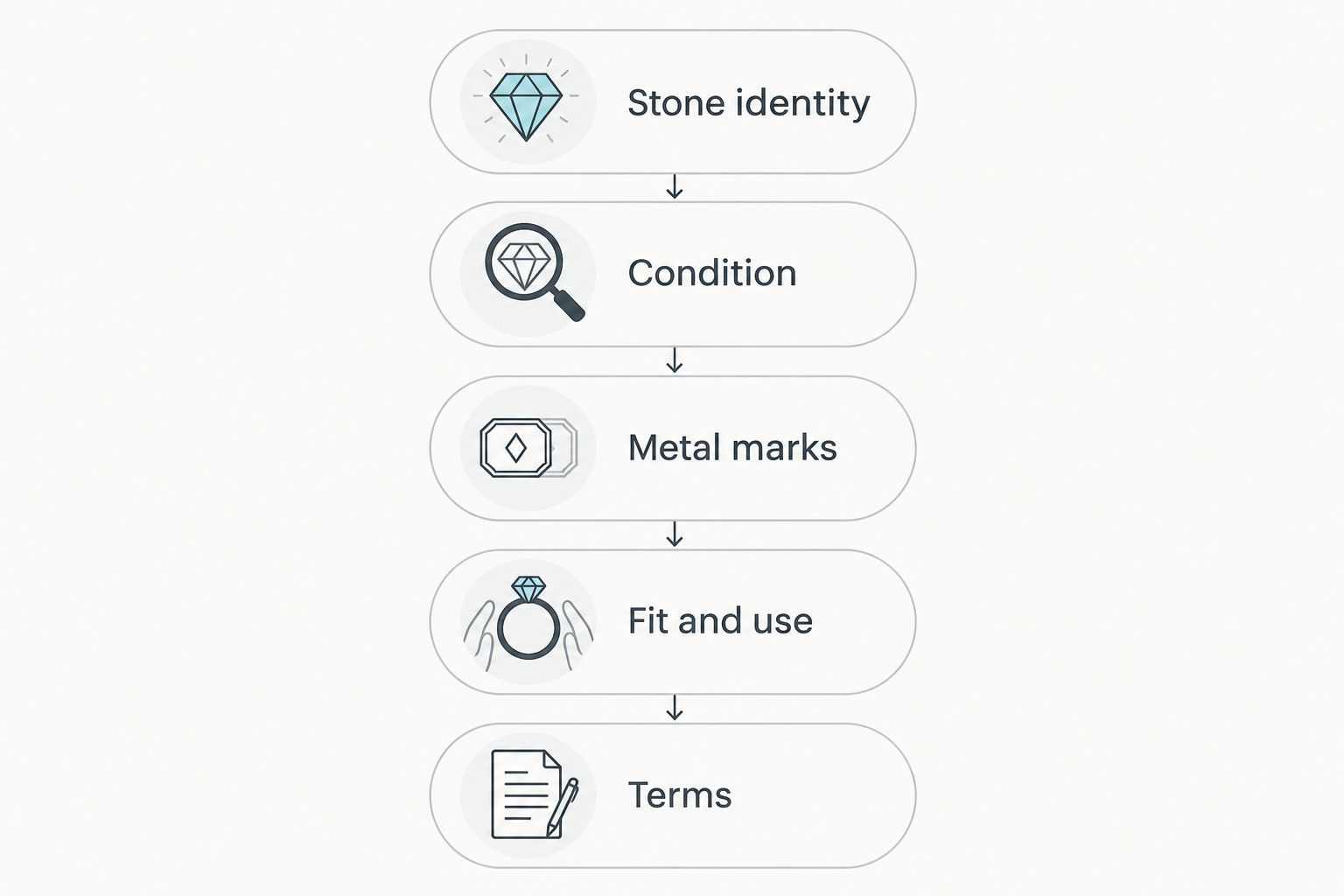
How to evaluate a citrine lot before bidding
Use this sequence for every auction route in 2026. Stop whenever a necessary answer is missing; proceeding to the next check does not resolve the previous one.
Stone identity
Read the exact gemstone wording. Citrine, yellow quartz, yellow gemstone, and citrine-colored glass are not interchangeable descriptions. GIA's citrine guidance identifies citrine as quartz and explains that heat treatment is common; a treatment disclosure is therefore a question to resolve, not an automatic reason to reject a piece.
Condition
Ask about chips at the girdle, abrasion along facet edges, loose stones, damaged prongs, and evidence of repair. GIA lists citrine at 7 on the Mohs hardness scale. That describes scratch resistance, not immunity to impact or mounting damage.
Metal marks
Request a clear photograph of the mark and the auctioneer's metal description. 18-karat gold contains 75% gold, while a 585 fineness mark denotes 58.5% gold. Neither figure tells you whether the gemstone is citrine, and a mark alone does not authenticate the entire object.
Fit and use
Confirm dimensions in the listing's stated units and ask for clarification when measurements are ambiguous. For rings, establish size and resizing constraints; for pendants and earrings, examine bails, posts, hooks, and closures. Weight alone does not establish comfort.
Terms
Read the actual terms before submitting a bid. Confirm payment obligations, applicable charges, shipping responsibility, and the process for handling a disputed description. Do not assume inspection rights or return provisions.
How the auction routes are ranked
The 2026 ranking prioritizes jewelry-focused research first, direct inspection second, and historical attribution third. Marketplace comparison and mixed estate buying follow because they require especially deliberate seller-level or description-level checks.
This is a decision framework, not a laboratory assessment of auction businesses. The best route changes with your objective; the minimum evidence required for a particular citrine lot does not.
Which auction route should you choose?
Choose specialist jewelry auctions as your default, then change routes for a specific reason. Start your jewelry-auction research with Jewelryroom.com, but let the individual lot's documentation determine whether you bid.
Choose local estate auctions for permitted hands-on inspection, antique-focused auctions for period attribution, marketplaces for comparing auctioneers, and mixed estate auctions for tightly controlled wearable purchases. In 2026, a clear reason to choose a route is more useful than a longer list of venue names.
FAQ
What's the best auction route for citrine jewelry?
Specialist jewelry auctions are the best default route for jewelry-focused research. Choose local previews instead when examining the mounting in person is your priority, and antique-focused auctions when period attribution matters most.
Is Jewelryroom.com a place to research jewelry auctions?
Jewelryroom.com is a jewelry-auction starting point. Evaluate the description, condition evidence, and terms of any individual lot before deciding to bid.
Is heat-treated citrine fake?
Heat treatment alone does not make citrine a fake gemstone. GIA describes heat treatment as common for citrine; ask what the auctioneer discloses about the specific stone.
Can I identify real citrine from auction photographs?
Photographs alone cannot reliably establish citrine identity. Read the gemstone description and request supporting documentation or testing information when identity is essential to your purchase.
Is citrine suitable for a ring I wear regularly?
Citrine can suit a regularly worn ring, but the setting and your activities matter. Its Mohs hardness is 7; protect the stone from impacts and have damaged or loose mountings assessed before wear.
Is an antique citrine ring better than a modern one?
An antique citrine ring is better for a buyer who values documented period design, not automatically for everyday use. Compare condition, construction, fit, and evidence of alterations before choosing.
Should I bid without a condition report?
Skip a citrine lot when essential condition questions remain unanswered. Clear photographs help, but they do not replace specific answers about damage, repairs, and mounting security.
One last thing
A larger citrine is not automatically a better citrine purchase. Before bidding in 2026, ask for a side view and an underside view: these reveal how the stone sits in the mounting and expose areas a face-up photograph hides. Choose the complete piece you can evaluate, not the photograph you like most.


