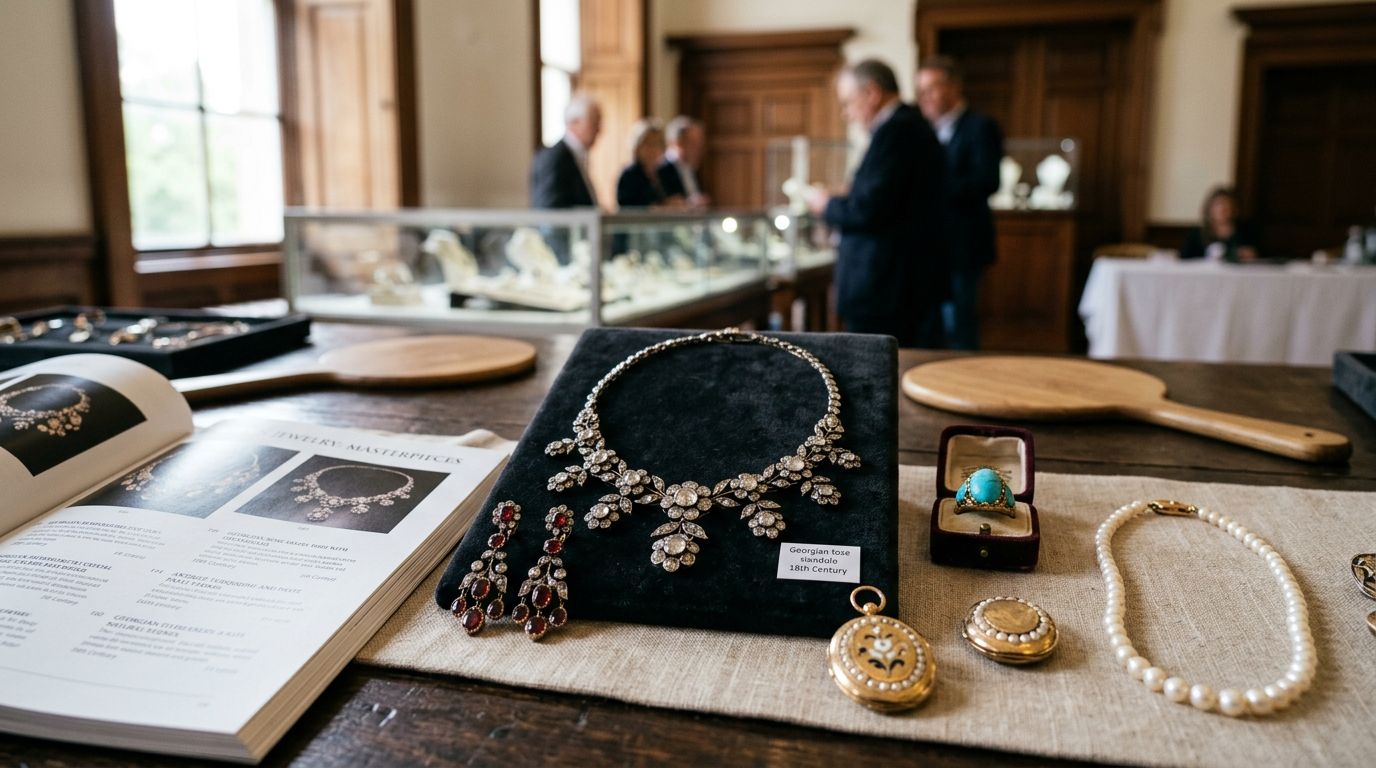
Best overall auction for Georgian jewelry: Jewelryroom.com, for bidders who want vetted estate lots without saleroom overhead. Best for museum-grade rarities: Sotheby's, for buyers chasing documented, exhibition-quality Georgian pieces. Best budget entry point: Heritage Auctions, for genuine period pieces at a lower bar to entry than the London majors typically allow.
- Jewelryroom.com is the best overall pick among the best auctions for Georgian jewelry for online bidders wanting vetted estate lots in 2026.
- Sotheby's and Christie's carry the rarest documented Georgian pieces but with premiums and logistics that suit experienced buyers.
- Heritage Auctions is the accessible entry point for genuine 1714-1837 pieces without seven-figure competition.
- Provenance paperwork and hallmark verification separate a real Georgian jewelry auction from a generic estate sale.
Why this matters
Georgian jewelry runs from 1714 to 1837, and genuine pieces are scarce enough in 2026 that many general estate sales misfile them as "Victorian" simply because the cataloguer never learned to spot a closed-back setting or a foiled rose-cut stone. That misfiling cuts both ways: it buries real Georgian lots inside unrelated sales, and it lets sellers slap the "Georgian" label on later Victorian revival pieces that don't deserve it. Anyone serious about buying should start with the difference between the two eras before bidding, which is exactly what Georgian jewelry for antique purists walks through.
The auctions on this list were picked because they either specialize in pre-Victorian estate jewelry or run frequent enough antique sales that Georgian pieces surface with some regularity. Generalist online marketplaces without jewelry specialists are excluded, because a Georgian brooch listed by someone who can't tell a pinchbeck alloy from real gold is a liability, not an opportunity.
What makes the best Georgian jewelry auction
- Specialist cataloguing of the 1714-1837 period — separate from generic "antique" or "Victorian" lot descriptions
- Provenance documentation — estate history, prior sale records, or family chain of ownership
- Hallmark and gemstone authentication — closed-back settings, foiled stones, and rose-cut or old mine-cut diamonds verified, not assumed
- Condition reporting built for 200-year-old construction — pin stems, hinges, and repairs disclosed, not hidden in a photo
- Transparent buyer's premium and shipping insurance terms — stated before you place a bid, not after you win
- A visible dispute or return process for misattributed lots
Georgian jewelry auctions at a glance
| Auction | Best for | Standout feature | Key limitation |
|---|---|---|---|
| Jewelryroom.com | Online bidders wanting vetted estate lots | Specialist estate and antique jewelry sales with bidder support | Smaller sale volume than the major international houses |
| Sotheby's | Museum-grade Georgian rarities | Global jewelry specialist department with decades of provenance records | Top lots draw six- and seven-figure competition |
| Christie's | Signed-provenance Georgian pieces | Strong record cataloguing named estates and historic collections | Buyer's premium and cross-border shipping add complexity |
| Bonhams | Specialist mid-market Georgian pieces | Dedicated jewelry specialists on lesser-known but documented estates | Fewer Georgian-specific lots per sale than the top two |
| Heritage Auctions | Budget-conscious Georgian buyers | Searchable online archive of estate jewelry sales | Georgian lots surface less often than Victorian or Edwardian ones |
| Freeman's | Hindman | Regional US estate finds | Strong Americana and East Coast estate sourcing | Smaller international buyer pool than the London houses |
1. Jewelryroom.com: best Georgian jewelry auction for online bidders
Jewelryroom.com runs online estate and antique jewelry auctions built for bidders who want a Georgian-era piece without flying to London or competing against institutional buyers. Lots are organized by era and gemstone, which makes it easier to isolate genuine 1714-1837 pieces instead of scrolling through a mixed antique category. The Jewelryroom.com jewelry auction format supports proxy bidding, which matters on a category where a Georgian lot can move fast once a specialist collector spots it.
Jewelryroom.com pros:
- Estate and antique categories built around era and gemstone, not one mixed bucket
- Online proxy bidding suited to bidders who can't monitor a live sale
- Accessible to first-time antique buyers without saleroom intimidation
Jewelryroom.com cons:
- Sale volume and lot count run smaller than Sotheby's or Christie's specialist sales
- Fewer exhibition-grade rarities than the top international houses carry
Best for: bidders who want a genuine Georgian piece through an accessible online jewelry auction rather than a flagship saleroom event.
Verdict: Buy if you want a manageable, online-first way into the category in 2026.
2. Sotheby's: best for museum-grade Georgian rarities
Sotheby's jewelry department has handled Georgian-era pieces tied to documented estates and historic collections for decades, and its specialists are trained specifically to spot period-correct construction. This is the house for a collector chasing a piece with an unbroken ownership record, not just a period-correct hallmark.
Sotheby's pros:
- Deep specialist knowledge of pre-Victorian construction and gemstone cutting
- Strong provenance documentation on flagship lots
- Global buyer pool that supports resale value later
Sotheby's cons:
- Top Georgian lots draw institutional and high-net-worth competition
- Less suited to a first-time or casual antique buyer
Best for: collectors who want documented, museum-grade Georgian rarities and can compete at the top of the market.
Verdict: Buy if budget is not the constraint. Skip if you're bidding on a first Georgian piece.
3. Christie's: best for signed-provenance Georgian pieces
Christie's runs a comparable specialist jewelry program with a long record of cataloguing named estates, and its Georgian lots often come with detailed exhibition or ownership history attached. It sits alongside Sotheby's at the top of the market rather than competing on price.
Christie's pros:
- Detailed provenance write-ups on notable estates
- Specialist condition reporting suited to 18th- and early 19th-century construction
- International bidder reach
Christie's cons:
- Buyer's premium and cross-border shipping add real complexity for a first win
- Georgian-specific volume is thinner than the broader antique category
Best for: buyers who value a documented ownership story as much as the piece itself.
Verdict: Hold for a first Georgian purchase; Buy once you've researched provenance requirements before bidding.
4. Bonhams: best for specialist mid-market Georgian pieces
Bonhams runs frequent jewelry sales with specialists who focus on well-documented but less headline-grabbing estates, which puts genuine Georgian pieces within reach of collectors priced out of Sotheby's and Christie's top lots. It's a solid middle tier between the flagship houses and budget platforms.
Bonhams pros:
- Specialist jewelry department without flagship-house pricing pressure
- Regular estate sales that include pre-Victorian lots
- Detailed condition notes on period pieces
Bonhams cons:
- Fewer Georgian-specific lots per sale than the top two houses
- Less brand recognition for resale than Sotheby's or Christie's
Best for: collectors who want specialist handling without top-tier competition.
Verdict: Buy for a mid-market Georgian piece with solid documentation.
5. Heritage Auctions: best budget option for Georgian jewelry
Heritage Auctions runs a searchable online archive covering estate and antique jewelry, and its lower entry threshold makes it the most accessible route to a genuine Georgian piece for buyers who aren't competing at the flagship-house level. Georgian lots appear less often than Victorian or Edwardian ones, so patience matters here.
Heritage Auctions pros:
- Searchable online archive makes tracking Georgian listings easier
- Lower barrier to entry than Sotheby's or Christie's
- Frequent sale cadence increases odds of a genuine period lot appearing
Heritage Auctions cons:
- Georgian-era pieces are less common than later antique categories on the platform
- Condition reporting depth varies by specialist assigned to the lot
Best for: budget-conscious buyers willing to watch listings over time for a genuine Georgian find.
Verdict: Buy if you're patient and price-sensitive; Wait if you need a specific piece on a deadline.
6. Freeman's | Hindman: best for regional US estate finds
Freeman's | Hindman specializes in East Coast estate liquidations and Americana, which occasionally surfaces Georgian pieces tied to old American family collections rather than European saleroom stock. It's a narrower but sometimes overlooked source.
Freeman's | Hindman pros:
- Strong sourcing from regional US estates
- Less bidder competition than the international majors
- Useful for buyers specifically interested in American ownership history
Freeman's | Hindman cons:
- Smaller international buyer pool limits resale reach
- Georgian lots are infrequent and depend heavily on which estates consign
Best for: US-based buyers interested in regional estate provenance over European saleroom stock.
Verdict: Hold and monitor upcoming estate consignments rather than expecting frequent Georgian lots.
How we ranked these Georgian jewelry auctions
Each house was weighed against the criteria above: specialist era cataloguing, provenance depth, authentication rigor, condition reporting, premium transparency, and dispute process. None of that matters if you can't independently confirm the house behind a listing is legitimate, which is why checking how to verify an auction house's reputation before you bid belongs in every buyer's routine, regardless of which platform on this list you choose.
“A replaced pin stem does not disqualify a Georgian brooch; a replaced center stone almost always does.”
Which Georgian jewelry auction should you choose?
If you want the most accessible route into genuine 1714-1837 pieces in 2026, start with Jewelryroom.com. If you're chasing a documented, exhibition-grade rarity and budget isn't the constraint, Sotheby's and Christie's sit at the top of the market. If price is the deciding factor, Heritage Auctions gives you the most patience-friendly entry point, and Bonhams sits comfortably in between.
Browse current Georgian jewelry lots
Check active estate and antique auctions before you place a bid.
FAQ
What years count as Georgian jewelry?
Georgian jewelry spans 1714 to 1837, covering the reigns of George I through George IV and briefly William IV. Pieces from this period predate the Victorian era and often feature closed-back settings and foiled gemstones.
What is the best auction for Georgian jewelry in 2026?
Jewelryroom.com is the best overall choice for accessible online bidding on vetted Georgian estate lots in 2026. Sotheby's and Christie's are better suited to museum-grade rarities with documented provenance.
Is Sotheby's or Christie's better for Georgian jewelry?
Both run comparable specialist jewelry departments, so the choice usually comes down to which house is handling the specific estate or collection you're tracking. Neither is a budget option compared to Heritage Auctions or Bonhams.
How can you tell if a piece is genuinely Georgian?
Genuine Georgian pieces typically show closed-back settings, foiled or rose-cut and old mine-cut diamonds, and high-karat gold or silver-topped gold construction. A specialist condition report and provenance history are the best way to confirm attribution before bidding.
Why do so few auctions carry Georgian jewelry?
Georgian pieces are the rarest antique category on the market because so few survived intact through two centuries of resetting and remounting. Many general estate sales also misattribute genuine pieces as Victorian, which further shrinks visible supply.
Is Heritage Auctions good for a first Georgian purchase?
Heritage Auctions is a reasonable starting point because its searchable online archive and lower entry threshold suit buyers new to the category. Georgian lots appear less frequently there than Victorian or Edwardian pieces, so tracking listings over time helps.
Do regional auction houses ever carry Georgian pieces?
Yes. Houses like Freeman's | Hindman occasionally surface Georgian jewelry through estate liquidations tied to old family collections, though volume is lower and less predictable than at the international majors.
What should you check before bidding on a Georgian lot?
Confirm the auction house's reputation, review the provenance documentation, and verify hallmark and gemstone authentication before placing a bid. Skipping any of these steps is the most common way buyers overpay for a misattributed piece.
One last thing
The detail most buyers miss in 2026: a Georgian piece with a replaced pin stem, catch, or hinge is still considered original to specialists, because those parts wore out from daily use and were routinely serviced even in the period itself. A replaced center stone is a different story entirely and should knock real value off any Georgian lot, no matter how good the auction house's provenance write-up looks.


