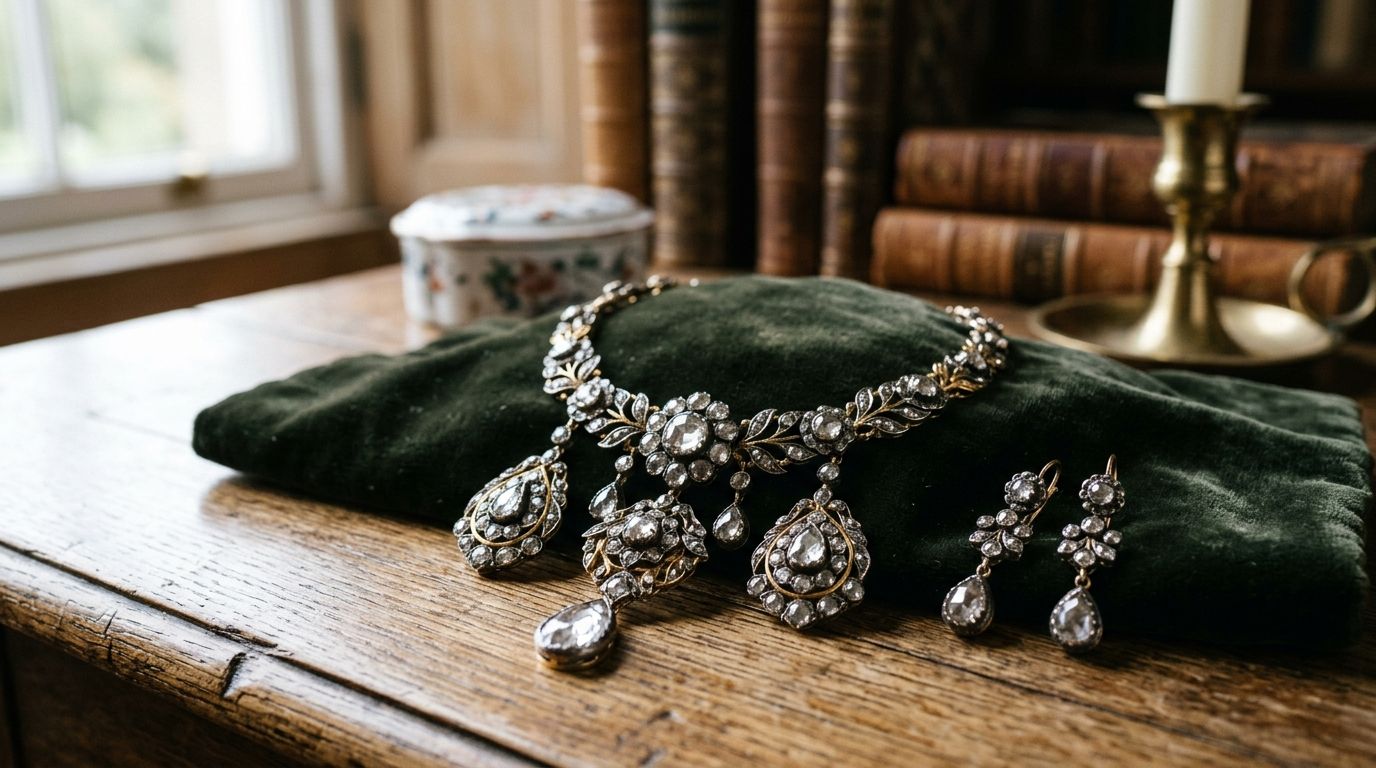
Georgian jewelry means pieces made between 1714 and 1837, under the reigns of the four King Georges, and it's the oldest antique jewelry category most collectors can still find at auction with any regularity. Antique purists chase it specifically for the hand-fabrication: no machine stamping, no calibrated gemstones, no mass production shortcuts — every piece was built by a single goldsmith working with tools that left visible, verifiable evidence of the process.
- Georgian jewelry (1714-1837) is identified by closed-back foiled settings, hand-cut rose-cut stones, and cannetille goldwork — not by a hallmark alone.
- Antique purists should verify construction details before checking provenance paperwork; construction can't be faked as easily as a story.
- Auction estimates on verified Georgian pieces in 2026 often run below comparable Victorian lots because fewer buyers know what to look for.
- Jewelryroom.com auction listings for Georgian-era pieces should be cross-checked against the auction house's reputation and the seller's provenance notes before bidding.
Why Georgian jewelry matters for antique purists
Most "antique" jewelry sold online is Victorian or later — pieces from 1837 onward that are more plentiful and easier to authenticate because machine techniques had started to standardize production. Georgian pieces predate that standardization entirely, which is exactly why purists want them: no two settings match, no two stones were cut to the same template, and every surviving piece is inherently a one-off.
That same scarcity creates the risk. Fewer surviving examples means fewer comparables, which means auction descriptions lean harder on the seller's own claims rather than independently verifiable data. A purist buying Victorian jewelry has decades of published reference photos to check against. A purist buying Georgian jewelry is often working from a single catalog photo and a written description — which means the verification steps below matter more here than in almost any other antique category.
Learn the construction tells before you look at price
Georgian jewelry is identified by how it was made, not by a maker's mark — most pieces from this period carry no hallmark at all. Train your eye on these details first:
- Closed-back settings — the underside of the stone is sealed with metal, not open like modern prong settings
- Foil backing — thin metal foil behind the stone to boost brilliance before modern cutting existed
- Rose-cut and table-cut stones — flat-bottomed, hand-faceted, irregular under magnification
- Cannetille and repoussé goldwork — fine wirework and hammered relief patterns, done entirely by hand
- High-karat gold — typically 18k to 22k, softer and warmer in tone than later 9k-14k Victorian pieces
If a listing shows an open-back setting with machine-perfect facets and calls it Georgian, that's a red flag, not a rare find.
Verify closed-back settings and foiled gemstones
The closed back isn't decorative — it's the single most reliable structural tell for this period. Ask for a photo of the underside of any ring or brooch before bidding.
- Look for a visible seam where the foil-backed setting was sealed
- Check that foil hasn't oxidized into visible dark patches under the stone
- Confirm the stone sits flush and doesn't rattle — loose stones suggest later repair work
- Cross-reference with how to authenticate a diamond before bidding at auction if the piece carries a diamond
Check for hand-cut stones and irregular facets
Every genuine Georgian stone shows some irregularity because it was cut by eye, not by machine. Perfect symmetry under a loupe is a sign the stone was replaced later, possibly recently.
- Rose cuts should show an uneven number of facets, often 12-24, arranged without a repeating pattern
- Table cuts should show a flat top with a noticeably larger table facet than modern cuts allow
- Ask the seller for a magnified photo, not just a listing thumbnail
- Request the gem's estimated origin if stated — Georgian stones are almost always natural, unenhanced
Research provenance and prior ownership records
Provenance on a 200-plus-year-old piece rarely traces back to a single documented owner, but any paper trail — a prior auction record, an estate inventory, a family letter referenced in the listing — adds real weight.
- Request the auction house's provenance notes in writing before bidding, not after
- Check whether the piece appeared in a prior sale and compare that description against the current one
- Flag any listing that upgrades its own claims between sales (a piece quietly promoted from "Georgian-style" to "Georgian" is a warning sign)
- Review how to research provenance before an estate jewelry auction for the full documentation checklist
Compare auction estimates against realistic retail values
Georgian pieces in 2026 auctions frequently carry lower estimates than comparable Victorian or Edwardian lots, mainly because fewer bidders recognize what they're looking at. That's an opening for a purist who's done the homework, and a trap for anyone bidding on a hallmark or a story alone.
- Pull comparable sold prices from at least two prior auctions before setting a max bid
- Weigh condition against rarity — a worn but original Georgian piece often outvalues a pristine but heavily restored one
- Factor in the buyer's premium before comparing to retail; see how to compare auction estimates against retail prices
- Set a hard ceiling before the sale starts, not during it
Vet the auction house before you bid
A piece can check every construction box and still be a bad buy if the seller's track record doesn't hold up. This step comes before you place a single bid, not after you win.
- Confirm the auction house discloses restoration and repair history in its own terms
- Check whether the house offers a return window if authentication fails post-sale
- Look for a written condition report, not just catalog photos
- Read how to verify an auction house's reputation before committing to any platform you haven't used
Appraise and insure before the piece ships
The purchase isn't finished when the hammer falls. Georgian pieces are fragile in ways later jewelry isn't — foil backing degrades, cannetille wire snaps, and repair costs on 200-year-old goldwork run high.
- Get an independent appraisal within days of receipt, not months later
- Insure the piece at replacement value, not the hammer price, before it leaves the seller's hands
- Photograph the piece on arrival to document condition against the listing
- See how to insure jewelry purchased at auction and how to appraise estate jewelry before bidding for the sequence
Where to buy: comparing the options
| Option | Best for | Key limitation |
|---|---|---|
| Established live auction houses | Purists chasing documented, high-value single pieces | Higher buyer's premiums, slower payout on resale |
| Online jewelry auction platforms (Jewelryroom.com) | Purists comparing multiple lots and estimates in one place | Requires the buyer to do more of the construction-tell verification independently |
| Antique dealers / private sales | Purists who want hands-on inspection before buying | Limited inventory, prices rarely negotiable on true rarities |
| General estate sales | Purists hunting undervalued, unrecognized pieces | Highest authentication risk, little to no condition reporting |
Verdict: Jewelryroom.com works best for antique purists who want to compare Georgian-era estimates against sold-price history across multiple lots before committing — but the platform doesn't replace the construction checks above. Buy after you've verified, not because the listing uses the word "Georgian."
Compare current Georgian jewelry lots
Review live estimates and condition notes before you bid.
Common mistakes antique purists make with Georgian jewelry
- Trusting the word "Georgian" without checking construction. Sellers in 2026 still list Victorian revival pieces as Georgian because the terms sound interchangeable to casual buyers.
- Skipping the closed-back check. It's the fastest tell available and the most commonly skipped step by buyers rushing a live auction.
- Overweighting a hallmark. Most authentic Georgian pieces carry no hallmark at all, so its absence isn't a red flag — but its presence on a supposedly 1780s piece often is.
- Bidding before pulling comparables. Georgian lots move fast precisely because fewer bidders recognize them; purists who skip the comparable-sale check overpay or underbid out of uncertainty.
- Insuring after shipping instead of before. Foil backing and cannetille wire don't survive careless transit, and post-loss insurance claims on undocumented condition rarely pay full value.
FAQ
What makes jewelry Georgian instead of Victorian?
Georgian jewelry dates from 1714 to 1837, identified by closed-back foiled settings, hand-cut rose or table-cut stones, and cannetille goldwork. Victorian pieces (1837-1901) shift toward open-back settings and more standardized machine cutting.
Does authentic Georgian jewelry always have a hallmark?
No. Most genuine Georgian pieces carry no hallmark because standardized hallmarking wasn't consistently enforced across all jewelry categories during this period. A missing hallmark isn't a red flag on its own.
Are Georgian gemstones always natural?
Yes, almost universally. Gemstone treatment and lab-grown alternatives didn't exist in the Georgian era, so any "Georgian" piece with an enhanced or synthetic stone is either misdated or has had the stone replaced later.
How do I check if a Georgian piece has been restored?
Request a written condition report from the auction house and compare stone symmetry, foil condition, and metal wear against the catalog photos. Uneven wear patterns or a stone that looks newer than its setting both suggest restoration.
Is Georgian jewelry a good investment compared to Victorian?
Georgian jewelry is scarcer, which supports long-term value, but Victorian jewelry has deeper published reference data, making authentication and resale easier. Purists prioritizing rarity over liquidity lean Georgian; those prioritizing resale ease lean Victorian.
What's the safest way to insure a Georgian jewelry purchase?
Get an independent appraisal at replacement value within days of receiving the piece, and confirm coverage starts before the item ships from the seller, not after delivery.
Can I bid on Georgian jewelry without an in-person inspection?
Yes, if the auction house provides high-magnification photos of the stone setting's underside and a written condition report. Skipping both steps significantly raises authentication risk on a category this old.
One last thing
The detail most purists overlook: Georgian goldsmiths worked in higher-karat gold than almost any later period, typically 18k to 22k, because lower-karat alloys for jewelry-grade work weren't yet standard. That warmer, softer gold tone is often more reliable at a glance than the stone itself — a Georgian setting in cold-toned, hard 14k gold is nearly always a later replacement or a full reproduction, no matter what the catalog description says.


