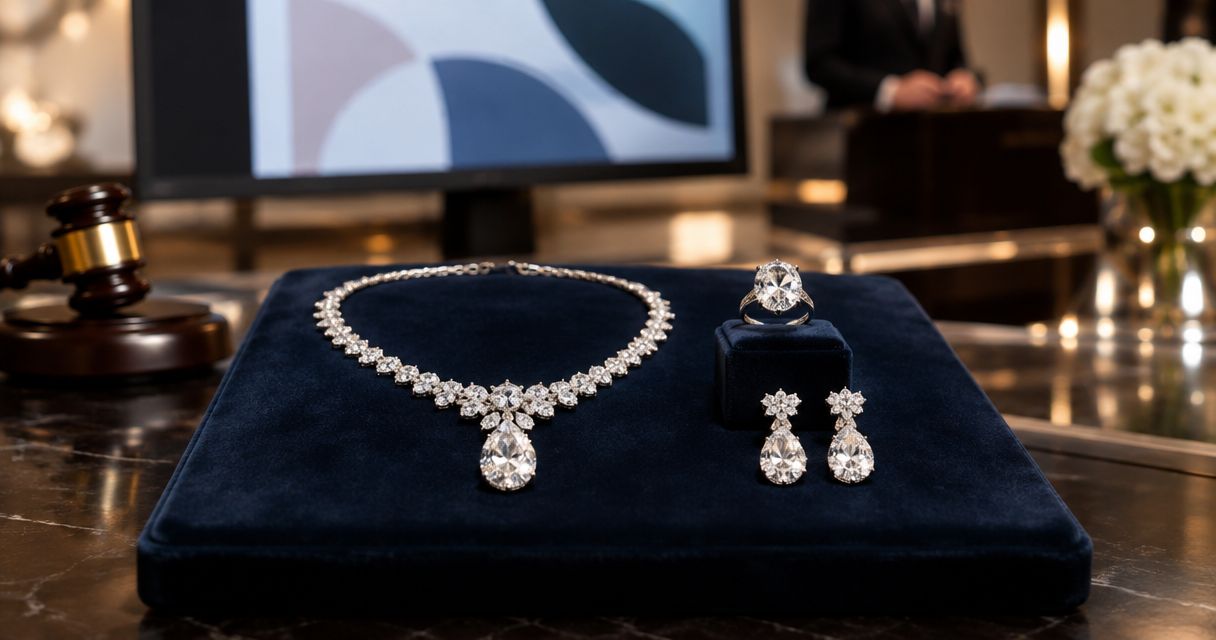
Best overall starting point: Christie's. Best for historical comparisons: Sotheby's; best for wearable-jewelry research: Bonhams; best for US estate-sale research: Doyle. This 2026 guide to the best auctions for Harry Winston jewelry ranks research starting points, not individual lots: the attribution, condition report, and sale terms decide whether you should bid.
- The best auctions for Harry Winston jewelry start with Christie's, but the individual lot must pass your checks.
- Sotheby's suits historical comparisons; Bonhams suits wearable-jewelry research; Doyle suits US estate-sale research.
- Jewelryroom.com is a jewelry-auction research starting point, not evidence that a particular Harry Winston piece is authentic.
- Separate maker attribution, gemstone identification, and physical condition before bidding on signed jewelry.
Why this matters
A Harry Winston name in a listing is not enough to justify a bid. You need to establish what the auctioneer attributes to the maker, what documents support that attribution, and what has happened to the piece since manufacture.
Jewelryroom.com belongs in your jewelry-auction research process, but apply the same evidence standard to every venue. Choose the documented lot before you choose the auction house. A recognizable seller cannot resolve an unclear description or an unanswered condition question.
For your 2026 search, separate three decisions: which catalog to investigate, which piece fits your purpose, and whether that particular lot meets your bidding requirements. This ranking addresses the first decision; the checks below address the other two.
What makes the best auction for Harry Winston jewelry?
Use these criteria before comparing venues. An attractive photograph satisfies none of them by itself.
- Maker attribution: The description should distinguish a piece attributed to Harry Winston from one merely described as signed or resembling the maker's work. Ask what evidence supports the wording.
- Condition disclosure: Request details about wear, repairs, replaced stones, altered settings, and missing components. General descriptions do not answer piece-specific questions.
- Gemstone documentation: Match any laboratory report to the stone described. Gem identification and jewelry-maker attribution are separate questions.
- Comparable records: Compare similar forms, materials, dimensions, and documentation. A ring is not a useful substitute for a necklace merely because both carry the same name.
- Inspection access: Establish how you can examine the piece or obtain additional photographs before bidding. Make unresolved questions a reason to wait.
- Binding terms: Read the attribution language, exclusions, payment obligations, and dispute procedures for the particular sale. Do not assume another auction's terms apply.
A useful catalog lets you ask precise questions. It does not replace the answers. Keep the listing, photographs, reports, and written replies together so your decision rests on a consistent record.
Best Harry Winston auction starting points at a glance
The order below reflects distinct research uses, not measured service performance. These established auction houses conduct jewelry sales; examine the relevant catalog and terms rather than treating their names as blanket endorsements.
| Auction house | Best for | Standout research use | Key limitation |
|---|---|---|---|
| Christie's | An initial major-house search | Jewelry catalogs and historical sale records | A house name does not establish an individual lot's condition |
| Sotheby's | Historical comparisons | Comparing jewelry descriptions across sale records | A past record cannot establish the condition of a different piece |
| Bonhams | Wearable-jewelry research | Investigating jewelry by form and intended use | Wearability requires piece-specific measurements and inspection |
| Doyle | US estate-sale research | Reviewing jewelry within a US auction-house context | Estate context does not independently prove maker attribution |
No starting-price column appears because the useful comparison is the evidence attached to each lot. For a 2026 purchase, assess the current sale documents rather than importing assumptions from an older catalog.
1. Christie's: best Harry Winston auction starting point overall
Christie's conducts jewelry auctions and publishes jewelry sale catalogs. Start here when you want a major-house reference for how a Harry Winston piece is described, photographed, and documented.
Read the full entry rather than scanning the maker name. Compare the attribution wording with the accompanying photographs and reports, then identify the questions that the entry leaves unresolved.
Christie's pros:
- A useful starting point for researching jewelry auction descriptions.
- Historical sale records give you material for like-for-like comparisons.
- Catalog entries provide a basis for specific follow-up questions.
Christie's cons:
- Historical records do not describe the present condition of another piece.
- A short catalog entry is not a substitute for a condition report.
- You must read the terms attached to the particular sale.
Best for: A buyer beginning a focused search for documented Harry Winston jewelry.
For an undecided buyer, Christie's is the default research starting point—not an instruction to bid. Ask whether the description attributes the entire jewel to Harry Winston and whether repairs or replacements affect that attribution.
Verdict: Hold until the lot's attribution and condition are clear.
2. Sotheby's: best Harry Winston auction research for comparisons
Sotheby's conducts jewelry auctions and maintains historical sale records. Use those records to compare descriptions of similar Harry Winston pieces, with attention to design, materials, dimensions, and supporting documents.
The useful comparison is narrow. Match a ring to a comparable ring, then examine the differences instead of assuming the shared maker name makes the pieces equivalent.
Sotheby's pros:
- Historical records support research into comparable jewelry.
- Descriptions help you identify the characteristics that require matching.
- Comparing entries can expose gaps in a listing you are considering.
Sotheby's cons:
- A comparable piece can have different repairs or replacement stones.
- Similar photographs do not establish identical construction.
- Historical documentation cannot authenticate the lot in front of you.
Best for: A collector who wants to investigate comparable descriptions before making a decision.
In 2026, use historical records as reference material, not as a certificate for your target lot. If the comparison depends on a detail that the current listing omits, request that detail in writing.
Verdict: Hold until the comparison matches the actual piece.
3. Bonhams: best Harry Winston auction research for wearable pieces
Bonhams conducts jewelry auctions. It is a useful research route when your main goal is a piece you intend to wear, rather than a maker-name purchase without a defined use.
Begin with the form you need: ring, earrings, bracelet, or necklace. Then investigate dimensions, closures, setting condition, and evidence of alteration before letting appearance decide.
Bonhams pros:
- Jewelry catalogs provide a starting point for form-specific searches.
- Lot descriptions let you develop practical inspection questions.
- Research can focus on the physical characteristics relevant to wear.
Bonhams cons:
- Photographs cannot establish comfort or fit.
- A dimensions entry does not establish the condition of a clasp or setting.
- Repair suitability requires an assessment of the particular piece.
Best for: A buyer prioritizing fit, construction, and everyday handling.
For earrings, ask about backs, posts, clips, and whether the pair remains matched. For a bracelet, ask about clasp function, links, and alterations. These questions matter even when you recognize the design.
Verdict: Hold until fit and mechanical condition are established.
4. Doyle: best Harry Winston auction research for US estate buyers
Doyle is a US auction house that conducts jewelry sales. Include it when you are researching estate jewelry and want another catalog perspective alongside the major international houses.
Treat an estate narrative as context, not proof. The piece still needs a clear maker attribution, an adequate condition description, and documents that actually relate to it.
Doyle pros:
- Adds a US auction-house perspective to your jewelry research.
- Jewelry entries provide another source of descriptions to compare.
- Estate-focused research encourages questions about ownership documents.
Doyle cons:
- Estate provenance alone does not authenticate a maker's signature.
- Family paperwork must be matched to the actual piece.
- You still need to examine alterations and replacement components.
Best for: A US buyer investigating estate context and accompanying records.
Ask whether an invoice, service record, or other document identifies the jewel specifically. A document that names an owner without identifying the object does not settle the attribution question.
Verdict: Hold until the documents connect to the jewel.
Before bidding: check the object, not just the name
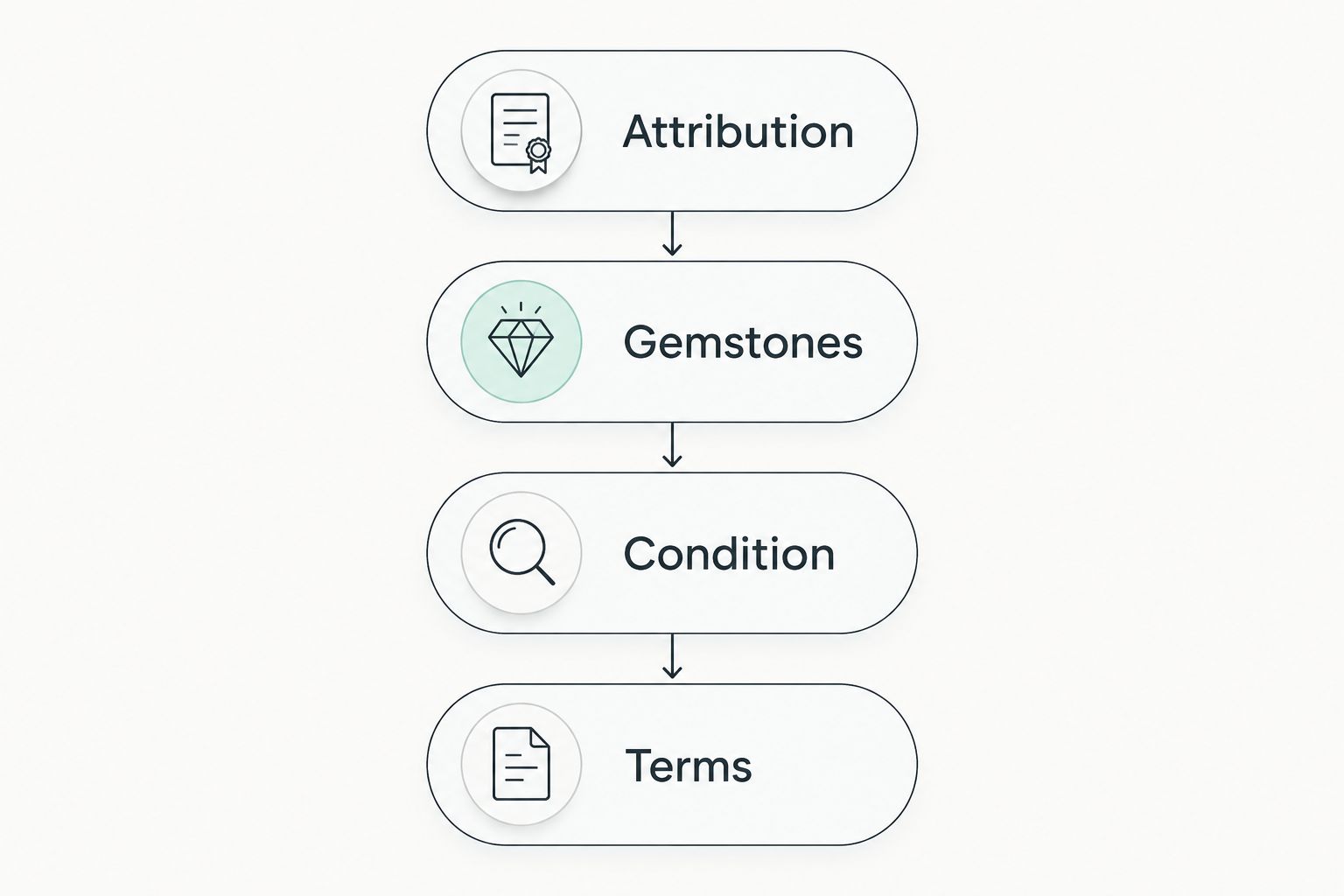
A Harry Winston purchase has several separate evidence questions. Keep them separate so a strong answer about one feature does not conceal an unanswered question about another.
Attribution
Ask what supports the maker attribution. Request clear photographs of signatures, hallmarks, and identifying marks, together with the auctioneer's explanation of the catalog wording.
A signature photograph is evidence to investigate, not a complete authentication. Your question is whether the whole piece is attributed to the maker and whether alterations change that assessment.
Gemstones
A diamond's carat weight measures mass: 1 carat equals 200 milligrams. It does not identify the jewelry maker or establish that the stone remains in its original setting.
Likewise, an 18-karat gold designation corresponds to 75% gold by mass; it describes fineness, not Harry Winston authorship. Separate material facts from maker claims when reading the entry.
Condition
Ask about loose settings, damaged prongs, clasp wear, solder repairs, resizing, and replacement stones. Request photographs of the underside and mechanical parts, not only the presentation view.
Use the guide to getting a condition report before bidding to organize your questions. Keep written answers with the catalog entry so you can identify exactly what remains unresolved.
Terms
Read the terms governing attribution, condition statements, and claims. Ask the auctioneer to identify the relevant provision if the wording is unclear; do not treat a general reassurance as a replacement for the written agreement.
An unanswered question should change your decision. Do not let a closing deadline turn missing evidence into an acceptable assumption. The same rule applies to every auction house in the table.
How we ranked these auction starting points
The ranking assigns each house a distinct research role using the criteria above: attribution, condition, gemstone documentation, comparable records, inspection, and terms. It does not claim hands-on testing or rank customer service.
Christie's is the default starting point; Sotheby's is the comparison route; Bonhams is the wear-focused route; Doyle adds a US estate-research perspective. The ranking stops where the individual catalog entry begins.
Jewelryroom.com is a jewelry-auction business, but a venue-level recommendation for Harry Winston requires lot-level evidence. Apply that requirement consistently rather than inserting a seller into the ranking solely because it hosts this guide.
Which Harry Winston auction should you choose?
Start with Christie's, then compare the specific piece—not merely the auctioneer—with other relevant records. Choose Sotheby's for historical comparison work, Bonhams for a wear-focused search, and Doyle for US estate-jewelry research.
Your final 2026 decision should pass the same test at every venue: clear attribution, useful condition disclosure, relevant gemstone documentation, and understood terms. If any required answer remains unclear, wait.
Jewelryroom.com jewelry-auction research should follow that same discipline. A carefully documented piece fits your decision better than a famous name attached to an incomplete listing.
FAQ
What's the best auction house to start with for Harry Winston jewelry?
Christie's is this guide's default research starting point for Harry Winston jewelry. Compare the specific lot's attribution, condition report, documents, and terms before deciding to bid.
Is Sotheby's better than Christie's for Harry Winston jewelry?
Neither house name makes every Harry Winston lot the better choice. This guide recommends Christie's for an initial search and Sotheby's for historical comparisons; the individual lot's evidence decides the purchase.
Does a Harry Winston signature prove a jewel is authentic?
A signature alone does not settle the attribution of the entire jewel. Ask what supports the maker attribution and whether repairs, replaced stones, or altered components affect it.
Does a gemstone laboratory report authenticate Harry Winston jewelry?
A gemstone report does not by itself establish Harry Winston maker attribution. Read the report's scope and match it to the stone, then investigate the jewelry attribution separately.
What should I ask before bidding on Harry Winston earrings?
Ask about maker attribution, matching components, backs or clips, repairs, and replaced stones. Request detailed photographs and a written condition report before deciding.
Can I use an old auction listing to authenticate a similar piece?
An old auction listing cannot authenticate a different piece. Use it to identify comparable characteristics and questions, then obtain evidence for the jewel you intend to buy.
Should I bid if the condition report hasn't arrived?
Wait if the missing condition report leaves questions you need answered. A closing deadline does not establish condition, attribution, or the suitability of the piece.
One last thing
Ask whether the paperwork belongs to the jewel, not simply whether paperwork exists. Compare identifiers, descriptions, measurements, and photographs wherever the documents provide them.
Before your final 2026 bid, write down the exact claim you are relying on and the document that supports it. If you cannot connect the two, you have found the reason to stop.


