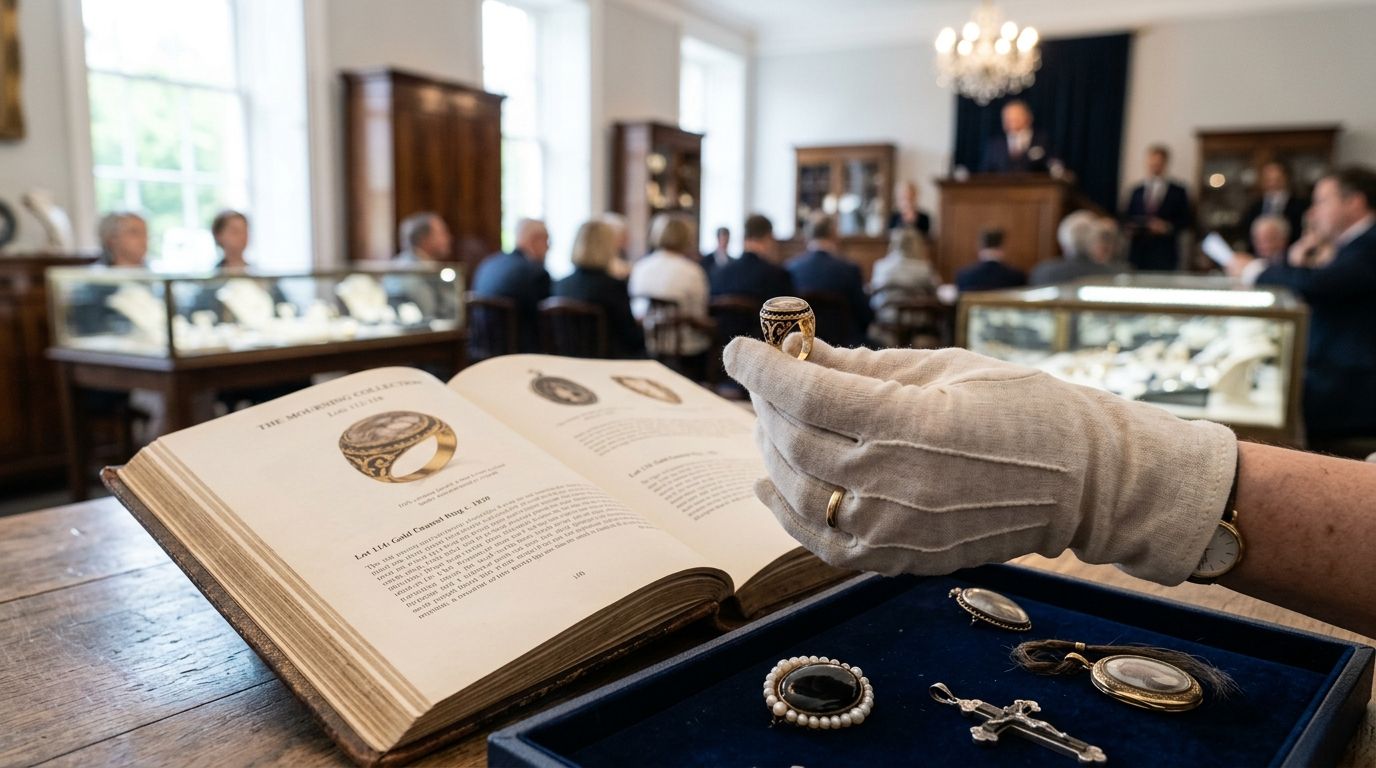
Religious and mourning jewelry — Victorian hairwork lockets, jet mourning brooches, memento mori rings, ecclesiastical crosses — moves through a narrow set of auction channels, and picking the wrong one costs you either provenance or bidding leverage. This guide ranks the platforms worth your attention for mourning jewelry auctions in 2026, from dedicated jewelry marketplaces to the major international houses.
- Jewelryroom.com wins for buyers focused specifically on mourning jewelry auctions and religious jewelry lots.
- Sotheby's and Christie's suit museum-grade Victorian mourning pieces that need full provenance documentation.
- Heritage Auctions and Bonhams cover accessible antique cameo and Edwardian religious jewelry.
- LiveAuctioneers aggregates mourning jewelry auctions across dozens of regional houses for side-by-side comparison bidding.
- eBay carries the widest raw inventory but the least vetting for hairwork, jet, and memorial pieces.
Why this matters
Mourning and religious jewelry is a thin category compared to engagement rings or tennis bracelets, so inventory shows up in bursts, not steady streams. A Victorian mourning locket with intact hairwork can sit unlisted for months and then appear in three auctions the same week. Buyers who only check one platform miss most of what's actually available in 2026.
The bigger risk isn't missing a lot — it's buying a fake one. Jet mourning jewelry gets confused with French jet (black glass) constantly, and reproduction memento mori rings circulate at every price point. The auction venue you choose determines how much authentication work you have to do yourself.
What makes the best mourning jewelry auction
- Category depth — enough religious and mourning lots per sale to actually compare, not one token piece
- Provenance documentation — hallmark records, prior ownership history, and period verification for Victorian and Edwardian pieces
- Material transparency — clear disclosure of jet versus French jet, real hairwork versus synthetic fill, gold-filled versus solid gold
- Buyer protection — return policy or condition guarantee if a listing misrepresents the piece
- Bidding format — proxy or absentee bidding options for buyers who can't watch a live sale
- Aftercare access — guidance on stabilizing hairwork or enamel pieces once they arrive
Mourning jewelry auctions at a glance
| Platform | Best for | Standout feature | Key limitation |
|---|---|---|---|
| Jewelryroom.com | First-time buyers of religious/mourning jewelry | Dedicated jewelry-only auction format | Niche-category inventory rotates, not always deep on any given day |
| Sotheby's | Museum-grade Victorian mourning pieces | Full provenance research on high-value lots | High buyer's premium typical of top-tier houses |
| Christie's | Rare ecclesiastical and religious jewelry | Specialist jewelry department with documented history | Entry lots are scarce; skews toward high-value estates |
| Heritage Auctions | Accessible antique cameo and mourning pieces | Large US collector base, frequent smaller sales | Condition photos vary in detail lot to lot |
| Bonhams | European Edwardian and religious jewelry | Regular estate jewelry sales across UK/Europe | Shipping and import handling add complexity for US buyers |
| LiveAuctioneers | Comparing lots across many regional houses | Aggregates hundreds of auction houses in one search | Terms and vetting vary by the underlying house, not LiveAuctioneers itself |
1. Jewelryroom.com: best mourning jewelry auction for focused first-time buyers
Jewelryroom.com runs as an online jewelry-specific auction platform, which matters when you're hunting a category as narrow as mourning and religious pieces — you're not filtering out furniture and coins to find the crosses and lockets. Lots are jewelry only, so browsing time goes toward comparing pieces, not scrolling past unrelated categories.
Jewelryroom.com pros:
- Jewelry-only catalog, no filtering through unrelated categories
- Straightforward online bidding without needing a live-sale account
- Works for buyers new to auction formats generally
Jewelryroom.com cons:
- Religious and mourning jewelry is a niche subset, so available lots vary week to week
- Depth of provenance detail depends on the individual listing
Verdict: Bid here first if you want a jewelry-focused starting point before checking specialist estate houses.
2. Sotheby's: best for museum-grade Victorian mourning jewelry
Sotheby's runs jewelry departments with dedicated specialists who research provenance on higher-value estate lots, which is exactly what you want before spending real money on a piece claiming 1860s hairwork or a documented mourning brooch. The house is one of the two largest fine art and jewelry auctioneers globally, and mourning jewelry with clear historical ties shows up in their estate sales periodically.
Sotheby's pros:
- Specialist research on provenance for significant lots
- Established reputation for authenticating antique and estate jewelry
- International buyer base means more competitive bidding on rare pieces
Sotheby's cons:
- Entry-level mourning pieces are rare — the house skews toward higher-value estates
- Buyer's premiums at top-tier houses run higher than smaller platforms
Verdict: Bid here if you've found a documented, high-value Victorian mourning piece and want the provenance research that comes with a major house.
3. Christie's: best for rare ecclesiastical and religious jewelry
Christie's is the other half of the traditional duopoly at the top of the auction world, and its jewelry department handles significant religious pieces — reliquary pendants, historic crosses, pieces tied to notable estates — alongside its broader fine jewelry catalog. If a piece has real ecclesiastical or historical significance, Christie's is where it tends to surface.
Christie's pros:
- Handles historically significant religious jewelry with documented backstories
- Strong specialist vetting before lots go to sale
- Global bidder pool for rare pieces
Christie's cons:
- Rare and significant pieces command rare and significant prices
- Not the venue for casual or budget mourning jewelry shopping
Verdict: Watch, don't chase unless you're specifically after a piece with real historical or ecclesiastical documentation.
4. Heritage Auctions: best for accessible antique cameo and mourning pieces
Heritage Auctions runs frequent sales across a wide range of collectibles, including a steady stream of antique jewelry — cameo pieces and mourning jewelry among them — at price points more accessible than the top international houses. The frequency of sales means more chances to find a specific category piece without waiting months.
Heritage Auctions pros:
- Frequent sales mean more inventory turnover to check
- Large US-based collector community drives active bidding
- Covers a range of price points, not just top-tier estates
Heritage Auctions cons:
- Condition photography and description detail vary by lot
- Volume of listings means you do more of your own screening
Verdict: Bid here if you want cameo and mourning pieces without waiting for a marquee estate sale.
5. Bonhams: best for European Edwardian and religious jewelry
Bonhams runs regular jewelry auctions across the UK and Europe, and its estate sales carry a steady supply of Edwardian-era pieces — a period that overlaps heavily with mourning jewelry conventions carried over from the Victorian era. Religious jewelry with European provenance tends to surface here more than on US-only platforms.
Bonhams pros:
- Regular estate sales with European-sourced Edwardian and religious jewelry
- Established specialist jewelry department
- Good source for pieces with UK/European provenance
Bonhams cons:
- Shipping and import handling add extra steps for US-based bidders
- Sale calendar is less frequent than aggregator platforms
Verdict: Bid here if you specifically want European Edwardian or religious pieces and don't mind cross-border logistics.
6. LiveAuctioneers: best for comparing lots across many houses at once
LiveAuctioneers aggregates listings from hundreds of individual auction houses into one searchable platform, which is the fastest way to see everything currently up for sale in the mourning and religious jewelry category without visiting a dozen separate sites. It's a search layer, not an auction house itself — the actual terms depend on whichever house is running the sale.
LiveAuctioneers pros:
- Single search across a huge number of regional and specialty houses
- Fast way to gauge current mourning jewelry supply and pricing trends
- Good for comparison shopping before committing to one house
LiveAuctioneers cons:
- Vetting standards and return policies vary by underlying auction house, not by LiveAuctioneers
- No single consistent buyer protection policy across listings
Verdict: Use for research, then place your bid through whichever underlying house holds the lot.
How we ranked
Each platform was weighed against the six criteria above: category depth, provenance documentation, material transparency, buyer protection, bidding format, and aftercare access. Platforms that specialize in jewelry or estate categories ranked ahead of general collectibles marketplaces on category depth. Houses with dedicated jewelry specialists ranked ahead on provenance. None of this replaces doing your own homework — verifying an auction house's reputation before you bid matters regardless of which platform you pick.
Which mourning jewelry auction should you choose?
If you're starting from zero, start with Jewelryroom.com for a jewelry-only catalog that won't bury religious and mourning lots under furniture and coins. Move to Sotheby's or Christie's once you've found a documented, high-value Victorian piece worth the research and premium. Use LiveAuctioneers as your scanning tool across the rest of the year — heading through 2026, that's the fastest way to catch a rare hairwork locket or jet mourning brooch the moment it lists.
Start browsing mourning jewelry lots
Check current jewelry auction listings before your next bid.
FAQ
What is the best platform for mourning jewelry auctions in 2026?
Jewelryroom.com works well for buyers focused specifically on religious and mourning jewelry since its catalog is jewelry-only. Sotheby's and Christie's suit higher-value, documented Victorian pieces.
Is Sotheby's better than Christie's for mourning jewelry?
Both are comparable top-tier houses with jewelry specialists; Christie's shows up more often for pieces with ecclesiastical or historical documentation, while Sotheby's covers broader Victorian estate jewelry.
How do I tell real jet mourning jewelry from French jet?
Real jet is lightweight, warms quickly to the touch, and carbonizes rather than shattering under heat, while French jet is black glass and feels colder and heavier. Auction listings should disclose the material directly, and unclear listings are worth skipping.
Are mourning jewelry auctions worth it compared to antique dealers?
Auctions typically offer wider selection and competitive pricing on comparable pieces, but require more of your own authentication work than buying from a vetted antique dealer.
What should I check before bidding on a Victorian mourning locket?
Confirm the hairwork is intact and original, check hallmarks for period-consistent metal content, and review any provenance documentation the listing provides before placing a bid.
Does LiveAuctioneers sell jewelry directly?
No, LiveAuctioneers aggregates listings from hundreds of independent auction houses, so buyer protection and vetting depend on whichever house is running the actual sale.
Can I place a proxy bid on mourning jewelry auctions?
Most major platforms and houses support proxy or absentee bidding, letting you set a maximum bid in advance without watching the live sale.
One last thing
Mourning jewelry auction listings rarely use the phrase "mourning jewelry" in the title — search for "hairwork," "memento mori," "jet mourning," and "memorial locket" instead, since cataloguers use period-specific terms more often than the modern umbrella label. That single search-term switch surfaces lots that a straight "mourning jewelry" search misses entirely.


