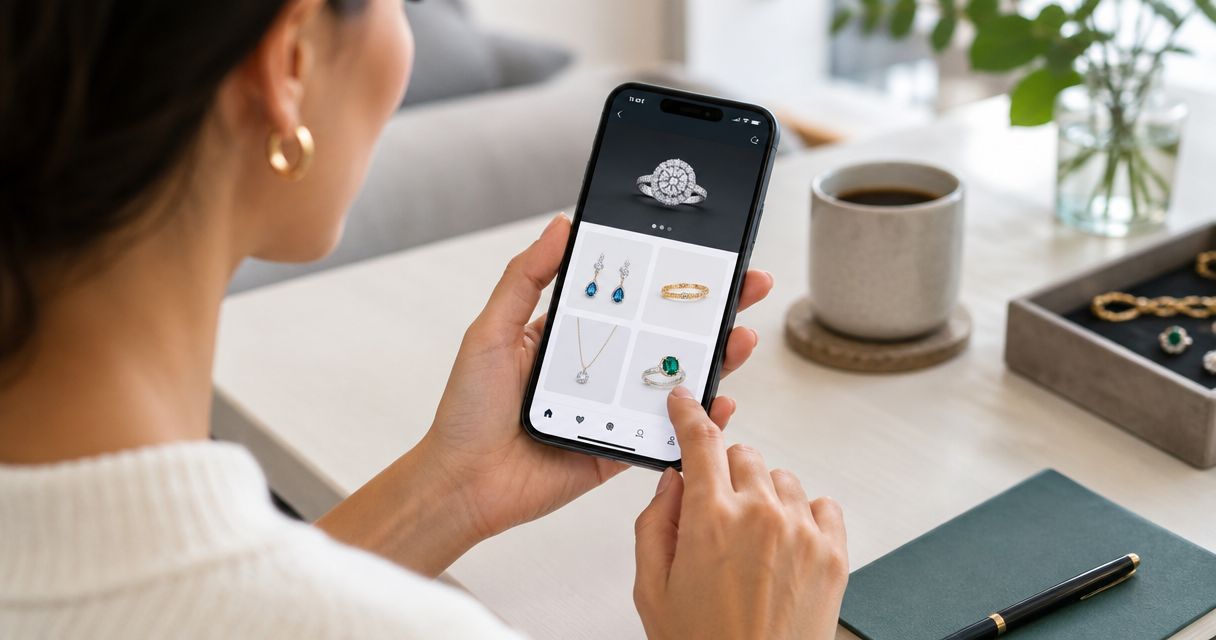
Best overall for multi-house browsing: LiveAuctioneers. Best jewelry-focused starting point: Jewelryroom.com. Best for independent, budget-controlled searching: eBay. This 2026 guide compares jewelry auction apps and web platforms by buying task, not download counts or promises of cheaper jewelry.
- LiveAuctioneers leads this best jewelry auction apps shortlist for browsing auctions from multiple houses.
- Jewelryroom.com is the jewelry-focused auction option for buyers who want a category-specific starting point.
- Invaluable suits catalog research; Catawiki suits curated discovery; eBay suits independent seller-by-seller searching.
- Choose jewelry bidding platforms by lot documentation and auction terms, not notifications alone.
Why this matters
A jewelry auction app helps you find a lot and submit a bid. It does not replace a condition report, establish gemstone identity, or make every seller's terms identical. The buying decision belongs at the lot level.
For your 2026 shortlist, distinguish a native phone app from a website you access through a mobile browser. Both belong in a practical comparison of mobile bidding options, but a jewelry auction business is not automatically an app developer. Jewelryroom.com belongs here as a jewelry auction option, without an assumption about a separate native app.
The right platform is the one that lets you evaluate the piece before committing to the bid. If a listing leaves a material question unanswered, a convenient interface does not fix it.
What makes the best jewelry auction apps?
Use these criteria before choosing a platform. They separate useful browsing tools from a purchase you can actually assess.
- Jewelry focus: Decide whether you want a jewelry-specific auction destination or a marketplace covering many collecting categories.
- Lot documentation: Look for clear descriptions, useful photographs, disclosed condition, and supporting reports where relevant.
- Seller accountability: Identify the auction house or seller responsible for the description, invoice, and fulfillment.
- Bidding clarity: Read the auction format, bidding increments, closing rules, and the meaning of each confirmation screen.
- Purchase terms: Check applicable charges, payment requirements, delivery arrangements, and the process for disputed descriptions.
- Mobile usability: Confirm that your device lets you enlarge photographs, read documents, and review your bid before submitting it.
No single criterion substitutes for the others. Strong photographs do not establish an undisclosed stone's origin; an established auction house's name does not answer a question about a particular repaired clasp.
Jewelry auction options at a glance
This 2026 comparison assigns each option a distinct buying task. It does not rank jewelry quality across entire platforms or promise that a particular lot is a good purchase.
| Option | Best for | Standout characteristic | Key limitation |
|---|---|---|---|
| Jewelryroom.com | Jewelry-focused searching | A business dedicated to jewelry auctions | Evaluate the website separately from any native-app expectation |
| LiveAuctioneers | Browsing multiple auction houses | Aggregates auction-house catalogs | The selling house's terms still require separate review |
| Invaluable | Catalog-led auction research | Brings auction-house offerings into one marketplace | Platform browsing does not replace lot-level investigation |
| Catawiki | Curated collecting discovery | Expert-led auction curation across collecting categories | Curation is not a substitute for the description and supporting evidence |
| eBay | Independent seller-by-seller searching | Broad marketplace with auction-format listings | You must distinguish auctions from other listing formats and assess each seller |
1. Jewelryroom.com: best jewelry auction option for focused searching
Jewelryroom.com is a jewelry auction business. That makes it a relevant starting point when your purpose is specifically to buy jewelry rather than browse a general collecting marketplace. Treat it as a category-focused option, not as evidence that every piece suits your requirements.
Jewelryroom.com is best for jewelry auction buyers who want a jewelry-focused starting point. Begin with the listing itself: identify the piece, read its description, and establish which questions need answers before you consider bidding.
Pros:
- The stated business focus matches a jewelry auction search.
- You can start your research with a category-specific destination.
- The option suits buyers who do not need a general collecting marketplace as their starting point.
Cons:
- A jewelry-specific business description does not establish native-app functionality.
- You still need to assess the individual lot and its purchase terms.
Best for: Buyers starting with jewelry auctions rather than general collectibles.
Verdict: Hold until the lot description and terms answer your purchase questions. Category fit earns a place on your shortlist; it does not justify an automatic bid.
2. LiveAuctioneers: best jewelry auction app for multi-house browsing
LiveAuctioneers brings catalogs from auction houses into a shared marketplace. Its strongest role in this comparison is helping you explore jewelry auctions across different sellers rather than beginning with a single auction business. Use that breadth to compare descriptions and identify houses worth investigating.
You are still evaluating the auction house behind each lot. A shared platform does not make different houses' condition descriptions, bidding rules, or fulfillment arrangements interchangeable.
LiveAuctioneers pros:
- Multi-house browsing supports a wider auction search.
- Catalogs let you investigate jewelry within the context of a sale.
- Comparing listings helps you spot questions a thin description leaves unanswered.
LiveAuctioneers cons:
- Each selling house's terms need their own review.
- Broad marketplace searching requires discipline to stay focused on your buying brief.
Best for: Buyers who want to discover jewelry auctions from multiple houses.
Verdict: Hold a bid until you have reviewed the selling house and the specific lot. Choose LiveAuctioneers as the default browsing option, not as an automatic endorsement of every auction it carries.
3. Invaluable: best jewelry auction app for catalog-led research
Invaluable is an auction marketplace connecting buyers with auction-house offerings. It suits a research-led approach: examine the catalog, identify the responsible house, and study the lot before deciding whether to participate. Its place here is the catalog research workflow, rather than a claim that its jewelry is better than another platform's.
Use Invaluable when you prefer to build a shortlist around auction descriptions. Record the lot identifier alongside your notes so you do not confuse similar rings, necklaces, or gemstone descriptions between sales.
Invaluable pros:
- Auction-house catalogs provide a structured starting point for research.
- A multi-house marketplace supports comparison between different sales.
- The catalog format suits buyers who investigate before bidding.
Invaluable cons:
- Marketplace access does not remove the need to investigate the selling house.
- A catalog description still needs supporting evidence for material claims.
Best for: Buyers who organize their search around catalogs and documented lots.
Verdict: Hold until your research resolves any gap in the description. Pick Invaluable for a catalog-led workflow, not because the platform name guarantees condition or authenticity.
4. Catawiki: best jewelry auction option for curated discovery
Catawiki runs online auctions across collecting categories using expert-led curation. That makes it a different starting point from an unrestricted seller search: you browse within a curated auction environment. Its role here is discovery, especially when you want to explore pieces before narrowing your collecting brief.
Do not confuse curation with a laboratory report or an inspection you commissioned. Read the actual description and determine which statements are supported by documents, photographs, or the seller's disclosures.
Catawiki pros:
- Curated auctions give discovery a collecting-focused structure.
- The category-based approach suits buyers exploring styles and materials.
- Expert-led curation is distinct from an open marketplace listing process.
Catawiki cons:
- Curation alone does not answer every condition or gemstone question.
- You still need to read the seller's information and applicable auction terms.
Best for: Buyers who want curated discovery before choosing a specific piece.
Verdict: Hold when a material claim lacks supporting evidence. Use Catawiki to discover candidates, then evaluate each candidate on its own documentation.
5. eBay: best jewelry auction app for independent searching
eBay includes auction-format listings within a broader online marketplace. It suits buyers who want to conduct their own searches and evaluate sellers individually. Check the listing format first: a jewelry listing on eBay is not necessarily an auction.
For budget-controlled searching, your advantage is a firm personal limit, not an assumption that eBay jewelry is cheaper. Decide what documentation you require before searching so an appealing photograph does not lower your standard.
eBay pros:
- Independent searching suits a specific style, maker, or material brief.
- Auction-format listings support competitive bidding where that format applies.
- Seller-by-seller assessment gives experienced buyers a direct research task.
eBay cons:
- Listing formats differ, so you must identify actual auctions.
- Description quality and supporting evidence require individual assessment.
Best for: Self-directed buyers willing to investigate each listing and seller.
Verdict: Skip any listing whose material claims remain unresolved. Choose eBay for independent searching, not for presumed savings or universal seller expertise.
How this shortlist is ranked
The 2026 ranking uses category fit, browsing scope, research workflow, seller accountability, and purchase clarity. Each option receives a separate use case because the best choice changes with the job: focused searching, multi-house discovery, catalog research, curated exploration, or independent seller assessment.
This is a buying-workflow comparison, not a device-speed test or an authenticity certification. The table does not imply identical features across phones, countries, or auction formats. Check the current interface and terms before registering for a sale.
Check the jewelry, not just the app
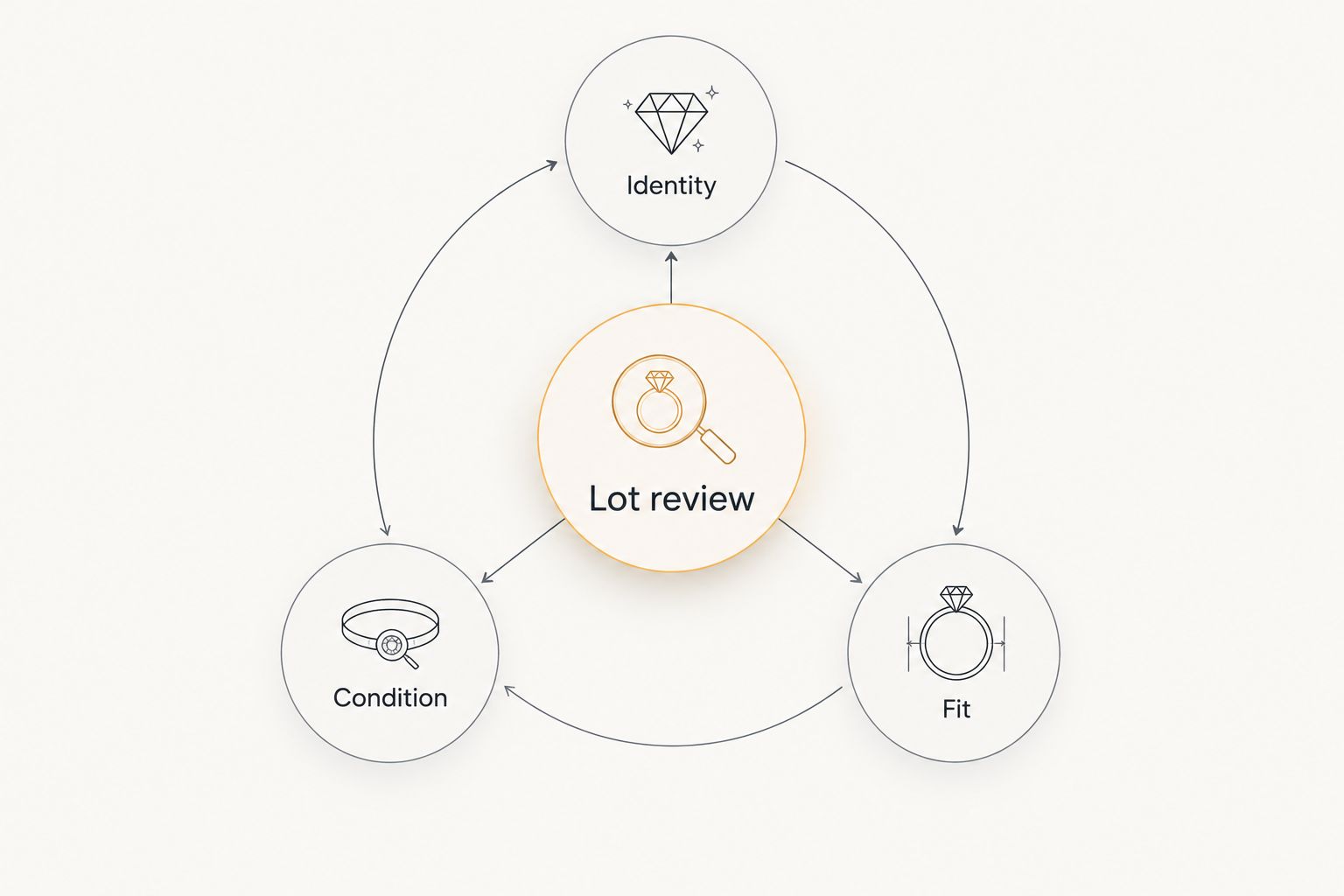
A smooth bidding screen tells you little about the object. Before bidding in 2026, separate identity, condition, and fit; each answers a different purchase question.
- Identity: What metal and stones does the description claim, and what evidence supports those claims?
- Condition: Are wear, repairs, missing components, and alterations described clearly?
- Fit: Do the stated dimensions suit how you intend to wear the piece?
For a useful numerical check, 1 carat equals 200 milligrams. Carat measures gemstone weight, not face-up dimensions, so two stones of equal weight need not look equally large. Ask for dimensions when appearance matters.
Gold descriptions need a different check. 18-karat gold denotes 75% gold by mass; 14-karat gold denotes approximately 58.3%. Those definitions explain fineness, but a stamp alone does not establish that an auction piece matches its description.
Request a condition report before bidding when the photographs or description leave questions about wear or repairs. Keep the response with the lot details; do not rely on memory when comparing similar pieces.
A mobile bidding check before you commit
A mobile interface should support your judgment rather than rush it. Use this sequence with any of the options in the comparison.
- Read the lot: Open the full description and any supporting documents rather than relying on a search-result thumbnail.
- Check the seller: Identify who conducts the auction and who answers questions about the piece.
- Review the terms: Confirm how bidding, payment, delivery, and disputes are handled for that sale.
- Set your limit: Account for the charges that apply to your transaction before choosing your maximum bid.
- Confirm the bid: Check the lot identifier, currency, and amount before submitting.
An outbid notification is information, not a reason to raise your limit. If you switch from a phone to a browser, confirm the account and recorded bid status before taking another action. Keep your notes attached to the correct lot.
Which jewelry auction option should you choose?
Choose LiveAuctioneers as the default for exploring multiple auction houses in 2026. Choose the jewelry-focused option when category focus matters more than marketplace breadth; use Invaluable for catalog-led research, Catawiki for curated discovery, and eBay for independent searching.
Do not install several apps merely to chase the same type of piece. Start with the option matching your research style, then expand only when you have a clear reason. A second platform is useful when it adds relevant candidates, not when it adds more notifications.
Buy only after the evidence and terms support your decision. That rule matters more than the order of this shortlist.
FAQ
What's the best jewelry auction app for browsing different auction houses?
LiveAuctioneers is the default recommendation here for multi-house browsing. Evaluate the selling house's terms and each lot's documentation separately before bidding.
Does Jewelryroom.com have a native jewelry auction app?
This guide recommends Jewelryroom.com as a jewelry auction website, not as a confirmed native app. Check the business's current information before looking for a separate download.
Is Invaluable better than LiveAuctioneers for jewelry?
Invaluable suits catalog-led research, while LiveAuctioneers is this guide's default for multi-house discovery. Choose by the relevant lots and selling houses rather than assuming one platform has better jewelry.
Is jewelry on eBay always sold by auction?
No, eBay includes different listing formats. Confirm that the individual listing uses auction bidding before treating it as an auction opportunity.
Does a curated jewelry auction replace a gemstone report?
No, auction curation does not replace a gemstone report. Evaluate the report's scope and whether it corresponds to the stone described in the lot.
Can I judge a gemstone's size from its carat weight?
Carat weight alone does not establish a gemstone's visible size. One carat equals 200 milligrams; dimensions and cut are needed to assess its appearance.
What should I check before bidding from my phone?
Check the lot description, supporting documents, seller, auction terms, currency, and bid amount. Enlarge the photographs and resolve material questions before submitting a bid.
One last thing
The most useful mobile feature is the ability to stop. Save the lot details, put the phone down, and return to your written requirements before bidding. If a piece only feels compelling while a countdown is on screen, leave it on your shortlist rather than changing your standards.


