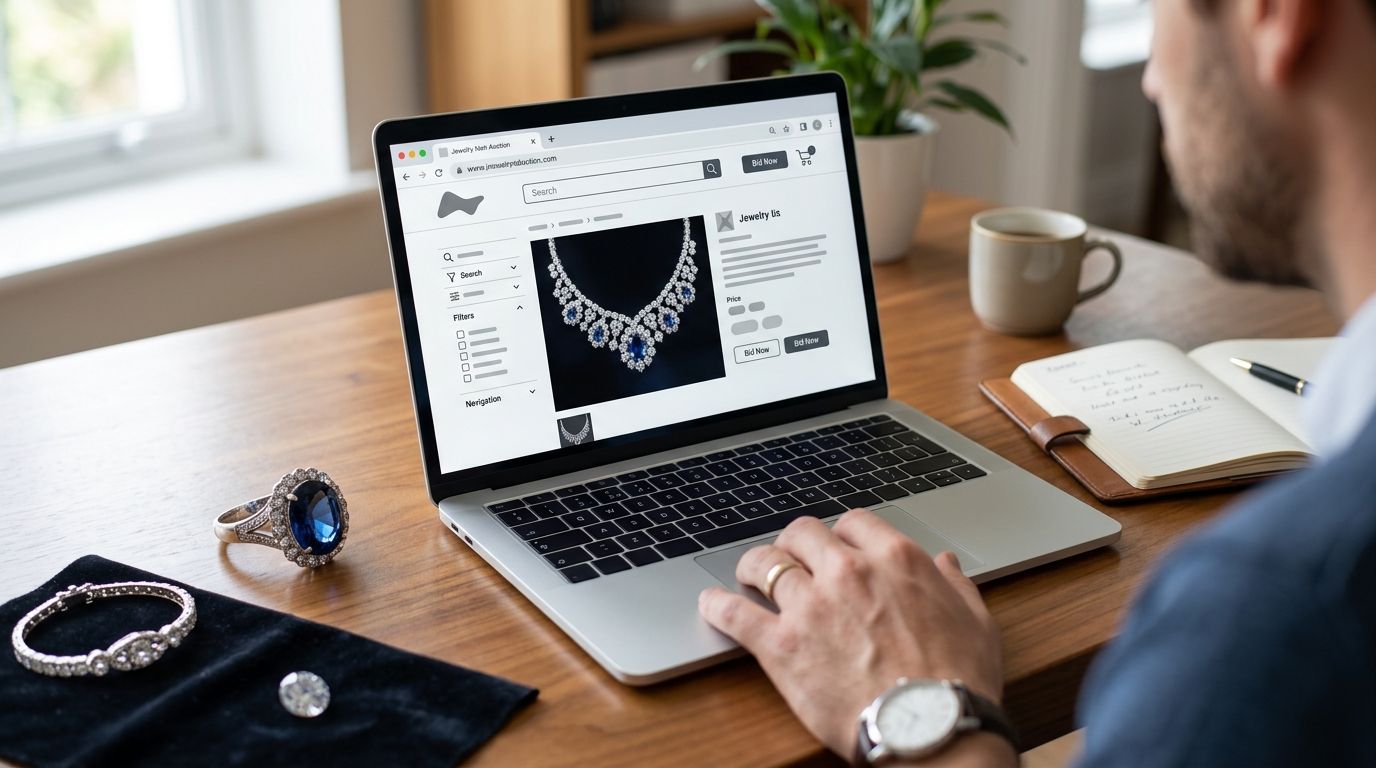
Avoiding jewelry auction scams comes down to three checks: verify the auction house's track record, confirm gemstone certification through the lab that issued it, and pay only through the platform's official invoice — never by wire transfer to a personal account. Skip any one of those three and you're bidding blind in 2026's crowded field of online jewelry auctions, where legitimate houses sit next to cloned sites built to look identical.
- Avoid jewelry auction scams by checking auction house history, certification, and payment method before you bid in 2026.
- Fake or altered gemstone certificates are the most common red flag in online jewelry auction complaints.
- Legitimate auction houses never ask for wire transfers to a personal bank account or a crypto wallet.
- A condition report and provenance history should exist for every high-value lot before you place a bid.
- Jewelryroom.com publishes condition-report and certification steps buyers can check before bidding on a lot.
Why this matters
Online jewelry auctions grew fast after 2023, and fraud grew with them because buyers can't hold the piece, weigh the stone, or check the hallmark in person before money changes hands. A ring or necklace is a high-value, easy-to-misrepresent item — a single retouched photo or forged certificate turns a cheap synthetic into a listing described as a mined diamond.
Once a wire transfer or crypto payment clears, it's gone. That's the mechanic every jewelry auction scam in 2026 is built around: get you to skip verification, then get you to pay in a way you can't reverse. The fix isn't complicated, but it has to happen before you bid, not after the invoice arrives.
Jewelryroom.com's jewelry auctions list condition and certification details inside the listing itself, which is the baseline every legitimate auction site should meet.
How to avoid jewelry auction scams
Run this six-step check before you place a bid on any jewelry auction listing:
- Verify the auction house's reputation — look for a business address, a licensing or bonding statement, and a history of completed sales, not just a polished website.
- Demand a condition report before bidding on any significant lot — a real auction house has photos and physical notes on wear, repairs, and stone setting.
- Cross-check the gemstone certificate against the issuing lab directly — GIA, AGS, and IGI each let you look up a report number independently of the seller's listing.
- Confirm payment routes through the platform's official invoice — a legitimate house bills you through its own system, not a personal email asking for a wire.
- Research provenance on antique or estate pieces — a vague "from a private European collection" with no paperwork is a gap, not a selling point.
- Read the full cost before bidding, including the buyer's premium, so the invoice total isn't a surprise that pressures you into a rushed payment.
Run the verify an auction house's reputation checklist before bidding with a house you haven't used before. That single step catches most jewelry auction scams before money moves.
Fake gemstone certification: the most common scam
A forged or mismatched certificate is the most reported problem in online jewelry auction complaints, and it's also the easiest to check. Every major gemological lab — GIA, AGS, IGI — publishes a report lookup where you enter the number and pull up the original findings independent of the seller.
If the seller can't produce a report number, or the number doesn't match the stone description when you look it up, that lot is a skip, not a bid. Watch for the softer version too: a real certificate for a different stone, attached to a listing photo of something else entirely.
Shill bidding and inflated reserves
Shill bidding is a seller (or an associate) bidding on their own lot to push the price up. It's harder to spot than a fake certificate because it looks like ordinary competition. Watch for accounts with no bidding history anywhere else on the platform, bids placed seconds apart in the closing minutes, and reserves that move right after a new account appears.
Set your maximum before the lot opens and do not raise it mid-auction. A proxy bid enforces that limit for you and removes the emotional pressure shill bidding is designed to create.
Payment fraud: wire transfers and fake invoices
This is where most jewelry auction scams cash out. A scammer sends an invoice that looks identical to the platform's real one, but with a different bank account or a request to pay by wire, gift card, or crypto. A legitimate auction house never needs you to leave its own payment system to complete a purchase.
If an invoice email asks for anything outside the platform, contact the auction house directly using a phone number or address you found independently — never the one in the suspicious email.
“If a seller asks for payment outside the auction platform's official invoice, that is not a shortcut. It is the scam.”
Non-delivery and item swaps after payment
The fourth pattern: you pay, and either nothing arrives or a lower-quality piece arrives in place of what you won. Documentation before the bid is what protects you here — a condition report with photos gives you something concrete to compare against what shows up at your door.
Keep the listing screenshots, the condition report, and your certificate lookup result until the item is in hand and matches. In 2026, that folder is the difference between a dispute you win and a story you tell.
Why jewelry auction scams keep working
- No physical inspection — buyers can't hold the piece or check the hallmark before bidding, so photos and paperwork do all the work.
- Cross-border anonymity — international bidding pools make it easy for a bad actor to disappear once payment clears.
- Emotional urgency — "one-of-a-kind" antique and estate framing pushes buyers past the verification step they'd normally take.
- Irreversible payment methods — wire transfers, crypto, and gift cards are difficult or impossible to claw back.
- Easy-to-forge documents — a certificate or provenance letter is a PDF; without an independent lookup, it's only a claim.
- Convincing clone sites — a phishing site copies a real auction house's layout, listings, and URL formatting almost exactly.
Check the auction house before you bid
Run the reputation and certification checks first, then bid.
Is it safe to buy jewelry from online auctions in 2026?
Buying jewelry from online auctions is safe when you verify the auction house, the certification, and the payment method before bidding — the risk isn't the format, it's skipping those three checks. The same due diligence an in-person estate sale buyer applies with a loupe, you apply online with documents and lab lookups.
How can I tell if a gemstone certificate is fake?
You can tell a gemstone certificate is fake by looking up the report number on the issuing lab's own website rather than trusting the PDF the seller sent. If the number doesn't exist, or the stone details in the lookup don't match the listing, the certificate is fabricated or belongs to a different stone. Learn the visual tells in the guide on spotting fake gemstones at online auctions.
What payment method is safest for auction jewelry?
The safest payment method for auction jewelry is the payment system built into the auction platform itself — a credit card or platform-processed invoice carries dispute and chargeback protection. Wire transfers, crypto, and gift cards carry none of that once the payment clears.
FAQ
How do I know if an online jewelry auction is legitimate?
An online jewelry auction is legitimate when it has a verifiable business address, published bidding history, and third-party gemstone certification on high-value lots. If any of those three are missing or unverifiable, treat the listing as unproven no matter how professional the site looks.
Is it safe to buy jewelry from online auction sites in 2026?
Buying jewelry from online auction sites in 2026 is safe when you confirm the auction house's reputation and pay through its official invoicing system rather than a personal account. The risk sits in skipped verification, not in the auction format itself.
How can I tell if a gemstone certificate is fake?
You can tell a gemstone certificate is fake by looking up the report number directly on the issuing lab's site, such as GIA or AGS, instead of trusting the document the seller provided. A nonexistent or mismatched report number means the certificate is fabricated or attached to a different stone.
What is the safest way to pay for auction jewelry?
The safest way to pay for auction jewelry is through the auction platform's own invoicing and payment system, which carries dispute protection. Wire transfers, crypto payments, and gift cards sent outside the platform are effectively unrecoverable if something goes wrong.
Should I trust an auction house with no buyer reviews?
Do not trust an auction house with no buyer reviews or bidding history on a high-value lot without independent verification first. Ask for references, check business registration, and start with a lower-value lot before committing to an expensive piece.
Can I get my money back if I am scammed on a jewelry auction site?
Recovering money after a jewelry auction scam depends almost entirely on the payment method used. Credit card and platform-processed payments carry dispute options, while wire transfers and crypto generally do not, which is why payment method matters more than any other single factor.
Do reputable jewelry auctions offer condition reports?
Reputable jewelry auctions offer condition reports on every significant lot, detailing wear, repairs, and setting condition with photographs. The absence of a condition report on a high-value estate or antique piece is itself a warning sign.
Is shill bidding illegal at jewelry auctions?
Shill bidding, where a seller bids on their own lot to inflate the price, is prohibited by legitimate auction platforms and treated as fraud in most US jurisdictions. Protect yourself by setting a maximum before the lot opens and refusing to raise it during the auction.
One last thing
The biggest tell in a jewelry auction scam isn't the price, the photos, or even the certificate — it's the payment method. If a seller or auction house pushes you off the platform to finish the sale with a personal wire, gift cards, or crypto, walk away no matter how legitimate everything else looks.
That one habit, applied every single time, blocks more jewelry auction scams in 2026 than any certificate lookup or reputation check does on its own. Certificates can be forged and reputations can be faked; an irreversible payment is the only part of the scam that has to happen.


