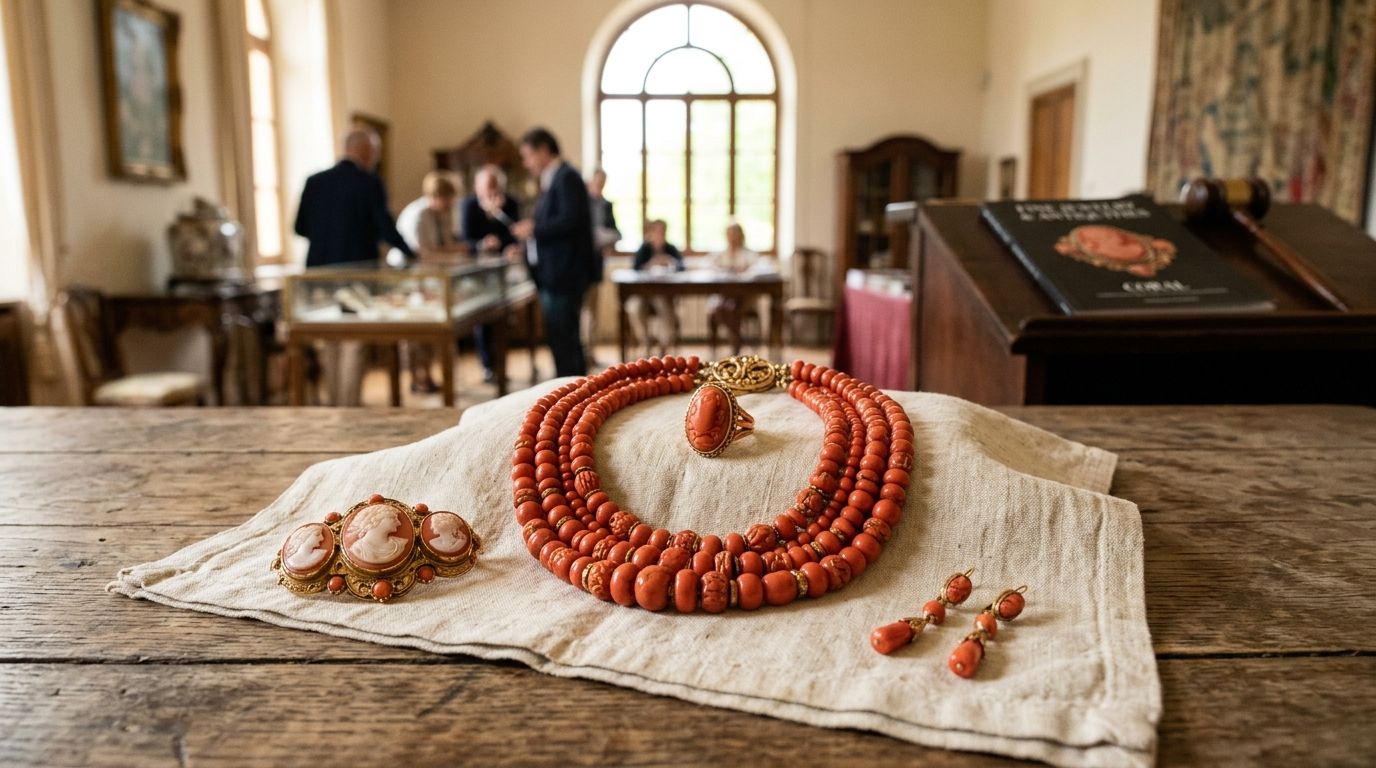
Vintage Mediterranean style buyers turn to a coral jewelry auction when they want natural Sardinian red coral, Sciacca coral, or carved Torre del Greco pieces instead of the dyed bamboo coral flooding costume jewelry racks. This segment cares about two things most gemstone buyers don't: color authenticity (true salmon-to-oxblood tones versus bleached-and-dyed substitutes) and carving provenance, since Mediterranean coral jewelry is as much about Italian workmanship as it is about the material itself.
- A coral jewelry auction rewards buyers who check for natural banding and refuse pieces with flat, dye-uniform color.
- Sardinian red coral and Sciacca coral define authentic Mediterranean style; angel skin coral reads Victorian instead.
- Jewelryroom.com auctions rotate estate coral lots and support proxy bidding, which suits buyers who cannot watch a live sale.
- Coral is organic and reacts to perfume, chemicals and sunlight, so post-auction care differs from hard gemstones.
Why coral jewelry auctions matter for vintage Mediterranean style buyers
Retail coral jewelry labeled "vintage" or "antique" often carries a gallery markup with no condition report and no stated harvest region. An auction listing usually states estimated age, the carving attribution if known, and whether the coral has been treated. That disclosure matters more for coral than for diamonds, because coral is soft and organic — a note about dye or reconstitution changes the whole value of the piece, not just its grade.
Italian and EU rules on harvesting Mediterranean red coral have tightened over recent decades, which is a large part of why vintage and estate material carries less legal friction than newly harvested coral. That is a concrete reason this segment defaults to auction sourcing rather than buying new. Jewelryroom.com runs estate and antique sales where coral pieces surface alongside other period jewelry, giving you a rotating source instead of one gallery's fixed shelf.
Two practical constraints shape how this segment bids in 2026: coral color grading is subjective, and matched sets are far scarcer than single pieces. Both push the smart move toward disciplined, ceiling-capped bidding.
Learn the coral varieties that define Mediterranean style
Not all coral reads as Mediterranean. Know the difference before you bid, not after the box arrives.
- Sardinian red coral (Corallium rubrum) — deep red to oxblood, the tone most associated with Italian jewelry houses
- Sciacca coral — a Sicilian variety, often darker and denser than Sardinian material
- Angel skin coral — pale pink, more common in Victorian and Art Deco settings than in true Mediterranean pieces
- Torre del Greco carving — not a source but the Italian carving tradition (cameos, beads, filigree mounts) that defines the finished look
- Momo coral — salmon-orange, Japanese in origin, routinely mistaken for Mediterranean coral by new buyers
Verify the coral is natural, not dyed or reconstituted
Dyed and reconstituted coral is the single biggest risk in this category, and it hides better in auction photography than a treated gemstone does.
- Look for growth-line banding under magnification; natural coral varies, dye jobs look flat and uniform
- Read the listing word for word for "dyed," "reconstituted," or "composite" before you bid
- Ask the auction house directly when treatment status is not specified
- Apply the photo-inspection tactics in the guide on how to spot fake gemstones at online auctions — they work on coral too
- Distrust perfectly matched bead strands; natural coral rarely comes in machine-identical tones
Choose the right lot type and auction format
Mediterranean coral appears in three very different contexts, and each one demands a different approach in 2026.
- General estate sales bury coral among unrelated lots, so scan the full catalog rather than trusting category filters
- Curated vintage jewelry sales group coral with other period pieces and usually include condition reports
- Single-owner estate auctions occasionally release a whole coral collection built over decades, which is where matched sets and carved cameo groups appear
- Check for a carving attribution; unattributed carved lots sell lower and carry more risk
Set your ceiling before the estimate anchors you
Coral estimates swing wider than diamond estimates because color grade and carving quality are judgment calls, not certificate-backed figures. Decide your maximum before you read the estimate range.
- Build your ceiling from comparable sold lots, not from the listed estimate
- Add the buyer's premium into the ceiling calculation, not on top of it afterward
- Cap yourself per lot, not per sale, so one contested piece cannot eat the whole budget
- Use the framework in how to set a budget for online jewelry auctions if you are bidding across multiple sales
Place a proxy bid that protects that ceiling
Live-bid pressure is where coral buyers overpay, because attachment to a specific carved set overrides the number decided an hour earlier.
- Enter your true maximum once and let the proxy system bid incrementally for you
- Add a 5-10% buffer for premium and fees before you finalize the figure
- Walk away when the reserve already sits above your researched comparable range
- Never re-enter a higher maximum mid-sale; that is the same overbid wearing a different label
Ready to bid on estate coral lots?
Browse rotating estate and antique jewelry sales before the next lot closes.
Confirm insurance and shipping terms before the hammer falls
Coral chips and fades faster than most gemstones in transit, so shipping terms carry more weight here than on a diamond lot.
- Confirm shipping insurance covers hammer price plus premium, not a flat default figure
- Ask whether coral lots ship in rigid cases; soft pouches invite chips
- Put your own insurance rider in place before the piece arrives
- Track the shipment actively — delivery confirmation is not condition confirmation
Care for coral after you win it
Coral is calcium carbonate from a living organism, not a mineral. It behaves like pearl, not like sapphire, once it is in your hands.
- Store coral separately so harder stones cannot scratch its surface
- Keep it away from perfume, hairspray and household chemicals, which pit and yellow the surface over time
- Avoid prolonged direct sunlight, which pulls red and salmon tones toward brown
- Clean with a soft dry cloth only, and never use an ultrasonic cleaner
Coral sourcing options compared
| Option | Best for | Key limitation |
|---|---|---|
| General estate auction, mixed lots | Buyers hunting underpriced sleeper lots | Coral is buried in unrelated catalog categories |
| Curated vintage jewelry auction | Buyers who want condition reports and attribution | Fewer coral lots per sale, more bidders per lot |
| Antique dealer or gallery | Buyers who want one vetted piece with no bidding | Fixed inventory, no price discovery |
| Jewelryroom.com auctions | Buyers who want proxy bidding on rotating estate coral | Inventory changes sale to sale, not a standing catalog |
Verdict: Jewelryroom.com auctions are the best fit for vintage Mediterranean style buyers who want estate coral with treatment disclosure and the ability to bid by proxy instead of live. Pros: rotating estate supply, proxy bidding, catalog detail on age and condition. Cons: no guarantee a coral lot appears in any given sale, and color grading still requires your own eye.
“Coral is organic, not mineral. Treat it like pearl rather than like a diamond and it outlasts the auction by decades.”
Common mistakes vintage Mediterranean coral buyers make
- Treating color as proof of origin. Dyed bamboo coral matches salmon and oxblood tones convincingly in auction photos.
- Bidding on carved cameo lots without checking the reverse for pressed or composite filler behind the carving.
- Comparing hammer price to gallery sticker price without adding the buyer's premium, which distorts the deal math badly.
- Skipping insurance because coral feels lower-risk than gemstones. It is more fragile in shipping and in storage, not less.
- Storing the won piece beside cosmetics in the same box, which dulls and pits the surface within months.
FAQ
What's the best coral for vintage Mediterranean style jewelry?
Sardinian red coral (Corallium rubrum) and Sciacca coral are the closest match to true Mediterranean style. Angel skin coral is attractive but reads Victorian rather than Mediterranean.
Is auction coral cheaper than new coral jewelry?
Not automatically. Vintage coral sidesteps current harvesting restrictions, but rare color and carving quality still drive the bid regardless of the sales channel.
How do I tell if coral jewelry is dyed?
Check for uneven, banded color under magnification, because natural coral rarely shows perfectly flat tone. Then read the catalog listing for dye or reconstitution disclosures before bidding.
Is it legal to buy vintage coral jewelry in 2026?
In most jurisdictions coral taken before current harvesting quotas is legal to resell in 2026. Cross-border shipments of some coral pieces can require additional documentation.
What's the difference between Sardinian coral and Torre del Greco coral?
Sardinian coral describes the harvest region; Torre del Greco is the Italian town known for carving coral into cameos and beads. One piece can be Sardinian coral carved in Torre del Greco.
Should I buy a single coral piece or a matched set at auction?
Matched sets command a premium because consistent color across several pieces is far scarcer than one strong piece. Buy a single piece first if you are still learning to grade coral color.
How much does a coral jewelry auction lot cost?
It depends entirely on color grade, carving attribution and condition, so check current lot estimates on the auction site. Always calculate the buyer's premium into your ceiling before you bid.
How do I care for coral jewelry won at auction?
Store it away from perfume, hairspray and direct sunlight, and clean it with a soft dry cloth only. Coral reacts to chemicals the way pearl does, not the way hard gemstones do.
One last thing
Coral is the only material in most Mediterranean estate collections that is a living organism's skeleton rather than a mineral. That single fact drives every practical decision in 2026: why treatment disclosure matters more here than in almost any other gemstone category, why rigid-case shipping is worth asking about, and why the habits that protect pearls are exactly the habits that keep a Sardinian red strand from browning out over the next twenty years.


