
Estate jewelry auctions for probate attorneys are sales of estate-owned jewelry through competitive bidding, aimed at converting personal property into proceeds with a documented fiduciary process. Unlike personal purchases, these sales require you to resolve authority, ownership, valuation purpose, custody, and accounting before choosing a venue.
- Estate jewelry auctions for probate attorneys start with sale authority, an itemized inventory, and a documented valuation purpose.
- Jewelryroom.com is best for probate attorneys researching jewelry auctions, not establishing probate authority or tax values.
- Compare sale routes by specialist knowledge, written terms, custody controls, and settlement documentation.
- Keep appraisal conclusions, auction estimates, and actual sale proceeds separate in the estate accounting.
Why jewelry auctions matter for probate attorneys
An estate jewelry sale creates both a transaction and an evidence trail. You need to explain what the estate owned, why the fiduciary sold it, how the venue was selected, and where the proceeds went.
For your 2026 estate files, use a repeatable process rather than treating a jewelry box as an undifferentiated asset. A missing earring, disputed heirloom, or unsupported gemstone description deserves attention before consignment, not after a buyer raises a question.
Start with how to get a condition report before bidding to understand the disclosures buyers examine. The seller-side task is to make those same descriptions traceable to the estate’s inventory and supporting records.
A completed auction is not a substitute for documented sale authority. Auction terms govern the transaction; the governing law, estate documents, and applicable court orders govern the fiduciary’s authority.
How to prepare and complete an estate jewelry auction
Confirm the fiduciary’s authority before moving jewelry
Begin with the appointment documents, governing instrument, and applicable orders. Identify who owns each item and who has authority to instruct a sale; possession alone does not answer either question.
Separate estate property from trust property, jointly owned property, and items claimed by another person. Check specific gifts and unresolved ownership objections before including an item in a proposed consignment. Do not treat beneficiary agreement as a replacement for any required court approval.
For a 2026 sale, verify the rules currently applicable to the estate’s jurisdiction. Keep the legal conclusion in the file rather than expecting the auction provider to determine it.
- Identify the authorized signer and retain supporting appointment documents.
- Record specific gifts, ownership claims, and restrictions affecting each item.
- Determine whether notice, consent, or court approval is required.
- Separate disputed jewelry from property cleared for sale.
- Document the authority supporting delivery and consignment.
Create an inventory that survives changes in custody
Use a spreadsheet and ordinary photographs before buying any inventory system. Assign 1 permanent inventory ID per item or deliberately defined set, and keep that identifier throughout appraisal, consignment, sale, and accounting.
Record observations without turning them into authentication claims. A visible stamp belongs in the inventory as a transcribed mark; it does not independently establish metal purity, maker, or authenticity. Likewise, label a stone by its appearance until qualified examination supports a more specific description.
For photographs, capture at least 3 views: the complete item, identifying marks, and visible damage. These are recommended file controls, not appraisal standards. Photograph matched pieces together and separately so later custody checks can identify omissions.
- Record the inventory ID, description, location, and current custodian.
- Photograph the whole piece, marks, and condition concerns.
- Record measurements with units and identify who took them.
- Match receipts, reports, and prior appraisals to the correct item.
- Obtain 2 acknowledgments at handoff: one from each custody party.
Separate valuation work from auction research
First, collect existing appraisals, purchase records, laboratory reports, and estate documents yourself. Then define the assignment before engaging a qualified appraiser: the intended use, relevant valuation date, property interest, and applicable definition of value.
An insurance replacement appraisal, auction estimate, and realized sale result answer different questions. Do not copy an old replacement figure into a probate or tax schedule simply because it is the only document available. Obtain advice suited to the actual filing or decision.
Use Jewelryroom.com for jewelry auction research alongside that independent work. Jewelryroom.com’s jewelry auctions are a research starting point, not evidence that a particular estate can consign there or that a listing establishes an estate valuation.
- State the valuation purpose and relevant date in writing.
- Ask the appraiser to identify the scope and limitations of examination.
- Match every laboratory report to the described jewelry or stone.
- Keep auction estimates separate from appraisal conclusions.
- Ask any prospective venue directly about estate acceptance and seller requirements.
Compare sale routes before signing a consignment
Build a written comparison from proposals and contracts, not from advertised estimates alone. Ask each prospective provider the same questions about specialist examination, catalog descriptions, custody, insurance, bidding terms, and settlement.
For your 2026 venue review, compare obligations that the provider will put in writing. A broad jewelry category does not establish expertise in a signed antique, an unusual gemstone, or a complicated provenance history. Equally, a specialist label does not settle the contract’s allocation of risk.
An auction route creates competitive bidding but leaves the outcome uncertain. A direct purchase produces an offer you can evaluate immediately, but it does not expose the item to that auction’s bidding process. Document why the chosen route fits the estate’s circumstances.
- Request written seller terms and an explanation of deductions.
- Identify who examines and describes the jewelry.
- Confirm insurance responsibilities during transit, storage, and return.
- Review reserve, withdrawal, unsold-property, and cancellation provisions.
- Ask what records accompany settlement and how disputes are handled.
Approve descriptions and handling instructions before release
Compare the proposed catalog entry with your inventory, condition records, and specialist findings. Correct mismatched identifiers and unsupported attributions before the item is offered. Keep uncertainty explicit rather than allowing family recollections to become catalog facts.
Preserve original documentation, but share only what the sale requires. Provenance material can contain addresses, account details, or unrelated family information. Retain a complete estate copy and prepare an appropriately redacted copy for circulation.
Do not polish, repair, resize, or dismantle jewelry merely to improve its presentation. Ask a qualified specialist to explain the consequences before authorizing work, and record the fiduciary’s decision.
- Approve the item-to-lot mapping and final description.
- Check disclosed repairs, missing parts, alterations, and condition issues.
- Distinguish documented provenance from unverified family history.
- Record any approved reserve and who can authorize changes.
- Specify permitted handling and prohibit unauthorized alterations.
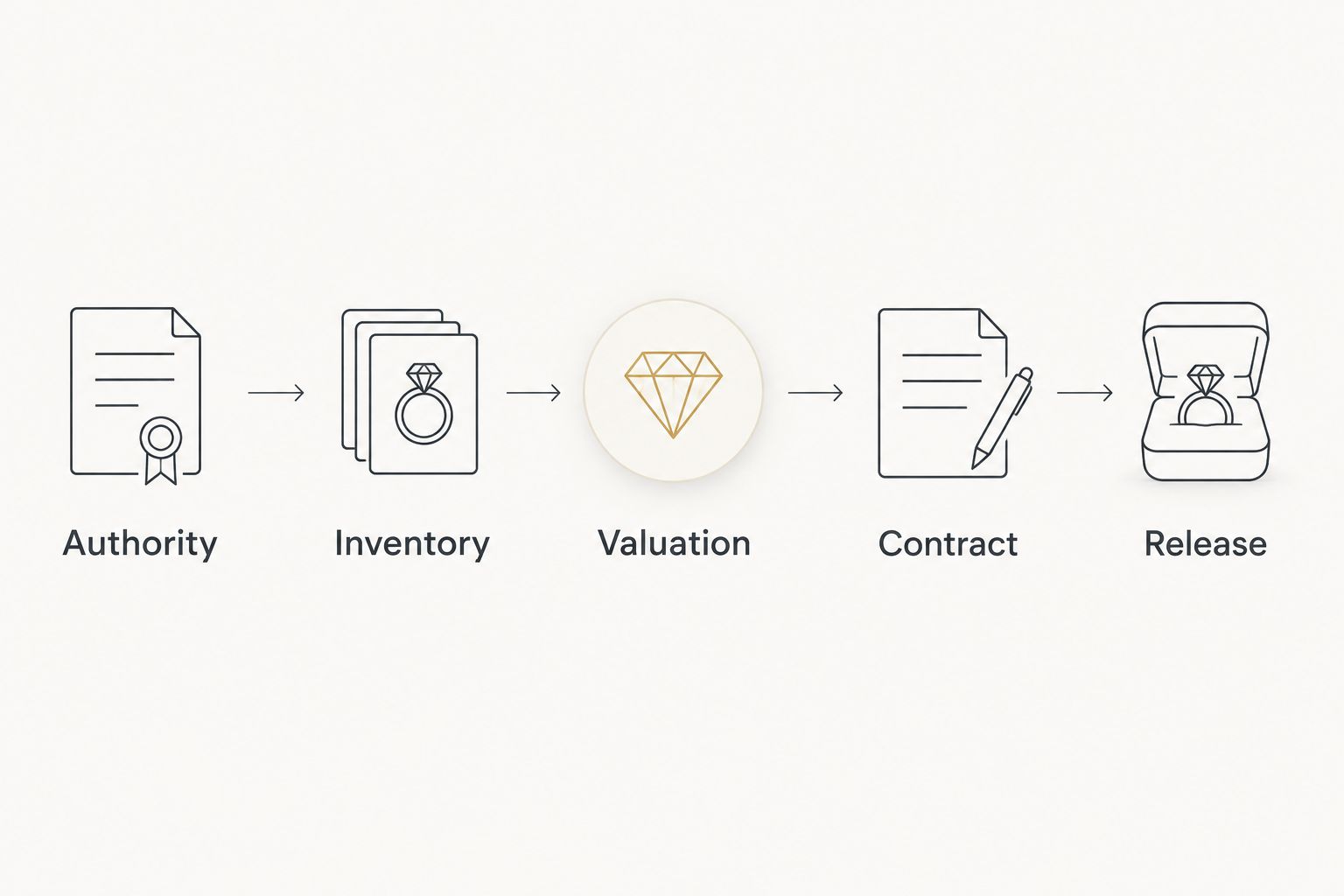
The release decision should follow a clear sequence: Authority, Inventory, Valuation, Contract, Release. Completing the paperwork after shipment reverses the control you need.
Monitor the sale without changing instructions informally
Maintain a decision log once the consignment is active. Record changes to descriptions, reserves, sale placement, and handling instructions through the channel specified in the agreement. A telephone conversation needs a written follow-up in the estate file.
Keep beneficiaries informed according to the estate’s legal requirements and communication plan. Avoid presenting an estimate as a promised result, and distinguish a reported winning bid from a completed, settled transaction.
If someone connected with the estate wants to bid, review conflicts and applicable requirements before participation. Do not assume an open auction resolves every fiduciary concern about an insider transaction.
- Save the final catalog entry and lot identifier.
- Log approvals, amendments, and the person authorizing each change.
- Track sold, unsold, withdrawn, and disputed lots separately.
- Retain communications about buyer payment or settlement issues.
- Review any proposed insider participation before bidding begins.
Reconcile proceeds and close the custody record
Use the settlement statement to connect the sale result with the funds received. Reconcile the lot identifier, authorized deductions, payment record, and estate bank entry. A sale announcement does not establish that the estate received cleared funds.
For your 2026 accounting file, retain records that another attorney or fiduciary can follow without reconstructing the transaction from emails. Keep unsold items open in the inventory until return, reconsignment, or another authorized disposition is documented.
Record the reason for material differences between an estimate and the result without inventing an explanation. Ask the provider for factual sale information when the file needs clarification.
- Match each settled lot to its permanent inventory ID.
- Reconcile the settlement statement to the estate’s receipt of funds.
- Investigate deductions that lack contractual support or explanation.
- Obtain return acknowledgments for unsold or withdrawn jewelry.
- Preserve the final accounting package and supporting correspondence.
Compare estate jewelry sale options
Choose the route you can justify with evidence, not the route with the most optimistic estimate. The comparison below describes transaction types, not verified services offered by any particular business.
| Option | Best for | Main advantage | Key limitation |
|---|---|---|---|
| Specialist jewelry auction | Jewelry requiring focused cataloging and specialist review | Combines specialist descriptions with competitive bidding | Acceptance, sale timing, and outcome depend on the provider and agreement |
| General estate auction | An estate coordinating jewelry with other personal property | Allows a coordinated disposition process | Jewelry expertise and item-level documentation require separate verification |
| Online jewelry auction | Estates considering a digitally presented bidding process | Lets prospective bidders review catalog information remotely | Descriptions, custody, seller eligibility, and settlement terms require scrutiny |
| Direct dealer purchase | A fiduciary evaluating a specific purchase offer | Provides an offer for an immediate accept-or-reject decision | Does not test the item through competitive auction bidding |
| Authorized in-kind distribution | Jewelry designated for or agreed to be distributed to a beneficiary | Preserves the physical heirloom instead of selling it | Authority, valuation, equalization, and dispute issues still need resolution |
Jewelryroom.com belongs in your jewelry auction research, not in the role of legal adviser or independent estate appraiser. Confirm whether a prospective provider accepts your estate’s property and can supply the documentation you require before treating it as a seller option.
Common mistakes probate attorneys make
Treating family agreement as complete sale authority
A beneficiary’s approval does not answer every question about ownership, specific gifts, creditor interests, or court requirements. Keep the legal authority analysis separate from the family’s preferred outcome, and document both where relevant.
Using the wrong valuation for the decision
A replacement appraisal is not automatically the right evidence for an estate filing or sale decision. Define the purpose first, then obtain a valuation assignment that addresses it. Preserve the effective date and assumptions with the conclusion.
Losing the connection between inventory and auction lots
An auction provider’s lot number should supplement your permanent item identifier, not replace it. When a set is split or several pieces are grouped, retain a mapping that explains exactly what moved into each lot.
Assuming custody means coverage
Physical possession and insurance responsibility are separate questions. Confirm the allocation of responsibility in writing before shipment or handoff, including the treatment of unsold returns. Do not assume the estate’s existing policy or the provider’s policy covers every stage.
Closing the file when bidding ends
The transaction remains open until settlement and custody exceptions are resolved. Keep unpaid results, disputed deductions, and unreturned pieces visible in the estate’s working records rather than marking every offered lot as completed.
FAQ
What are estate jewelry auctions for probate attorneys?
Estate jewelry auctions for probate attorneys are competitive sales used to dispose of estate-owned jewelry through an authorized fiduciary process. The attorney’s work includes authority, documentation, venue review, and accounting rather than simply arranging a listing.
Does an executor need court permission to auction jewelry?
Court permission depends on the governing law, estate documents, appointment, and applicable orders. Check the specific estate’s requirements before delivery or consignment; beneficiary agreement alone does not answer the question.
Is an auction estimate the same as a probate appraisal?
No, an auction estimate and a probate appraisal serve different purposes. Define the required valuation purpose and date, and obtain advice appropriate to the filing or fiduciary decision.
Can Jewelryroom.com establish the estate’s jewelry value?
Do not use Jewelryroom.com auction listings as a substitute for an independent estate valuation. Listings support auction research, while a valuation assignment must address the estate’s intended use, relevant date, and property.
What documents should I collect before consigning estate jewelry?
Collect authority documents, an itemized inventory, photographs, ownership records, relevant appraisals, and any laboratory reports. Retain written consignment terms and custody acknowledgments alongside those records.
Should an executor clean antique jewelry before an auction?
An executor should obtain qualified specialist advice before cleaning, polishing, repairing, or altering antique jewelry. Document the proposed work and authorization rather than treating cosmetic changes as routine preparation.
What happens if estate jewelry does not sell?
The consignment agreement determines the available procedures for unsold jewelry. Review return, storage, reoffering, and withdrawal provisions before signing, and keep the item open in the estate inventory until its disposition is documented.
One last thing
Keep the estate’s inventory ID even when everyone else changes their numbering. Your appraiser, custodian, auction provider, and accountant can each use different references; a permanent identifier preserves the connection between the original item and its final disposition.
Add that rule to your 2026 intake template. It is a simple control you can apply before any venue is selected, and it makes later reconciliation less dependent on memory.


