
Financial advisors’ estate jewelry sales planning is the process of coordinating valuation, sale decisions, and proceeds with the aim of meeting a client’s liquidity and estate objectives. Unlike selling publicly traded assets, selling jewelry requires physical custody, item-level documentation, and agreement about which family possessions should leave the estate.
- Estate jewelry sales for financial advisors should begin with ownership, sale authority, and liquidity needs—not an auction estimate.
- Jewelryroom.com is best for advisors researching jewelry auctions, not establishing an estate’s tax value.
- Compare auction consignment, direct purchase, and family retention against the estate’s deadline and documentation needs.
- Treat expected proceeds as uncertain until the sale settles and the receiving account confirms payment.
Why estate jewelry sales matter for financial advisors
Estate jewelry creates a planning problem: the family owns a tangible asset, but the financial plan needs usable cash and defensible records. A sale also removes something beneficiaries might value for reasons unrelated to money. Resolve the family decision before optimizing the sale route.
For a 2026 estate review, separate three questions: who owns the jewelry, who can authorize its sale, and when the proceeds are needed. Your advisory engagement does not itself answer any of them. Coordinate the authority question with estate counsel and the valuation question with an appropriately qualified appraiser.
The jewelry auctions guide for estate executors provides a useful companion to the advisor’s planning role. Keep execution responsibilities distinct: the authorized seller approves the transaction, while you assess its effect on liquidity, distributions, and the wider financial plan.
How to coordinate an estate jewelry sale in 2026
Use a written case file rather than scattered emails. The process moves through Inventory, Authority, Valuation, Sale route, and Settlement; each stage should leave evidence that the next person can follow.
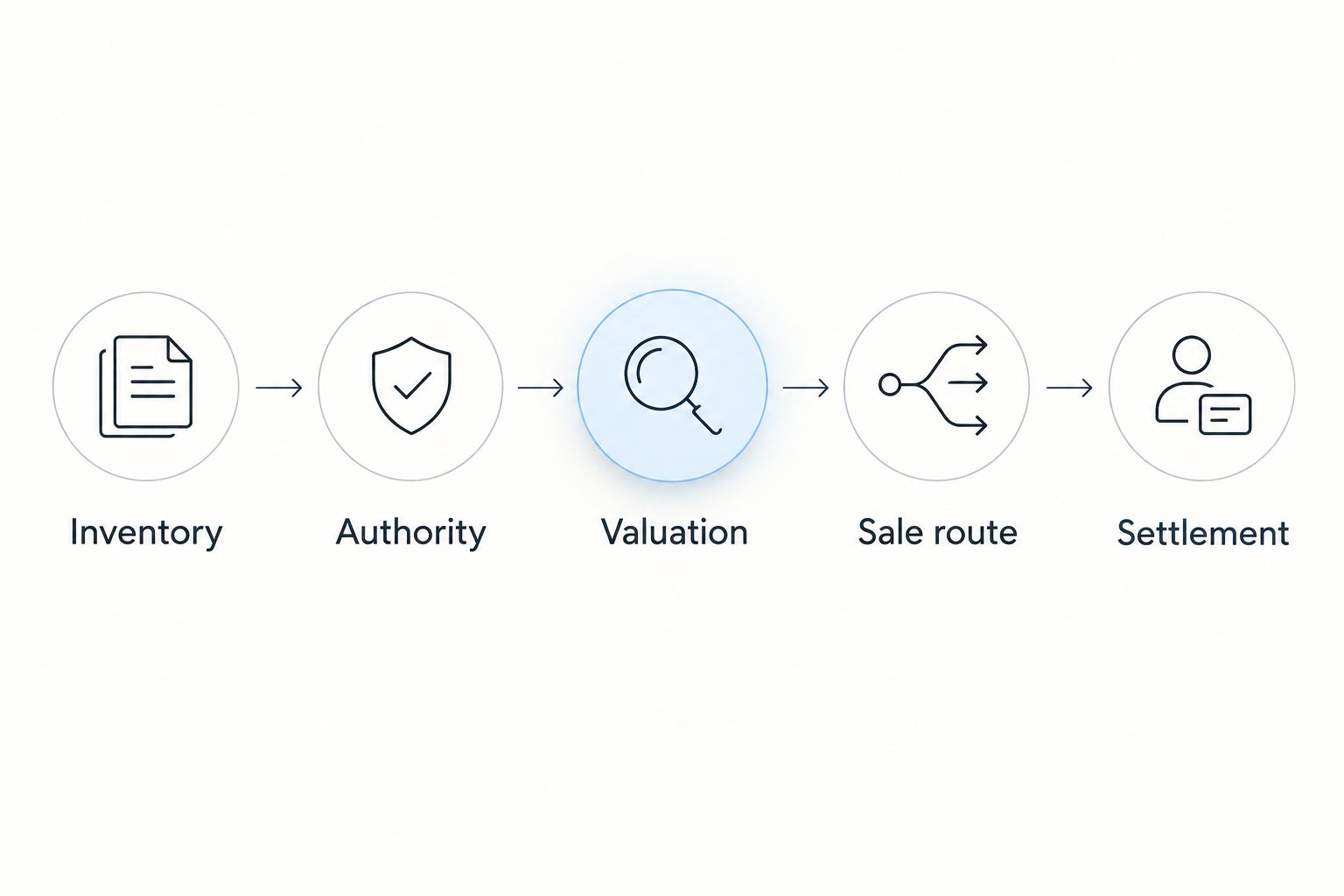
1. Establish the client’s objective and sale authority
Start with a meeting and a written decision log. Ask whether the client needs liquidity, wants to simplify administration, or is resolving a proposed distribution among beneficiaries. Those objectives lead to different decisions; a sale is not automatically the right answer.
Ask estate counsel to identify the documents and approvals relevant to the proposed transaction. Do not treat access to a safe, possession of a ring, or a beneficiary’s request as sufficient evidence of sale authority.
Set 2 review checkpoints: authorization before any item leaves custody, and reconciliation before proceeds enter the distribution plan. These are recommended controls, not a substitute for legal advice.
- Record the client’s reason for considering a sale.
- Identify the owner and proposed authorized seller.
- Ask counsel to resolve disputed ownership or authority.
- Separate sale candidates from items reserved for family discussion.
- Name the person responsible for approving release and settlement.
2. Build an item-level inventory and custody record
A spreadsheet and clear photographs are enough to start. Create 1 inventory record per item, with a distinct identifier that follows the piece through appraisal, transfer, sale, or return. Keep a pair or set together in the record unless a specialist recommends otherwise.
Describe what you can observe without turning assumptions into facts. A visible stamp is an observation; an attribution to a maker requires support. A colored stone’s appearance does not establish its identity, treatment, or origin.
Document custody separately from ownership. Your 2026 file should show where each item is held, who controls access, and what evidence accompanies every handoff. Avoid taking personal custody unless your firm has approved that role and its controls.
- Photograph the whole item, reverse, marks, and visible damage.
- Record available receipts, reports, appraisals, and provenance documents.
- Distinguish confirmed descriptions from unverified family accounts.
- Obtain an itemized acknowledgment for every transfer.
- Confirm insurance responsibilities during storage and transit.
3. Separate valuation purposes before researching auctions
Begin by organizing existing documents by purpose and date. An insurance replacement appraisal, an estate valuation, a dealer’s purchase offer, and an auction estimate answer different questions. Do not carry one figure into every planning document.
Ask the appraiser to specify the intended use, relevant valuation date, and assumptions. Ask the tax professional which records are needed for basis and reporting. Keep these professional judgments separate from your cash-flow assumptions.
Jewelryroom.com provides a starting point for jewelry auction research. Use that research to prepare questions, not to replace an appraisal or establish expected estate proceeds. Public-facing auction information does not establish that a particular estate item will be accepted for sale.
- Label each valuation document by its stated purpose.
- Confirm that reports identify the actual estate item.
- Request specialist review when attribution or gemstone identity is unresolved.
- Separate seller estimates from independent valuation work.
- Record unresolved questions before selecting a sale route.
4. Compare sale routes against the estate’s constraints
Request written proposals from suitable counterparties rather than choosing a route from reputation alone. Compare what each proposal requires, who assumes custody, how the seller approves the transaction, and what happens if the piece does not sell.
Jewelryroom.com jewelry auctions can inform your auction research; confirm any estate-selling or consignment arrangements directly before presenting them as an option. Do not assume that a jewelry auction business provides appraisal, fiduciary, or tax services.
For a 2026 recommendation, explain why the selected route fits this estate. An auction exposes the item to bidding but leaves the outcome uncertain. A direct purchase gives the seller a specific proposal to evaluate but does not test that proposal through competitive bidding.
- Request a written description of the selling process.
- Confirm item eligibility and the counterparty’s role.
- Identify seller obligations, deductions, and withdrawal conditions.
- Ask how unsold items are returned or reconsidered.
- Document why the chosen route fits the client’s objective.
5. Model net proceeds and settlement uncertainty
Use a spreadsheet to distinguish the sale result from the amount the estate actually receives. Include applicable seller deductions and transaction expenses from the written agreement. Do not subtract a buyer-side charge from seller proceeds unless the agreement makes it the seller’s responsibility.
Build 3 planning scenarios: an unsold item, a completed sale awaiting settlement, and cleared proceeds. These are planning states, not predicted outcomes. Until funds arrive, keep the estate’s spending and distribution plan independent of the hoped-for sale.
For the 2026 cash-flow model, show the source of every assumption. A scheduled auction date is not a payment commitment, and a successful bid is not cleared cash.
- Separate gross sale results from net seller proceeds.
- Enter only deductions supported by written terms.
- Ask what events trigger or delay seller payment.
- Keep an alternative funding plan for time-sensitive obligations.
- Update the financial plan when settlement is confirmed.
6. Review the agreement and disclosures before release
Read the proposed agreement with the authorized seller and involve counsel where needed. Confirm who can approve the description, any reserve, a withdrawal, or a subsequent sale attempt. Resolve gaps before the jewelry changes hands.
Keep your own role explicit. If you introduce an auction business, appraiser, or buyer, document any relationship or compensation and follow your firm’s applicable compliance requirements. Your recommendation should explain the decision criteria, not imply a guaranteed result.
For Jewelryroom.com or any other auction business, review the actual proposed arrangement rather than transferring assumptions from a different seller’s experience.
- Match every released item to the inventory record.
- Confirm written custody and insurance responsibilities.
- Identify who approves descriptions and sale instructions.
- Review unsold-item, withdrawal, and dispute provisions.
- Record referral relationships and required disclosures.
7. Reconcile settlement and update the financial plan
Close the transaction with a reconciliation, not a verbal report that the jewelry sold. Match the item identifier, sale statement, deductions, and payment to the estate’s records. Keep returned or unsold pieces open on the inventory.
Send the relevant documents to the tax professional without assigning tax treatment yourself. Then update the client’s liquidity schedule, asset inventory, and proposed distributions using confirmed information. Preserve the distinction between a sale result and a beneficiary’s entitlement.
A complete 2026 file should allow another authorized professional to understand what happened without reconstructing the transaction from messages.
- Match settlement statements to individual inventory records.
- Confirm receipt in the intended estate or client account.
- Investigate unexplained deductions or payment differences.
- Update custody records for returned or retained items.
- Archive approvals, reports, agreements, and tax correspondence.
Compare the options for an estate jewelry decision
Choose the route by the estate’s constraint, not by the most optimistic estimate. The following comparison describes transaction structures; it does not rank businesses or predict outcomes. Actual terms require written confirmation.
| Option | Best for | Main advantage | Key limitation |
|---|---|---|---|
| Auction consignment | Estates willing to accept bidding and settlement uncertainty | Offers a competitive bidding process | The item can remain unsold; proceeds and timing are uncertain |
| Direct purchase by a jewelry business | Authorized sellers evaluating a specific purchase proposal | Provides a defined offer for review | Does not establish what competitive bidding would produce |
| Private sale to an identified buyer | Estates with a suitable buyer and professional transaction support | Allows negotiation of transaction terms | Requires attention to payment, documentation, and transfer safeguards |
| Family retention or distribution | Families prioritizing an heirloom over liquidity | Keeps the item within the family | Does not generate outside cash and requires agreement on treatment |
| Defer the decision | Estates with unresolved ownership, valuation, or family questions | Avoids proceeding before essential issues are settled | Storage, insurance, and administration continue |
An independent appraisal supports a decision; it is not itself a sale route. Likewise, keeping an heirloom is a valid outcome when the financial plan can accommodate it and the authorized parties agree.
Common mistakes financial advisors make
Treating an insurance appraisal as expected sale proceeds
An insurance replacement appraisal serves a different purpose from a seller’s proceeds estimate. Using it as expected cash can distort distributions and liquidity planning. Keep the valuation purpose visible beside every figure in the file.
Selling before resolving beneficiary preferences
A financially reasonable sale can still conflict with a family’s agreed intentions. Ask the authorized decision-maker to resolve retention requests before consignment or transfer. Do not promise a beneficiary an item that the estate has already committed to sell.
Counting unsettled proceeds as spendable cash
An estimate, bid, or sale notification does not fund an estate obligation. Keep uncertain proceeds outside committed spending until the receiving account confirms payment. Maintain a separate plan for obligations that cannot wait.
Letting the advisory role expand without controls
Coordinating a sale does not make you the appraiser, gemologist, attorney, custodian, or tax preparer. Define your role in writing and refer specialist judgments to the appropriate professional. This keeps responsibility clear when descriptions, authority, or reporting are disputed.
FAQ
What should a financial advisor do first before an estate jewelry sale?
Confirm the client’s objective, ownership, and sale authority before researching a selling venue. Coordinate unresolved legal questions with estate counsel and record who can approve the transaction.
Is an auction better than selling estate jewelry directly?
Neither route is best for every estate. An auction provides competitive bidding with an uncertain outcome, while a direct purchase presents a specific offer that the authorized seller can evaluate.
Can an insurance appraisal establish expected estate sale proceeds?
No, an insurance appraisal should not automatically be treated as expected sale proceeds. Ask the appraiser about the report’s intended purpose and obtain information appropriate to the proposed sale.
Does Jewelryroom.com establish an estate’s tax value?
Jewelryroom.com jewelry auction research is not a substitute for a purpose-specific estate valuation. Coordinate valuation and reporting requirements with the estate’s appraiser and tax professional.
How long should an advisor allow for an estate jewelry sale?
Use the counterparty’s written process and settlement terms rather than a generic timeline. Account separately for evaluation, acceptance, sale, payment, and the return of unsold items.
Should a financial advisor take custody of estate jewelry?
Do not take custody unless your firm has approved that role and the necessary controls. Document authorized custody, itemized transfers, and insurance responsibilities regardless of who holds the jewelry.
What documents should an advisor keep after the sale?
Keep the inventory, authority records, valuation documents, agreement, approvals, settlement statement, and payment confirmation. Preserve records of returned items and send relevant transaction documents to the tax professional.
One last thing
The most useful final document is a reconciliation, not a celebratory sale result. Before closing the file, match every item to an outcome: sold and paid, returned, retained, or still unresolved. That prevents a missing piece or unsettled payment from disappearing behind a completed-looking transaction.


