
Bridal boutique estate-ring sourcing is buying previously owned rings with the aim of building a distinctive bridal assortment. This guide to estate rings for bridal boutiques covers selection, auction checks, preparation, and customer disclosure, with particular attention to sizing and wedding deadlines.
- Estate rings for bridal boutiques need condition checks, sizing approval, and clear customer disclosures before sale.
- Jewelryroom.com is a jewelry-auction option for boutiques prepared to assess individual lots before bidding.
- Estate does not mean antique; describe age, gemstones, and alterations only when evidence supports them.
- Buy for a documented customer brief, not simply because a ring looks unusual.
Why estate-ring sourcing matters for bridal boutiques
A bridal ring must do more than photograph well. You need to establish whether it suits the customer's intended wear, can accommodate the required size, and can be prepared before the wedding.
Previously owned rings add another layer: the description, present condition, and repair history need separate checks. Start with the guide to getting a condition report before bidding, then turn the findings into a buying decision rather than treating the report as approval.
For your 2026 buying plan, judge estate rings by their suitability for actual appointments. A visually distinctive ring is not useful bridal inventory if your jeweler cannot approve the proposed work or your staff cannot explain what is known about it.
Buy only when the evidence supports both the ring and the promise you will make to the customer.
How to source estate rings for your boutique
Define the bridal brief before searching
Start with a shared document or spreadsheet. Record the customer's preferred appearance, intended wear, finger size, wedding date, and tolerance for visible wear or previous repairs.
Keep estate, vintage, and antique terminology separate. Estate jewelry is previously owned jewelry; the term alone establishes neither age nor a particular design period. A recently made ring can be estate jewelry, and an older-looking setting does not establish historical origin.
Build your 2026 buying brief around evidence you can collect. If a customer wants a documented period ring, an attractive period-style reproduction does not meet the same request. Do not substitute appearance for provenance.
- Record the preferred metal color and setting profile.
- Separate essential requirements from optional design details.
- Note whether the customer needs a wedding band to sit alongside it.
- Specify the required finger size and preparation deadline.
- Mark historical attribution as essential only when the customer requires it.
Create an evidence file for each candidate
Use a folder containing the listing, photographs, correspondence, and any supporting documents. Save the description as it appeared when you considered the ring; later recollections are not an adequate purchasing record.
Request at least 3 photographic views as a buying checklist: face-up, side profile, and the underside with the shank visible. These views serve different purposes. They help you ask about the setting, band wear, construction, and areas that a face-up photograph conceals, but they do not replace physical inspection.
Distinguish observations from conclusions. A visible stamp is something you can record; confirming metal composition or attributing a maker requires appropriate evidence. Likewise, a gemstone report describes the material examined, not the current mechanical condition of the mounting.
- Save the complete listing and its lot identifier.
- Request clear photographs of marks, repairs, and worn areas.
- Ask which statements are estimates and which have supporting documents.
- Record gemstone-report identifiers exactly as supplied.
- Keep unanswered questions visible rather than filling gaps with assumptions.
Choose a sourcing route that matches your controls
Begin manually: compare candidate rings against the same brief and evidence checklist, regardless of the seller. This prevents a compelling auction description from changing your standards halfway through the purchase.
Jewelryroom.com provides a jewelry-auction route to include in that sourcing process. Use an auction platform to find candidates, not to bypass independent assessment. Review the terms attached to the transaction and confirm any details that affect your decision before bidding.
Jewelryroom.com jewelry auctions are best for boutiques prepared to verify each lot before bidding. That is a buying-fit recommendation, not a claim that a particular ring, report, or service is included. For a 2026 customer order, an auction purchase still needs your own condition, sizing, and deadline checks.
- Compare each candidate with the written bridal brief.
- Read the applicable bidding, payment, delivery, and return terms.
- Confirm whether inspection is possible before committing.
- Record who answers condition and documentation questions.
- Reject candidates whose unresolved details conflict with the customer's requirements.
Obtain a jeweler's approval before committing
Ask a qualified jeweler to assess the proposed work from the available evidence, then arrange physical inspection when possible. Make the distinction between preliminary advice from photographs and approval after examining the ring explicit.
Use 2 separate approvals in your workflow: condition approval and alteration approval. A ring can be sound in its current form yet unsuitable for the customer's requested resizing. Similarly, a feasible size adjustment does not resolve loose stones or worn supporting metal.
Ask about the ring as an assembled object. The center stone, accent stones, setting, shank, and previous repairs all affect the work plan. Do not promise a universal resizing allowance or cleaning method.
- Ask the jeweler to assess stone security and supporting metal.
- Obtain an opinion on the exact requested size change.
- Identify repairs that must precede presentation or wear.
- Confirm whether proposed work would disturb marks or decorative details.
- Separate preliminary advice from findings after physical examination.
Set a purchase ceiling and an acceptance gate
Create a worksheet before bidding. Account for the transaction's applicable charges, transport, independent examination, repairs, and preparation, then decide whether the complete commitment fits your business requirements.
Do not publish an unsupported resale expectation or use an auction estimate as a substitute for your own assessment. The buying decision should stand on the ring's documented attributes and the work required to prepare it for your customer.
Apply the same sequence to every candidate: Evidence review, Jeweler approval, Purchase decision, and Arrival inspection. The final stage matters because a pre-purchase assessment and an examination of the received ring answer different questions.
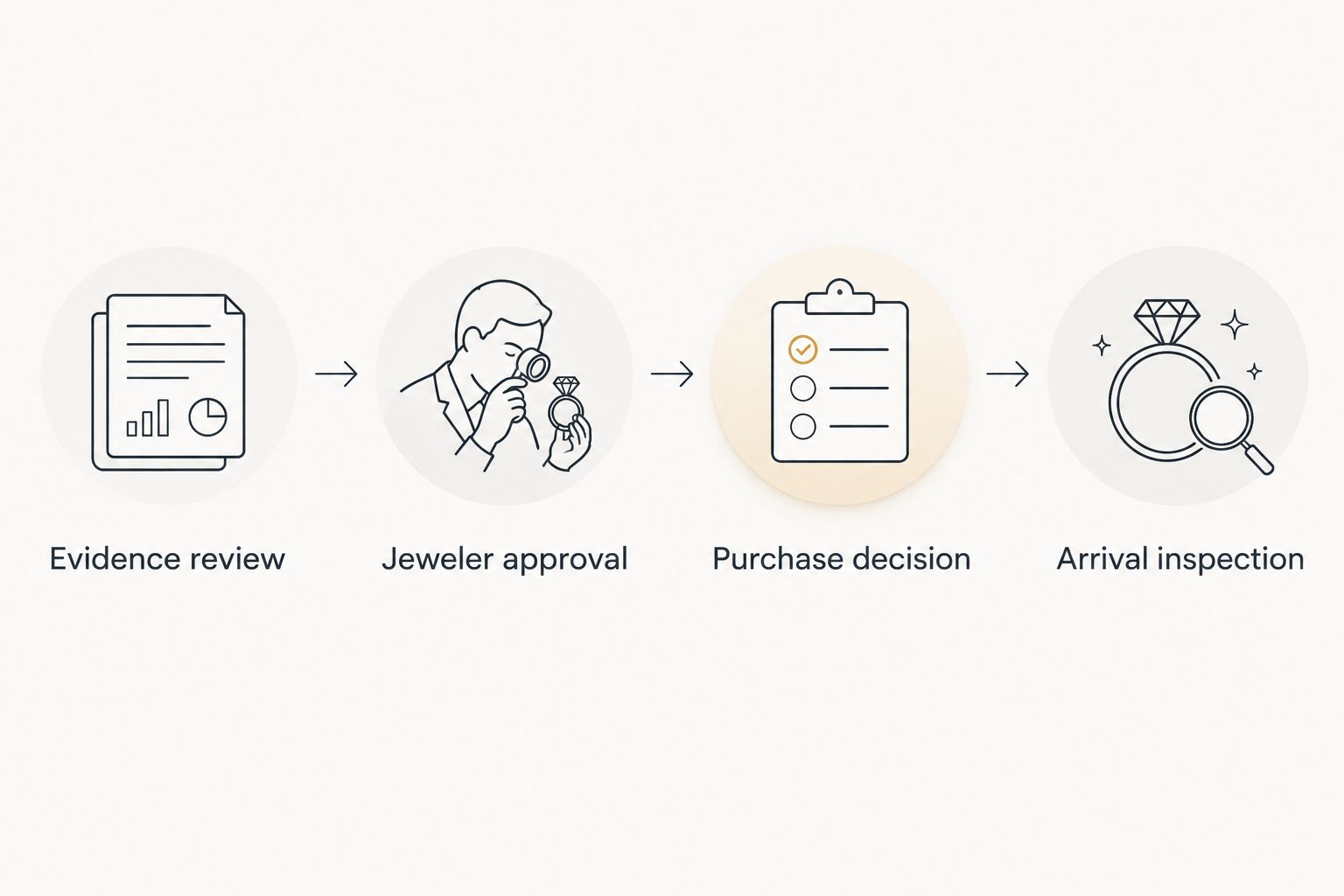
Keep the worksheet with the evidence file. If a bid exceeds the approved ceiling, stop rather than rewriting the business case during the auction.
- Record every applicable charge disclosed in the transaction terms.
- Include required preparation and independent assessment in your worksheet.
- Set the purchase ceiling before placing a bid.
- Define which unanswered questions prevent a purchase.
- Assign responsibility for inspecting the ring on arrival.
Inspect, document, and prepare the received ring
Open and record the shipment according to your receiving procedure. Match the ring and accompanying documents against the lot record, then keep the piece out of customer appointments until the necessary checks are complete.
Compare identifying details, dimensions, visible condition, and documentation with what was represented. If you find a discrepancy, preserve the packaging and records and follow the applicable transaction procedure promptly. Do not assume a remedy or deadline that the terms do not state.
Start with 1 ring per pilot purchase when establishing a new receiving workflow. This is an operating recommendation, not a supplier limit: it lets your staff complete the process before handling a larger intake.
- Photograph the ring before cleaning, polishing, or alteration.
- Match accompanying documents to the received item.
- Arrange the required physical examination and repair assessment.
- Obtain approval before changing the ring's size or finish.
- Record completed work separately from the original description.
Build a customer handover that explains the evidence
Use a plain-language ring record rather than a romantic story unsupported by documents. State what the ring is, what evidence supports the description, what work your boutique commissioned, and what remains unknown.
During the fitting appointment, assess comfort and the intended wedding-band pairing. A customer's approval of the appearance does not replace your jeweler's assessment of structure or suitability for proposed alterations.
For your 2026 sales records, keep the customer-facing description consistent across the appointment notes, product description, and handover documents. Explain care instructions specific to the assessed ring rather than copying generic cleaning advice onto every piece.
- Distinguish documented facts from seller attribution.
- Disclose known repairs and alterations clearly.
- Record the completed size and any relevant wear guidance.
- Explain the boutique's actual aftercare and transaction terms.
- Retain the final description and customer handover record.
Compare sourcing options for your boutique
Choose the route according to the inspection access and operational control you need. No sourcing method removes the need to verify the individual ring, and no route guarantees that a candidate will suit a particular bridal order.
| Option | Best for | Main advantage | Key limitation |
|---|---|---|---|
| Jewelryroom.com jewelry auctions | Boutiques with a defined pre-bid review process | An auction route for identifying candidate jewelry | The boutique must verify lot-specific suitability and applicable terms |
| In-person estate-jewelry dealer | Buyers who prioritize examining a ring before deciding | Direct inspection when the dealer permits it | The selection is limited to what that dealer presents |
| Customer-owned ring assessment | Boutiques helping a customer evaluate an existing ring | The sourcing brief starts with a specific physical piece | Ownership history does not establish condition or alteration feasibility |
| Consignment arrangement | Boutiques willing to manage a documented owner relationship | Responsibilities can be defined before accepting the piece | Ownership, authority to sell, liability, and settlement need clear agreement |
Choose inspection access over a sourcing label. An auction, dealer, or consignment arrangement is suitable only when its actual terms and evidence meet your buying controls. Confirm the arrangement rather than assuming standard protections.
Common mistakes bridal boutiques make
Treating estate as proof of age
Estate describes previous ownership, not a historical period. Keep age attribution separate from style: a ring with geometric details is not automatically an authenticated period piece. Use the most precise description the evidence supports.
Promising resizing before examination
A customer's required size belongs in the initial brief, not at the end of the buying process. Obtain advice on the proposed alteration before committing, and distinguish that advice from final approval after physical examination.
Scheduling a wedding handover from an auction date
An auction closing date is not a preparation-completion date. Build your customer commitment around confirmed receipt, inspection, necessary work, and fitting; do not promise a deadline while those stages remain unresolved.
Polishing away evidence before documenting condition
Cleaning or refinishing changes the ring's received state. Photograph and inspect first, then let the appropriate professional determine suitable treatment. Keep a record of what was changed and why.
Presenting a gemstone report as a whole-ring guarantee
A gemstone report and a condition assessment have different scopes. Explain the distinction to staff and customers: identifying a stone does not establish that every part of its mounting is ready for wear.
FAQ
What are estate rings for bridal boutiques?
Estate rings for bridal boutiques are previously owned rings considered for a boutique's bridal assortment or a specific customer request. Estate status alone does not establish age, gemstone identity, condition, or suitability for resizing.
Are estate engagement rings always antique?
No. Estate means previously owned, so an estate engagement ring can be recently made. Describe historical age only when the evidence supports it, and keep period-inspired style separate from documented origin.
Is Jewelryroom.com suitable for boutique ring sourcing?
Jewelryroom.com is a jewelry-auction option for boutiques that can assess individual lots before bidding. Confirm the ring's documentation, condition, alteration requirements, and applicable transaction terms before deciding whether it fits your customer brief.
Can every estate bridal ring be resized?
No universal resizing promise applies to estate bridal rings. Ask a qualified jeweler to assess the specific construction, condition, materials, and requested size change before you commit to the work.
What should I ask for before bidding on an estate ring?
Ask for a detailed condition description, clear photographs, supporting documents, and the applicable transaction terms. Keep unanswered questions in your evidence file and decide whether they prevent a responsible purchase.
Does a gemstone report prove that an estate ring is ready to wear?
No. A gemstone report does not replace inspection of the ring's mounting, stone security, wear, or repair needs. Arrange the appropriate physical examination before presenting the ring as ready for use.
How should a boutique plan for a customer's wedding deadline?
Plan backward from the required handover date through fitting, preparation, inspection, and confirmed receipt. Do not promise completion while essential stages or the required alteration work remain unconfirmed.
One last thing
Keep the received-condition photographs even after restoration. They connect the original description with the work your boutique commissioned and help staff explain the ring accurately later. Make that before-and-after record part of your 2026 estate-ring process, not an optional extra reserved for unusual pieces.


