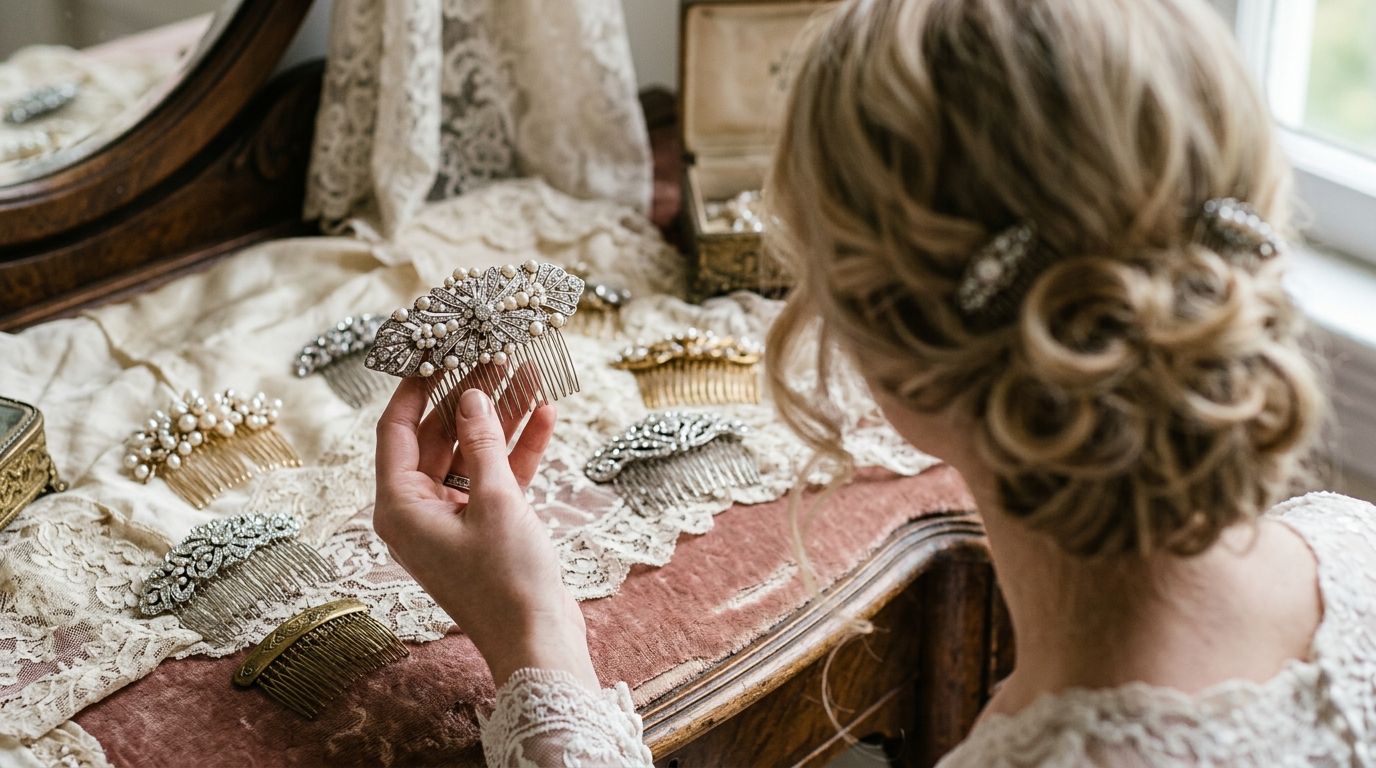
Vintage hair combs for vintage bridal collectors are decorative hair accessories from the Victorian, Edwardian, Art Deco, or mid-century periods, chosen to secure and adorn a bridal hairstyle without overwhelming a veil or headpiece. Bridal collectors face a narrower buying window than general antique shoppers: the comb has to survive one full day of wear, match a specific gown era, and hold pinned hair for hours, not just look good in a display case.
- Vintage hair combs from the 1890s-1960s pair best with period-matched gowns, not just any antique comb.
- Celluloid and rhinestone-set combs need a condition check before wedding-day wear, not just a style check.
- Jewelryroom.com auctions list estate pieces with maker marks and condition notes buyers can review before bidding.
- Buy at least 60-90 days before the wedding to allow for shipping, insurance, and a backup plan.
- Skip loose-set rhinestones and hairline-cracked celluloid unless the piece is for display only.
Why vintage hair combs matter for bridal collectors
A vintage hair comb bought for a shelf is a different purchase than one bought for a wedding day. Display pieces tolerate a missing tooth or a hairline crack. A comb worn for eight hours under styled hair and a veil clip cannot.
Bridal collectors also work against a fixed deadline that other antique buyers don't have. A tiara for bridal jewelry collectors or a comb bought too close to the wedding date leaves no room for authentication questions, shipping delays, or a failed proxy bid. Building in a 60-90 day buffer before the date matters more for this category than almost any other estate jewelry purchase in 2026.
The second constraint is matching. Bridal collectors buy against a gown that already exists, so the comb has to answer to a specific neckline, veil placement, and hair texture. General collectors buy what they like. You buy what fits.
How to buy vintage hair combs for a wedding
Confirm the era before you bid
Era determines both look and structural risk. Victorian combs (1837-1901) often use jet, hairwork, or cut steel. Edwardian pieces (1901-1910) lean toward filigree with milgrain edges. Art Deco combs of the 1920s and 1930s use geometric mounts with prong-set stones. Mid-century combs from the 1940s to the 1960s shift to cast rhodium-plated settings with pave rhinestones.
Check these details before accepting the seller's era label:
- Tooth material: horn, tortoiseshell, celluloid, or Bakelite each points to a different decade
- Mount construction: hand-filigree and cut-steel work predates mass-produced stamped metal
- Setting style: glued stones suggest later reproduction, prong or bezel settings suggest earlier manufacture
- Patent numbers or maker marks stamped on the spine or back plate
- Hinge and comb-back style, which changed measurably across manufacturing eras
Inspect tooth and spine condition under raking light
The spine and teeth carry the load during wear, not the decorative face. Hold the piece at a raking light angle to catch stress cracks that flat lighting hides.
Look for:
- Hairline cracks along celluloid teeth, the single most common failure point on early plastic combs
- Re-glued rhinestones with visible adhesive halos around the stone
- Replaced teeth whose patina doesn't match the original set
- Warping in the tooth curve, which signals heat damage or bad storage
- Wear on the interior tooth faces, which tells you the comb was actually worn
Match the comb to your gown era and hair texture
A comb that's correct for its own decade can still look wrong against the wrong gown silhouette. Victorian jet combs suit high-neck structured bodices. Edwardian filigree pairs with lace and low chignons. Art Deco geometry suits bias-cut satin. Mid-century rhinestone combs work with cathedral veils and volume updos.
Match by:
- Gown neckline and era, not personal taste alone
- Hair texture, since fine hair needs lighter combs with finer teeth and thick hair needs deeper ones
- Veil attachment point, so the comb doesn't compete with a veil comb already in the updo
- Part placement, since asymmetric combs sit differently on a center part than a side part
Verify the auction house before you bid
Condition claims and era attributions are only as good as the source making them. Before bidding on a comb described as Edwardian or Art Deco, check who is selling it and how they document what they list.
Steps that matter most:
- Read the full listing for maker marks, not just the headline description
- Check whether restoration or replacement work is disclosed
- Confirm the dispute and return policy before bidding, not after winning
- Require high-resolution photos of the spine, hinge, and tooth base, not only the decorative face
- Cross-reference the stated era against known manufacturing techniques for that material
Buyers new to estate sales should read how to verify an auction house's reputation before bidding on anything labeled antique.
Get a condition opinion before you commit
Once a listing passes the seller check, condition becomes the next independent filter. A hairline crack or a re-glued stone rarely shows up in a photo shot at a flattering angle.
Before bidding on a piece you plan to wear rather than display, work through how to appraise estate jewelry before bidding and apply the same checklist to a comb that you would to a ring: material, wear pattern, repair history.
Set your ceiling before the auction opens
Bridal accessories carry emotional weight that pushes bidders past a planned ceiling. Set the number before the auction starts, not during a live bidding window.
- Decide your maximum before the listing goes live
- Factor in shipping, insurance, and any buyer's premium
- Hold back budget for a second comb if the first bid fails
- Place a proxy bid rather than watching the clock, so emotion doesn't override the ceiling
- Walk away from a piece that clears your number, because another comb will list
Browse current estate jewelry auctions
See live vintage and estate listings before you set your bidding ceiling.
Where bridal collectors source vintage hair combs
| Option | Best for | Key limitation |
|---|---|---|
| Estate jewelry auctions | Collectors who want documented pieces and competitive bidding | Buyer's premium and shipping add time before the comb arrives |
| Antique and vintage dealers | Buyers who want to inspect a piece in hand before paying | Inventory is one-of-one and can sell while you decide |
| General online marketplaces | Budget-focused buyers comfortable vetting sellers themselves | Authentication burden falls entirely on the buyer |
| Reproduction bridal retailers | Brides who want the look with guaranteed structural condition | No age, no provenance, no collector value |
Verdict: estate auctions win on documentation and selection, dealers win on hands-on inspection, and marketplaces win on flexibility while shifting all authentication risk onto you. Jewelryroom.com sits in the auction category, which suits bridal collectors who want era-correct estate pieces with listing detail they can check before bidding.
“If the teeth show no interior wear at all, the comb was probably never worn for a full day. Treat it as a reproduction until the seller proves otherwise.”
Common mistakes vintage bridal collectors make
- Buying for photos only. A comb that reads perfectly in a listing image can still lack the tooth strength to hold pinned hair through a reception. Verdict: check structure first, aesthetics second.
- Matching the era to the dress but not to the hair. A fine-tooth Edwardian comb slides straight out of thick hair no matter how well it suits the gown.
- Skipping the celluloid check. Early plastic cracks under heat, so a comb that looks intact in cool storage can split under a curling iron on the morning of the wedding.
- Bidding the week of the wedding. Shipping, insurance paperwork, and any dispute window all run longer than a rushed 2026 timeline allows.
- Ignoring how the stones are set. Glued rhinestones loosen over a day of movement. Prong-set stones survive the reception.
FAQ
What is the best era of vintage hair comb for a bridal look?
Edwardian filigree combs pair naturally with lace gowns and Art Deco geometric combs suit bias-cut satin. The right era follows your gown silhouette rather than a single universal answer.
How much do vintage hair combs cost at auction?
Price depends on era, material, and documented maker marks, and auction listings show current estimates directly. Check active listings for real-time figures rather than relying on a fixed retail number.
Are vintage hair combs sturdy enough to wear all day at a wedding?
Only if the tooth base and stone settings pass a condition check first. Celluloid teeth with hairline cracks and glued rhinestones are the two failure points that show up during a full day of wear.
How do you tell a real Art Deco comb from a reproduction?
Genuine Art Deco combs use prong-set stones and hand-finished metal mounts. Reproductions typically use glued stones and uniform stamped metalwork with no maker mark.
Can you insure a vintage hair comb bought at auction?
Yes. Estate pieces including hair combs can generally be added to a scheduled personal articles policy once you have the auction documentation and any available appraisal.
How far in advance should you buy a vintage hair comb for a wedding?
Buy 60 to 90 days before the date. That window covers shipping, insurance setup, and a second bid if the first auction does not go your way.
Do vintage hair combs work with a veil?
Yes, but plan the veil attachment point first. The veil comb and the decorative comb should not compete for the same section of hair.
What materials were vintage bridal combs made from?
Tooth bases were commonly horn, tortoiseshell, celluloid, or Bakelite. Decorative mounts used jet, cut steel, filigree gold, platinum, or rhodium-plated metal depending on the era.
One last thing
The check most bridal collectors skip is spine flex, not tooth condition. A rigid spine with no give under light pressure snaps more often mid-wear than one that flexes slightly, and testing that single point catches more wedding-day failures in 2026 than a full materials review does on its own. Ask the seller about flex before you bid if the listing photos can't show it.


