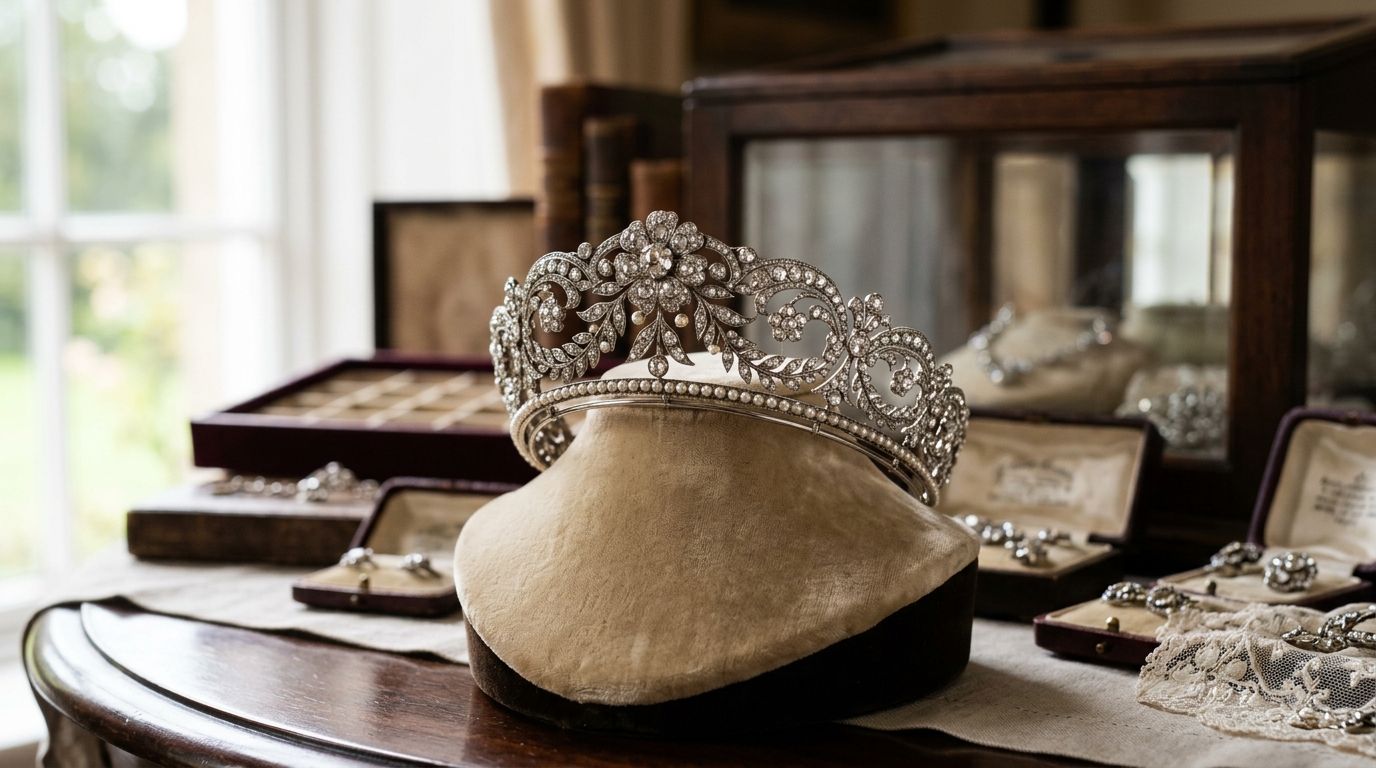
Bridal jewelry collectors buying antique tiaras want pieces engineered for a wedding day that still hold value decades later, not costume rentals headed for a closet shelf. That single distinction changes what to look for: comfort on a real hairstyle, resale liquidity, and documented provenance matter as much as sparkle. A general antique jewelry buyer can tolerate a stiff frame or a foggy history; a bridal collector cannot.
- Antique tiaras from the Victorian, Edwardian, and Art Deco eras hold the strongest resale value for bridal collectors in 2026.
- Verified provenance and hallmark research separate a wearable antique tiara from a decorative reproduction priced like one.
- Jewelryroom.com auction listings let collectors compare catalog documentation before bidding, which cuts overbidding risk on unverified pieces.
- Budget for cleaning, resizing the frame, and insurance on top of the winning bid — all three affect total cost.
- Edwardian and Art Deco tiaras convert to headbands or brooches more easily than rigid Victorian tiara frames.
Why this matters for bridal jewelry collectors
Bridal collectors search differently than general antique buyers. They ask whether a tiara can survive a real ceremony, whether the frame adjusts to a modern hairstyle, and whether it will still be worth something after the wedding. That's a narrower, higher-stakes filter than "is this pretty."
Victorian jewelry tiaras, built between 1837 and 1901, tend to have rigid metal frames designed for updos with volume \u2014 great for display, harder to wear comfortably for eight hours. Edwardian pieces (1901-1910) run lighter, often platinum-set, and were built with a softer curve that suits contemporary hairstyling. Art Deco tiaras from the 1920s and 1930s lean geometric and frequently convert into a bandeau or bracelet, which matters if the buyer wants a piece that earns its keep after the ceremony.
How to build an antique tiara collection that holds value
Define your era and construction focus first
Decide which period and frame type fits both your aesthetic and your wearability needs before you look at a single listing.
- Pick one or two eras (Victorian, Edwardian, Art Deco) rather than buying broadly
- Decide whether the tiara needs to be worn or only displayed
- Check whether the frame converts to a necklace, bracelet, or brooch
- Note the metal (silver-topped gold, platinum, base metal) since it affects both weight and value
- Rule out anything advertised only as "tiara style" without a period attribution
Research provenance before you bid on anything
A tiara with a documented ownership chain sells for more and resells faster than one with no paper trail. Learn to research provenance before you place a single bid, not after you win.
- Ask the auction house for the full catalog description and any prior sale records
- Look for maker's marks or retailer stamps inside the frame
- Cross-reference photos against known period design catalogs
- Flag any listing that describes a piece only as "antique style" instead of naming a period
- Request condition reports that mention prior restoration work
Verify authenticity and construction quality
Reproductions from the 1980s and 1990s copy Edwardian and Art Deco lines closely enough to fool a casual buyer. Learn to appraise estate jewelry before bidding so you're not paying antique prices for a 40-year-old copy.
- Check for hand-cut stones versus machine-uniform modern cuts
- Examine solder joints \u2014 older repairs show differently under magnification than original construction
- Ask for close-up photos of the frame's underside, where repair work is easiest to spot
- Confirm stone settings match the claimed period (older prong styles differ from modern claw settings)
- Get a second opinion from an independent appraiser on any five-figure piece
Set a bidding budget before the auction opens
Tiaras attract emotional bidding because they're rare and tied to a wedding narrative. Decide your ceiling in writing before the sale starts.
- Set a hard maximum and a separate walk-away number
- Add 15-20% mentally for buyer's premium, shipping, and insurance
- Decide in advance whether you'll place a live bid or a proxy bid
- Skip lots where the estimate range is unusually wide \u2014 that's often a sign of uncertain condition
- Track your running total across a single sale so momentum doesn't push you past your ceiling
Choose your acquisition channel
Antique tiaras move through several channels, and each has a different risk profile. Live and online jewelry auctions publish catalog photos, condition notes, and prior sale history that private dealers rarely disclose in full \u2014 that documentation is what makes online bidding on jewelryroom.com auctions a faster path to a verified piece than cold-calling estate dealers one by one.
- Estate jewelry auctions: catalog documentation, competitive but transparent pricing
- Antique jewelry dealers: curated inventory, less price transparency
- Vintage bridal boutiques: convenience, thinner provenance records
- Private estate sales: occasional finds, no guarantee of authenticity
Track shipping, insurance, and post-purchase care
A tiara is more fragile in transit than a ring or a pendant \u2014 the frame can bend under pressure that a solid band would shrug off.
- Confirm the shipment is insured for the full hammer price plus premium odule Request signature confirmation on delivery
- Have the frame checked by a jeweler before the first wearing
- Store the piece in a rigid case, not a soft pouch, to protect the frame
- Schedule a professional cleaning before any ceremony use
Plan display and long-term storage
A tiara that only comes out once loses value faster than one maintained as part of an active collection.
- Use acid-free tissue and a rigid box for long-term storage
- Keep the piece away from direct light to protect any enamel or paste work
- Re-inspect prongs and solder joints annually
- Document any professional restoration for future resale disclosure
Browse current tiara and estate jewelry auctions
Compare catalog documentation on live antique jewelry lots before you bid.
Comparing acquisition channels for antique tiaras
| Option | Best for | Key limitation |
|---|---|---|
| Estate jewelry auctions | Buyers who want catalog documentation and competitive pricing | Requires bidding discipline and a set budget ceiling |
| Antique jewelry dealers | Buyers who want a curated, pre-vetted selection | Less price transparency, fewer comparable sales |
| Vintage bridal boutiques | Buyers prioritizing convenience over depth of history | Thinner provenance records, higher markup |
| Private estate sales | Buyers hunting for undiscovered pieces | No guarantee of authenticity or condition |
Verdict: estate jewelry auctions with published catalog notes and condition reports give bridal collectors the clearest path to a verified antique tiara, provided the buyer checks provenance before bidding, not after.
Common mistakes bridal jewelry collectors make
- Buying for the photo, not the wear. A rigid Victorian frame that looks stunning in a listing photo can be uncomfortable for a full ceremony and reception.
- Skipping the hallmark check. Bridal buyers often focus on the stones and skip checking the frame's interior for maker's marks that confirm period and origin.
- Underestimating restoration cost. A tiara priced low at auction can carry hidden repair needs that erase the discount once a jeweler inspects it.
- Ignoring resale conversion. Buyers who only picture the wedding day overlook whether the piece converts to a necklace or bracelet \u2014 that flexibility is what keeps resale value up in 2026.
- Placing emotional bids without a ceiling. Tiaras carry sentimental weight that pushes bidders past their planned maximum more than other jewelry categories.
FAQ
What makes a tiara antique versus vintage?
An antique tiara is generally 100 years or older, placing genuine antique tiaras in the Victorian (1837-1901) or Edwardian (1901-1910) periods as of 2026. Vintage tiaras from the Art Deco era through the mid-20th century are collectible but not technically antique.
Are antique tiaras comfortable to wear for a full wedding day?
Edwardian and Art Deco tiaras, built lighter and with softer curves, tend to be more wearable than rigid Victorian frames. Always check the frame's fit against your hairstyle before committing to wearing it during a ceremony.
How do I know if an antique tiara is real or a reproduction?
Check for hand-cut stones, period-appropriate prong settings, and maker's marks inside the frame. A condition report and independent appraisal are the most reliable way to confirm authenticity before bidding.
Do antique tiaras hold resale value?
Tiaras with documented provenance and period-correct construction, especially Edwardian and Art Deco pieces that convert to another jewelry form, tend to resell better than undocumented Victorian pieces. Provenance and condition reports drive resale price more than the tiara's age alone.
Should I buy an antique tiara at a live auction or from a dealer?
Estate jewelry auctions publish catalog documentation and condition reports that most dealers don't disclose in full, giving bidders more information before they commit. Dealers offer curated inventory but usually less price transparency.
What should I budget for beyond the winning bid?
Add roughly 15-20% for buyer's premium, then separately budget for insured shipping, a professional cleaning, and a jeweler's inspection before first wear. These costs apply regardless of the tiara's era or acquisition channel.
One last thing
The most overlooked detail in antique tiaras isn't the stones \u2014 it's the frame's convertibility. A tiara that dismantles into a necklace or a pair of brooches keeps earning wear long after the wedding, which is exactly why Edwardian and Art Deco frames tend to outperform rigid Victorian designs on resale in 2026. Buy the frame that has a second life, not just a first-day one.


