To verify a gemstone’s country of origin before bidding, request an independent laboratory report that explicitly addresses geographic origin, authenticate it with the issuing laboratory, and confirm that it describes the auction stone. A seller’s description, gemstone color, or ownership history does not establish where a gem was mined; even laboratory testing can produce an inconclusive origin opinion.
- To verify gemstone country of origin, authenticate a geographic-origin report and match it to the auction stone.
- GIA distinguishes gemstone identification from geographic-origin reporting; read the actual conclusion.
- An inconclusive origin result does not prove fraud, but it does not support a country claim.
- Treat seller descriptions and provenance documents as supporting evidence, not substitutes for laboratory analysis.
Why this matters
A country name in an auction title can become the reason you bid. Separate the stone’s documented characteristics from the story attached to it, particularly when geographic origin is central to your decision.
For your 2026 bidding checklist, keep condition and origin separate. A condition report before bidding helps you investigate damage and repairs; it does not replace a laboratory’s geographic-origin opinion. You need evidence that answers the specific question you are asking.
How do you verify a gemstone’s country of origin before bidding?
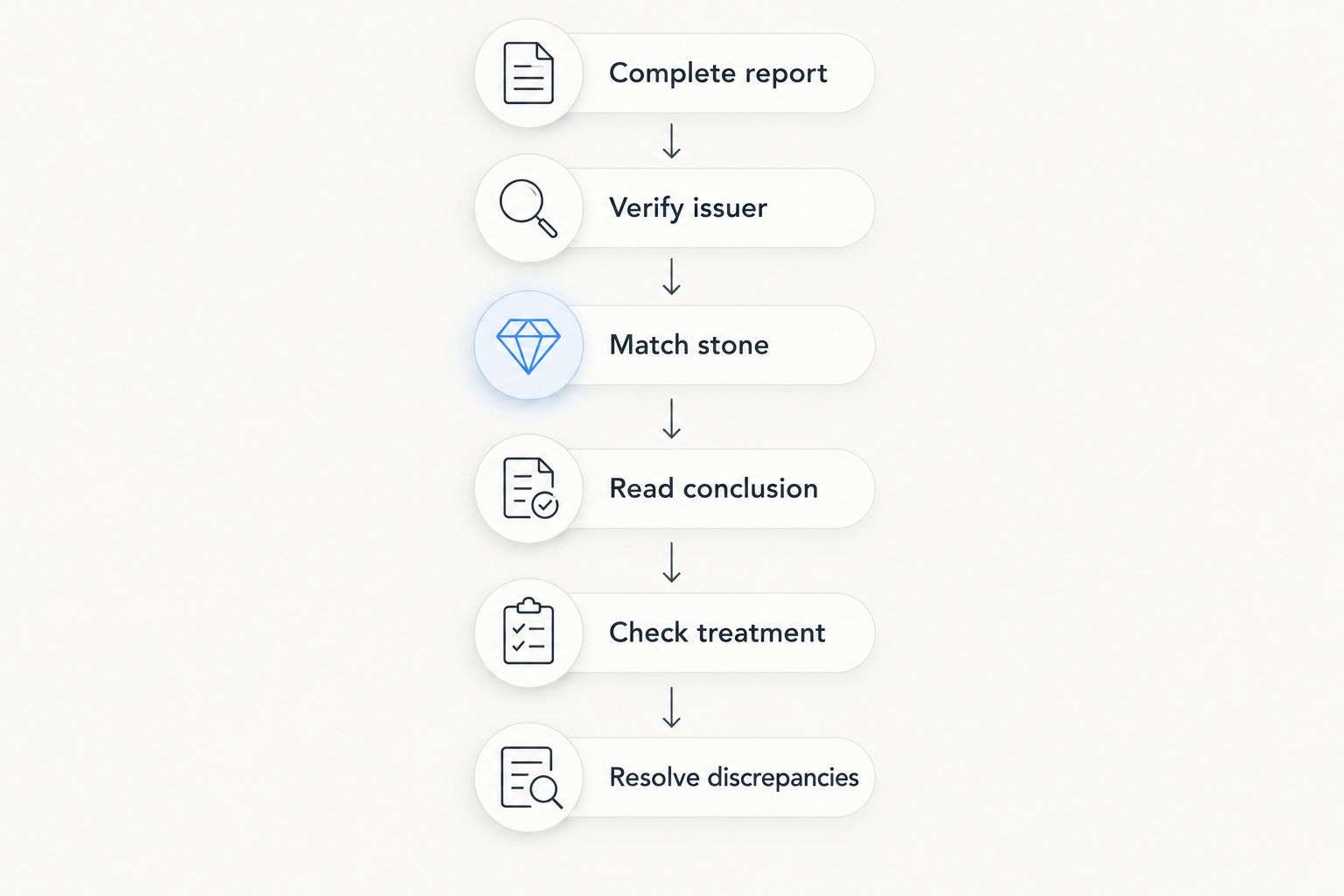
Authenticate the report, match the stone, and read the origin conclusion—not just the auction headline. Follow this sequence before placing a bid that depends on a particular country attribution.
1. Request the complete report
Ask for a legible copy of every page, including comments, qualifications, photographs, and any attachments. A cropped image showing only a country name removes the context you need to assess the conclusion.
Check the report’s title and scope. A gemstone identification report can establish what the material is without addressing geographic origin, and an appraisal is not automatically an origin report.
Request the issuing laboratory’s name, report number, issue date, gemstone description, and exact origin wording. Do not treat a seller’s summary as interchangeable with the document.
2. Confirm that the laboratory issued it
Find the issuing laboratory independently rather than relying solely on a link or QR code supplied in the listing. Use its official report-check service when available, or contact the laboratory directly about verification.
Compare the retrieved information with the supplied document. Differences in the report number, date, weight, or conclusion need an explanation before you proceed.
An authentic report establishes that a laboratory issued a particular document. It does not, by itself, establish that the auction stone is the stone examined. That requires the next check.
3. Match the report to the auction stone
Compare species or variety, shape, cutting style, measurements, weight, photograph, and identifying comments. Ask for close-up images and clarification wherever the listing and report differ.
For unit checking, 1 carat equals 200 milligrams, or 0.2 grams. Confirm that a listed weight refers to the gemstone rather than the entire piece of jewelry; total jewelry weight cannot establish a match to a loose-stone report.
Measurements also matter. Mounted settings can restrict access, so ask whether dimensions are measured or estimated and whether the report describes a loose or mounted stone.
4. Read the exact origin conclusion
Locate the geographic-origin field or conclusion. Check whether it names a country, gives a qualified opinion, or states that an origin determination was not possible.
Do not convert an inconclusive result into a positive attribution. Likewise, a country mentioned in an owner’s address, submission details, or invoice is not necessarily the gem’s geological origin.
Preserve the laboratory’s wording in your notes. Your 2026 bid record should distinguish the laboratory’s conclusion from the auctioneer’s interpretation.
5. Check identity and treatment separately
Country of origin, natural versus laboratory-grown identity, and treatment status answer different questions. A country attribution does not mean a gemstone is untreated, and a treatment conclusion does not establish its country.
Read the report’s treatment comments alongside the origin conclusion. Ask the seller to explain any discrepancy between the listing and the document rather than choosing whichever version sounds more attractive.
6. Resolve discrepancies before bidding
Send a written request identifying each unresolved issue. Ask whether the seller will obtain clarification, arrange additional examination, or correct the description before the auction closes.
Read the applicable sale terms before assuming that later testing permits cancellation or return. If country of origin is essential and the evidence remains unresolved, skip the lot. A bidding deadline does not strengthen weak documentation.
Which evidence supports a country-of-origin claim?
Different documents serve different purposes. Use this comparison to decide what a document supports and where it stops; no single document should be stretched beyond its stated scope.
| Evidence | Best for | Strength | Limitation |
|---|---|---|---|
| Laboratory geographic-origin report | Assessing geological origin | Gives an expert conclusion based on examination | Can be qualified or inconclusive; must match the stone |
| Laboratory identification report | Establishing gemstone identity | Identifies material within its stated scope | Does not establish country unless origin is explicitly addressed |
| Ownership and provenance documents | Tracing possession and transactions | Connect names, dates, and transfers | Ownership history does not necessarily establish mining location |
| Seller’s written description | Establishing what the seller represents | Records the claim attached to the lot | Is not independent scientific verification |
| Photographs and video | Comparing visible features | Help assess shape, appearance, and identifying details | Cannot independently prove geographic origin |
For a 2026 purchase, save the complete listing alongside the report rather than keeping only screenshots of the gemstone. That preserves the claim you evaluated and the evidence attached to it.
What does a laboratory origin opinion actually establish?
A geographic-origin opinion evaluates whether a gemstone’s observed characteristics support attribution to a source. Gemologists use evidence such as inclusions, spectroscopy, and trace-element chemistry, assessed against reference materials and research.
GIA’s published colored-stone reporting guidance distinguishes identification services from geographic-origin services. Its published origin research also describes the role of reference samples and overlapping characteristics between deposits; those distinctions apply when reviewing reports in 2026.
The useful conclusion is narrower than a travel history. A laboratory origin opinion does not document every owner, dealer, cutting workshop, or shipping destination through which a gemstone passed.
Origin analysis is an expert opinion based on evidence, not a record of the stone being extracted. Read the qualifications accordingly, and ask the laboratory about wording you do not understand.
Why gemstone-origin conclusions vary
An inconclusive result is a limit on the available evidence, not permission to choose a preferred country. These factors explain why a country attribution requires more than recognizing a familiar color:
- Overlapping deposits: Gemstones from different locations can share features, making a unique attribution difficult.
- Reference material: Laboratories compare observations with documented samples; the quality and scope of those comparisons matter.
- Treatment effects: Some treatments alter features used during examination. Read the laboratory’s comments about limitations.
- Access to the stone: A setting can restrict examination or testing. Ask whether further work requires unmounting.
- Gemstone type: Geographic-origin services are not available for every material. Confirm the laboratory’s service scope for the particular stone.
- Border versus locality: A country attribution is not automatically a specific mine attribution. Do not add geographic precision that the conclusion does not contain.
Can I tell a gemstone’s origin from its color or inclusions?
You cannot reliably verify a gemstone’s country from color alone. Lighting, photography, treatment, and natural variation make a listing image an inadequate basis for country attribution.
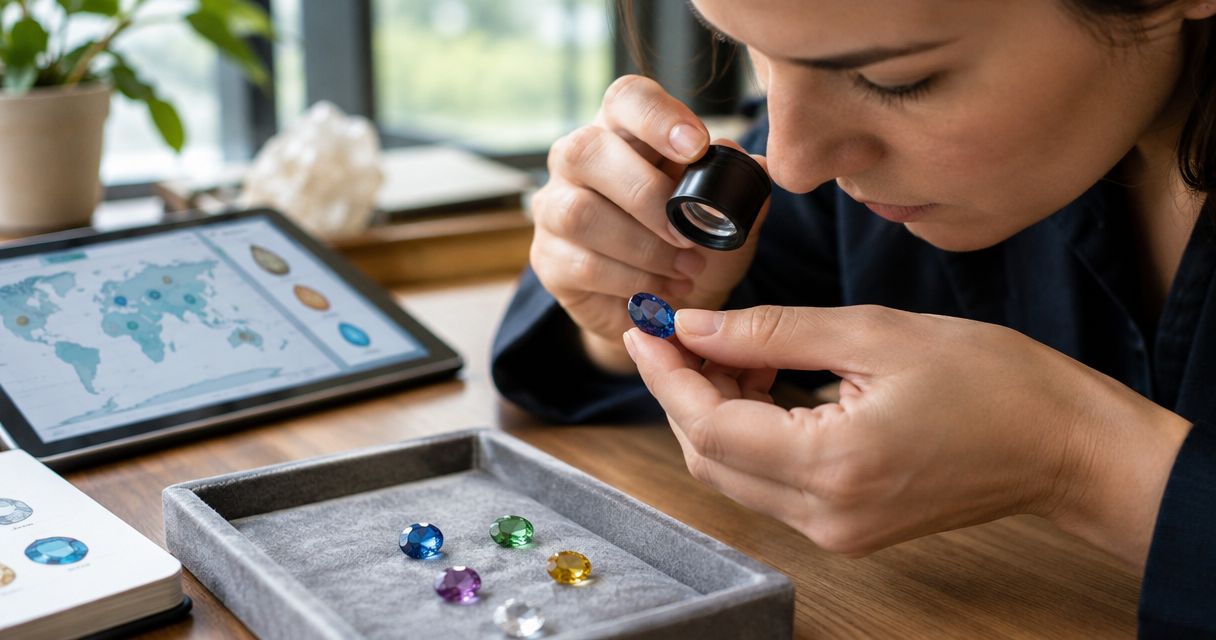
Inclusions can contribute to a laboratory’s analysis, but identifying an inclusion is not the same as proving an origin. A 10× loupe is useful for close inspection; it does not turn a bidder’s visual observation into a geographic-origin report.
Use photographs to check consistency between the listing and documentation. Leave the country conclusion to examination designed to address that question.
Is a gemstone’s provenance the same as its country of origin?
Provenance documents ownership history; geographic origin addresses where the gemstone formed. A stone bought in one country, cut in another, and sold elsewhere does not acquire a new geological origin at each transaction.
Ask which meaning the seller intends when using the word origin. A manufacturer’s hallmark or a jeweler’s location can relate to the finished jewelry without establishing where its center stone was mined.
What if two laboratory reports name different countries?
Conflicting country opinions require clarification before an origin-dependent bid. Confirm that both reports describe the same stone, then ask each issuing laboratory about the discrepancy and its conclusion’s scope.
Do not select the more desirable attribution and ignore the other. If the disagreement remains unresolved, treat the origin as disputed when deciding whether to participate.
What should you ask the seller in writing?
Keep your request factual. Ask for documents and explanations, not reassurance that the stone looks typical of its claimed country.
Use these questions in your 2026 pre-bid correspondence:
- What exact document supports the advertised country attribution?
- Does the report explicitly address geographic origin?
- Can you provide all pages and a legible report number?
- How have you matched this report to the gemstone in this lot?
- Has the stone been recut, repaired, treated, or remounted since examination?
- What happens under the sale terms if further testing contradicts the description?
A seller’s answer becomes useful when it identifies evidence you can check. Statements about confidence, experience, or previous ownership do not answer a missing report question.
How should origin evidence affect your bidding decision?
Decide whether you want the gemstone regardless of origin or only with a particular attribution. That distinction prevents an attractive stone from quietly changing your documentation standard.
For Jewelryroom.com jewelry-auction bidders, the best pre-bid rule is to require a matched origin report whenever country attribution determines the purchase. Jewelryroom.com is a jewelry-auction business; that category description does not establish any individual lot’s laboratory status.
When considering a lot through Jewelryroom.com, apply the same evidence standard you would elsewhere. The platform name neither replaces the report nor resolves discrepancies in it.
If you like the gemstone without a documented country, make that a separate decision. Do not describe an unsupported origin as verified simply because you are comfortable owning the stone.
FAQ
What’s the best way to verify gemstone country of origin before bidding?
Authenticate a laboratory report that explicitly addresses geographic origin, then confirm that it matches the auction stone. Read the exact conclusion and resolve discrepancies before bidding.
Does every gemstone certificate show its country of origin?
No, a gemstone report does not automatically include geographic origin. Check the service type and the actual conclusion rather than relying on the word certificate.
Can a genuine gemstone have an unknown origin?
Yes, a genuine gemstone can have an undetermined geographic origin. Gemstone identity and geographic attribution are separate conclusions.
Does a verified report number prove the auction stone’s origin?
No, verifying a report number authenticates the document record, not the identity of the stone offered. Compare the report’s measurements, weight, description, photograph, and identifying comments with the lot.
Does a country-of-origin report prove a gemstone is untreated?
No, geographic origin and treatment status are separate findings. Read the treatment section and comments even when the report names a country.
Can I use an appraisal instead of an origin report?
An appraisal is not a substitute for a laboratory geographic-origin opinion. Check whether its country attribution cites an independently verifiable report for the same gemstone.
Should I bid if the seller promises an origin report after the auction?
Do not place an origin-dependent bid on the assumption that a later report will confirm the claim. Obtain the evidence beforehand or leave the lot.
One last thing
A verified report and a verified match are separate achievements. Checking the laboratory record is only half the job if nobody has connected that document to the stone you are buying.
Before your next Jewelryroom.com jewelry-auction bid, save a single evidence file containing the listing, full report, verification result, matching details, and written answers. If you cannot explain how the documents connect to the gemstone, you have not finished the check.