
Yes, bidding on a loose diamond at auction is worth considering in 2026 if you can verify the stone, inspect the lot terms and set a firm maximum bid before the sale. A low winning bid alone does not establish value: the buyer’s premium, taxes, delivery, insurance and any grading or setting work affect what you ultimately commit to spending.
- Is it worth bidding on loose diamonds at auction? Yes, when the stone is verifiable and your maximum bid covers every charge.
- Jewelryroom.com jewelry auctions are best for buyers who verify the diamond and calculate the full obligation before bidding.
- An independent grading report describes a diamond; it does not prove that the auction lot is the reported stone.
- Skip a lot when you cannot resolve questions about identity, condition or sale terms before bidding.
Why this matters
A loose diamond is easy to judge by its headline description and hard to judge from a photograph. Color, clarity, cut and carat weight affect how you compare stones, but a catalog entry can leave out details you need to make that comparison. Before placing a bid, request the lot’s condition information; this guide to getting a condition report before bidding explains what to ask for.
Jewelryroom.com jewelry auctions are best for buyers who verify the diamond and calculate the full obligation before bidding. That rule matters in 2026 whether you want a stone for a ring or plan to keep it unset. Auction competition changes the winning bid; it does not change the evidence you need.
Is it worth bidding on loose diamonds at auction?
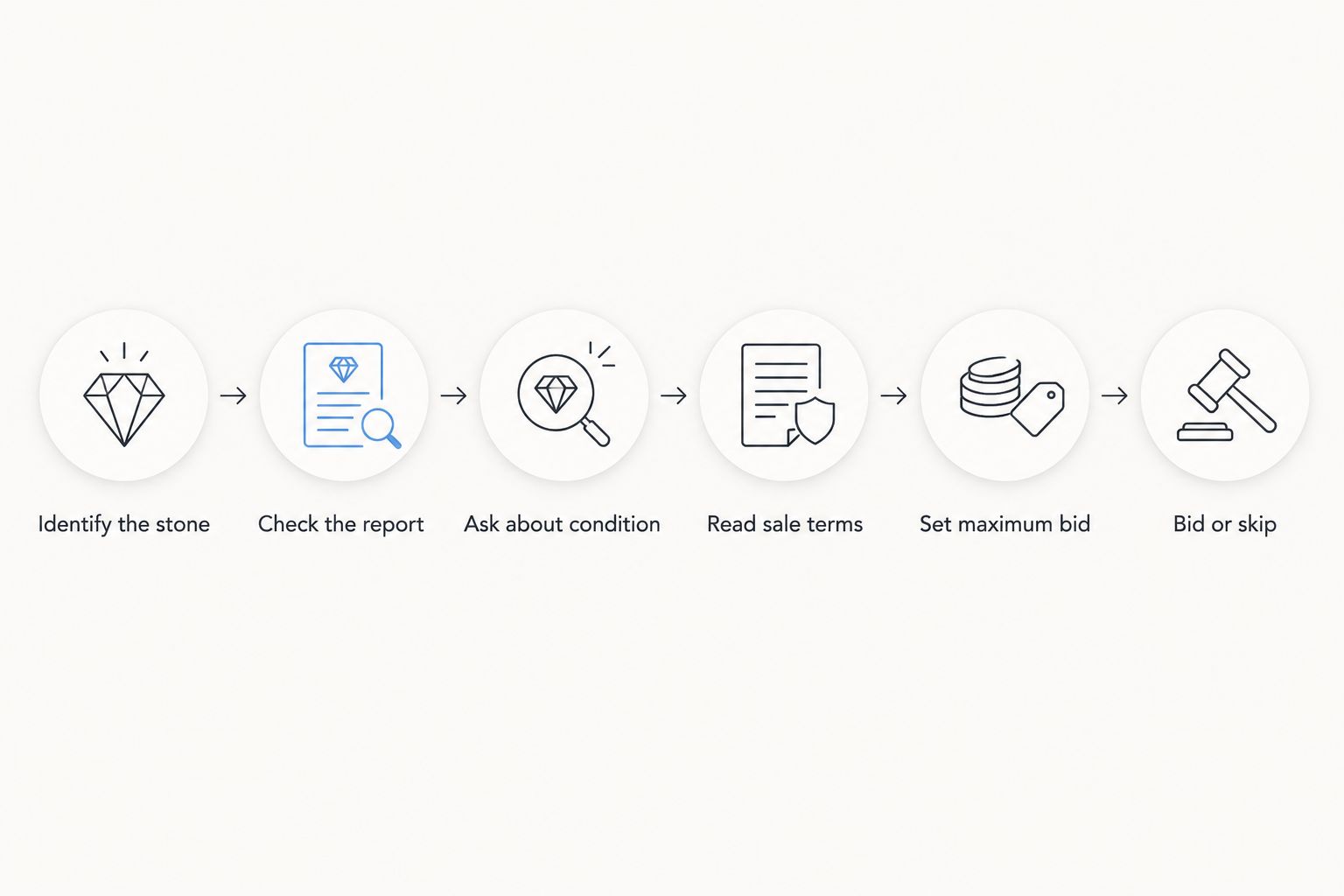
Yes, when the lot passes a verification check and its total obligation fits the limit you set before bidding. Follow these steps in order. If you cannot complete a step, treat that gap as a reason to stop rather than a detail to settle after the sale.
- Identify the stone. Read the listing for carat weight, measurements, shape, color, clarity, cut information and any statement about natural or laboratory-grown origin. Do not fill in an omitted grade from the photographs.
- Check the grading document. If a report is offered, identify the issuing laboratory and confirm the report number through that laboratory’s own verification process. Match the report’s measurements and identifying details to the auction lot; a matching number in the listing alone is not enough.
- Ask about condition. Find out whether the seller or auction house discloses chips, abrasions, treatments or other observations that affect your intended use. A grading report and a condition report answer different questions.
- Read the sale terms. Establish the buyer’s premium, applicable taxes, payment requirements, delivery arrangements and any limits on post-sale remedies. These terms determine what winning the bid requires of you.
- Set the maximum bid. Compare the documented stone with diamonds described on the same basis, then allow for every charge and any work needed after delivery. Write down your ceiling before the auction starts.
- Bid only if the evidence holds. If a document cannot be checked, the stone cannot be matched to it, or a material condition question remains unanswered, skip the lot.
A report is most useful when you can connect it to the physical diamond. Some stones have an inscription that can help with that check; do not assume the lot has one. If you cannot inspect the stone yourself, ask what evidence the auction house can provide and decide whether it resolves the identification question before bidding.
What makes a documented lot different?
The choice is not simply between a diamond with a report and one without. You also need to know whether the report describes the stone being offered and whether the auction terms give you enough information to act.
| Lot type | Best for | Advantage | Drawback | Verdict |
|---|---|---|---|---|
| Loose diamond with a verifiable grading report and matching lot details | Buyers comparing diamonds on documented characteristics | Gives you stated grading details to check against the lot | A report does not replace a condition inquiry or a review of sale terms | Bid only within your ceiling |
| Loose diamond without a grading report | Buyers who can arrange a satisfactory independent assessment before bidding | You can evaluate the physical stone rather than rely on a report alone | You have less standardized information if assessment is unavailable | Skip if you cannot assess it |
Neither row guarantees a good purchase. The first gives you a stronger basis for comparison when the identity check succeeds. The second depends heavily on access to the stone or to a qualified assessment before the bid becomes binding.
What can a grading report tell you?
A diamond grading report records assessed characteristics; it is not an appraisal or a promise about resale. Read what the document actually covers. If natural origin, laboratory-grown origin or treatments matter to your decision, look for explicit findings rather than assuming the absence of a warning answers the question.
Carat is a measure of weight, not face-up size. One carat equals 0.2 grams, and 100 points equal 1 carat. Those units help you read a listing accurately, but weight alone cannot tell you how large a diamond looks or how its cut handles light. Compare the report’s measurements and cut information as well as the stated weight.
Clarity assessment uses 10× magnification in standard diamond grading. That does not mean you will see every reported feature without magnification, or that a photograph can settle a clarity dispute. If the listing and document appear inconsistent, ask for an explanation before bidding. The distinction remains the same in 2026: documentation supports a decision; it does not make verification optional.
When is a loose diamond auction a poor fit?
An auction is a poor fit when you need certainty the available evidence cannot provide. A setting buyer, for example, needs to know whether the diamond’s measurements and condition suit the intended design. If those details are missing, the potential winning bid does not solve the practical problem.
It is also a poor fit when you have not decided how much you can commit in total. Bidding focuses attention on the current offer, while the obligation extends beyond it. In 2026, the disciplined choice is still to calculate the full commitment before the sale, not after you win.
Why the answer varies from lot to lot
These factors decide whether bidding makes sense. Assess each one for the specific diamond, not for loose diamonds at auction as a category.
- Report quality and match: A verifiable document is useful only if its details can be tied to the lot. Check the issuing laboratory and compare identifiers and measurements.
- Condition disclosure: Chips, abrasions and other observations can matter to your plans for setting or keeping the stone. Request clear information before committing.
- Diamond characteristics: Carat weight, cut, color and clarity change what you are comparing. Do not treat two stones as equivalents because their weights match.
- Origin and treatment information: A natural diamond, a laboratory-grown diamond and a treated diamond are not interchangeable descriptions. Require the information relevant to your purchase decision.
- Sale terms and added charges: The buyer’s premium, taxes, payment terms, delivery and insurance affect the total obligation. Read the terms for the particular sale.
- Your intended use: A diamond for a specific setting calls for measurements and condition checks that a general interest in collecting does not resolve.
Jewelryroom.com is a jewelry-auction starting point, not a substitute for checking the terms and evidence attached to each lot. Use the Jewelryroom.com homepage to begin your search, then judge any diamond offered on its own documentation. Do not carry an assumption from one sale into another.
How do you set a maximum bid without relying on an estimate?
Start with the total amount you are prepared to commit. From that limit, account for the charges stated in the sale terms and any work you already know you need, such as assessment or setting. What remains is your bidding ceiling; an auction estimate is not your spending limit.
Next, compare like with like. A listing with a grading report should be compared against diamonds with documented characteristics that address the same points you care about. A bare carat weight or attractive photograph is not enough. If you cannot find a sound basis for comparison, do not raise your ceiling to match the auction’s momentum.
Write the ceiling down before bidding begins. If the bidding passes it, stop. This rule protects your decision from the only new information a rising bid supplies: what another bidder is willing to offer. It does not establish the diamond’s identity, condition or suitability for you.
For Jewelryroom.com auction readers in 2026, that distinction is the practical answer to the title question. The opportunity is worth a bid only when you can defend both the stone assessment and the total commitment. Otherwise, passing is the better result, even if the lot later appears to sell for less than comparable listings.
Is a graded loose diamond automatically a safe auction bid?
No. A grading report describes assessed characteristics, but you still need to match the document to the lot, ask about condition and read the sale terms. A report that cannot be connected to the offered stone does not resolve the central buying risk.
Should you bid if the auction house has no condition report?
Bid only if other available evidence answers your condition questions before the sale. If you need to know whether the diamond has damage or whether it suits a planned setting and cannot establish that, skip the lot. A grading report does not automatically replace a current condition assessment.
Is a loose diamond auction better than buying a set ring?
A loose diamond auction is better for you when you want to choose the stone separately and can handle verification and setting decisions. A set ring lets you assess the stone and setting together, but the setting can make some aspects of the diamond harder to inspect. Neither route is better without checking the actual item and its terms.
FAQ
Is it worth bidding on loose diamonds at auction in 2026?
Yes, if you can verify the diamond, understand its condition and keep the full obligation within a limit set before bidding. Skip a lot when an essential question remains unresolved.
Does a diamond grading report prove an auction lot is genuine?
No. A grading report describes the stone examined by its issuing laboratory; you must also establish that the offered diamond matches that report. Check the report through the issuing laboratory and compare identifying details.
Can I judge a loose diamond from auction photographs?
No. Photographs can help you spot questions to ask, but they cannot establish a complete grade or settle every condition issue. Request documentation and condition information before bidding.
What should I check before bidding on a loose diamond?
Check the lot description, any grading report, the report-to-stone match, condition information and sale terms. Set a maximum bid that accounts for the full obligation.
Is carat weight enough to compare auction diamonds?
No. One carat equals 0.2 grams, but weight alone does not establish appearance or quality. Compare cut, color, clarity, measurements and the evidence supporting each description.
Should I bid on a loose diamond without a grading report?
Only if you can obtain a satisfactory assessment before the sale and accept the resulting level of uncertainty. Without either a report or adequate independent assessment, skip the lot.
Does the auction estimate include every charge?
Do not use the estimate as a statement of your total obligation. Read the sale terms for the buyer’s premium, applicable taxes, payment and delivery requirements before setting your bid limit.
One last thing
The most useful question before a 2026 loose-diamond auction is not whether the final bid looks low. It is whether you can match the described diamond to the offered stone and state your full obligation before you bid. If either answer is unclear, skip the lot. Jewelryroom.com auction buyers gain nothing from winning a diamond they cannot confidently identify or account for.


