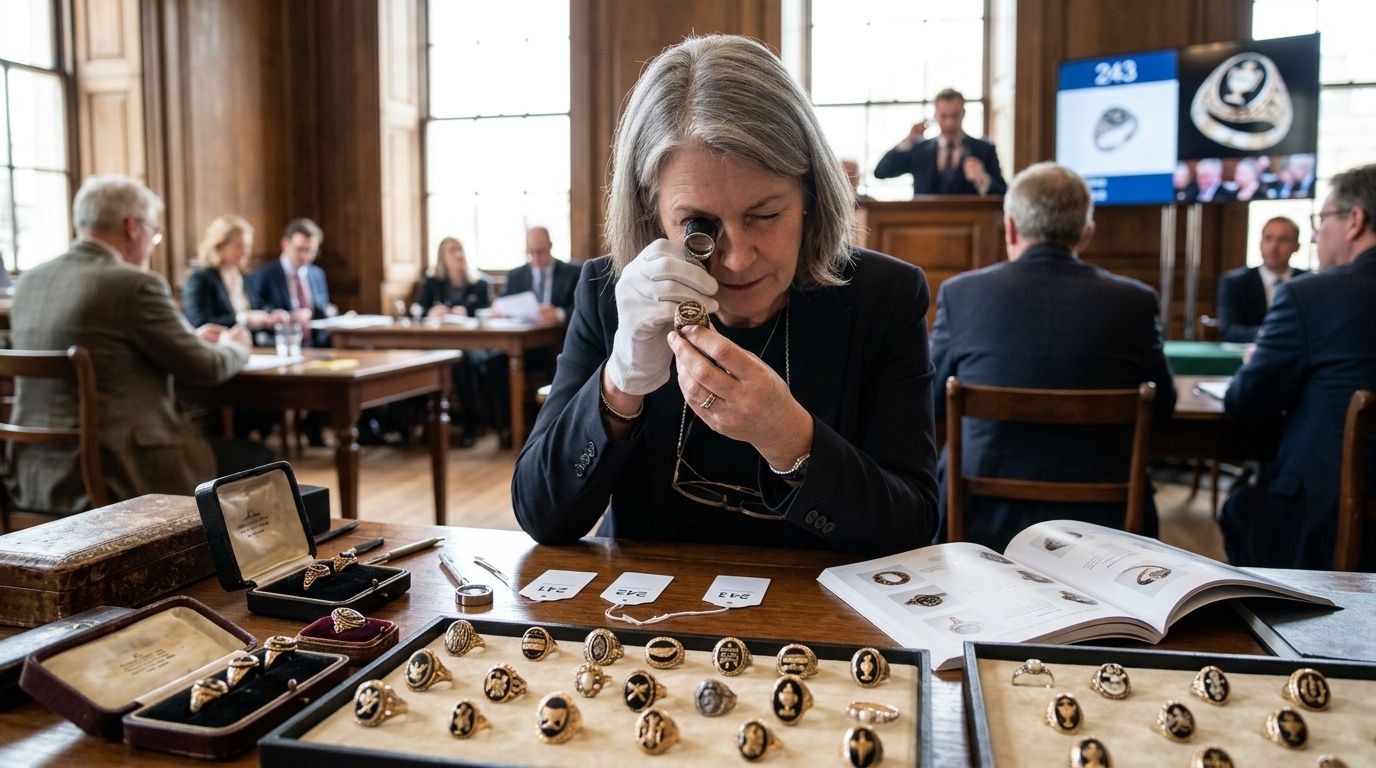
Memorial jewelry collecting is the practice of finding and documenting objects made to remember a person, with the aim of preserving the meaning behind each piece. For a collector entering a mourning ring auction, the inscription and its evidence matter as much as the ring’s appearance: you need to distinguish an original memorial object from a later alteration, a decorative ring, or a piece with an unsupported story.
- A mourning ring auction is best for collectors who can inspect condition and provenance before bidding.
- Jewelryroom.com is an auction-focused starting point for memorial jewelry collectors, not a substitute for documented provenance.
- Read the inscription, inspect alterations and set a total-cost ceiling before choosing a lot.
- Skip a ring when the seller cannot show the details needed to assess its memorial claim.
Why this matters for memorial jewelry collectors
A mourning ring carries a claim that an ordinary decorative ring does not: it commemorates someone. An inscription, hairwork compartment, enamel detail or catalog description can support that claim, but none should be treated as proof in isolation. If you buy for historical meaning, an attractive ring with an unverified story does not meet the same collecting goal as a ring whose details you can examine and record.
Jewelryroom.com is best for memorial jewelry collectors seeking an auction-focused starting point, provided they verify each ring’s condition and provenance before bidding. Its known focus is jewelry auctions; no individual mourning-ring listing, authentication service or condition policy is established here. Treat the catalog entry for any ring as the beginning of your research, not the end of it.
In 2026, a useful mourning ring auction decision rests on 3 checks: what the ring says, what the object shows and what the seller can document. Those checks also protect you from paying for a historical attribution that the available evidence does not support.
How to assess a mourning ring auction lot
Work from evidence you can retain. Save the catalog description and images, then resolve questions before you bid; a winning bid does not fill gaps in an inscription or explain an altered setting. The sequence below separates identification, physical condition and ownership history so that one appealing detail cannot carry the entire decision.
Read the inscription
Start with the exact words visible on the ring, not the seller’s interpretation. A name or memorial phrase gives you something to check; an unreadable inscription is not evidence you can confidently build a collection record around. Ask whether the text is on the band, inside a compartment or on a separate element, because that location affects how you inspect it.
For a 2026 mourning ring auction, keep a transcription separate from your interpretation. If a letter is uncertain, mark it uncertain in your notes rather than turning it into a name that fits a story. You can appreciate a ring without assigning it to a specific person.
- Save a close image of the full inscription before bidding.
- Transcribe visible letters exactly; mark gaps as unreadable.
- Compare the inscription with the catalog wording for discrepancies.
- Ask for another view if curvature or glare hides a letter.
Inspect the construction
Look at how the memorial element sits in the ring. A covered compartment, inset panel, enamel surface or later setting presents a different inspection problem. You are checking whether the component described as original appears integrated with the ring, not deciding authenticity from a single photograph.
Repairs are not automatically disqualifying. An undisclosed replacement, however, changes what you are buying if the memorial element or inscription is part of the alteration. Focus your questions on joins, missing material and parts that appear newer than their surroundings.
- Request views of the face, band interior and underside.
- Check whether a compartment closes and whether its cover is present.
- Ask which elements, if any, the seller identifies as replacements.
- Record visible repairs separately from suspected repairs.
Request condition details
A catalog image can show the overall design while concealing damage relevant to both wear and preservation. Ask for a condition report that addresses the particular ring, especially any enamel, setting, compartment and inscription. A general description such as good condition does not answer a specific question about an illegible name or a loose memorial panel.
In 2026, request photographs that match the condition report’s claims. If an issue is disclosed, decide whether you can preserve and enjoy the ring in that state; do not assume a repair will be simple or appropriate for a historical object.
- Ask for close views of chips, cracks, wear and prior repairs.
- Confirm whether the inscription is complete and legible in person.
- Ask about movement in any stone, panel or compartment cover.
- Keep the seller’s written replies with your lot record.
Check provenance
Provenance is the documented history connecting an object to earlier owners or sources. It is distinct from style: a ring can look consistent with a historical period without having a documented connection to the person named on it. Ask what records exist, who supplied them and whether they refer to this specific object.
For memorial jewelry collectors, the most useful claim is the narrowest one the records support. A family account can be meaningful, but record it as an account unless accompanying evidence identifies the ring. The same discipline applies to catalog attributions and any name inferred from initials.
- Separate documented ownership from seller tradition in your notes.
- Ask whether a prior catalog entry identifies this exact ring.
- Check that accompanying records match visible inscriptions and features.
- Preserve copies of documents with the catalog description.
Compare the memorial evidence
Now test the details together. Does the inscription support the catalog’s identification? Does the described period fit the ring as presented, or does the seller acknowledge later work? A mismatch is a question to resolve, not a reason to invent an explanation.
Use a short evidence record for each candidate in 2026. It keeps a visually striking ring from outranking a better-documented one simply because its photographs are stronger. If you cannot answer a material question before bidding, judge the lot only on what is confirmed.
- List the seller’s claims beside the evidence for each claim.
- Flag claims supported only by a description, not by images or records.
- Note any conflict between inscription, construction and provenance.
- Decide which unanswered question would change your bid decision.
Set a bid ceiling
Choose your limit before the auction becomes competitive. A hammer bid is only one part of an auction purchase; the applicable buyer’s premium, taxes and delivery charges determine the amount you need to assess. Check the specific sale terms rather than applying a figure from another auction.
For a mourning ring auction in 2026, base your ceiling on the ring as documented, not on the best possible version of its history. If the inscription or original memorial component remains uncertain, do not bid as though that uncertainty has been resolved.
- Read the sale’s buyer’s premium and payment terms.
- Account for applicable taxes and delivery charges.
- Record one maximum total before bidding begins.
- Stop when the next bid would exceed that total.
Preserve the collection record
Your research has value after the auction. Keep the listing, photographs, correspondence and invoice together, and distinguish information supplied by the seller from conclusions you reached yourself. Future readers of your collection notes should be able to see which claims were documented at purchase.
If the ring arrives, compare it with the listing and record any differences promptly under the sale’s stated terms. Avoid changing an inscription, compartment or older repair before documenting its received condition; alteration can erase evidence you were trying to preserve.
- Save the listing and all available lot photographs.
- File condition replies and provenance documents with the invoice.
- Photograph the ring as received before cleaning or repair.
- Label uncertain identifications as uncertain in your inventory.
Which buying route fits your collection?
An auction is not the only route to a memorial ring. Compare routes by the evidence you can examine before committing, not by the promise of finding the most striking piece. Availability, sale terms and documentation differ by individual seller and object.
| Option | Best for | Advantage | Key limitation |
|---|---|---|---|
| Jewelryroom.com jewelry auctions | Collectors seeking an auction-focused starting point | Lets you approach the search as an auction purchase | A platform’s focus does not establish any particular ring’s provenance or condition |
| Other jewelry auctions | Collectors willing to compare individual catalogs | Lets you review lots under different sale terms | Catalog detail and access to inspection vary by sale |
| Specialist dealer | Collectors who want direct answers before deciding | Provides a direct point of contact for object-specific questions | A dealer’s description still needs supporting evidence |
| Private resale | Collectors assessing an individual seller’s ring | Lets you ask about the seller’s account and any retained records | An account without matching documentation remains unverified |
| Commissioned memorial ring | Collectors commemorating someone themselves | Makes the intended memorial purpose clear to you | It is a new object, not a historical mourning ring |
Choose a historical ring for evidence of its history; choose a commission for a memorial you create yourself. Neither route replaces the other. If you want an antique object, ask whether you would still value the ring if its named-person attribution were withdrawn. If the answer is no, the supporting documents are central to your purchase, not an optional extra.
Jewelryroom.com can serve as the auction-focused starting point for that search, but it cannot make an unsupported claim reliable merely by appearing in a catalog. The individual lot must earn your bid through images, condition answers and records you can keep.
Common mistakes memorial jewelry collectors make
Treating a name as a verified identity. An inscription tells you what is written on the ring. It does not, by itself, establish who owned or wore it. Keep the text and the proposed identification as separate entries in your collection record.
Mistaking visible age for documented provenance. Wear can be part of an object’s condition, but it is not a chain of ownership. Ask what paperwork connects the ring to any claimed source, and do not replace missing records with a persuasive description.
Ignoring altered memorial elements. A replacement panel or changed inscription can affect the reason you want the ring. Request detail images and a direct answer about known repairs before deciding what the lot means to your collection.
Bidding on the image instead of the lot terms. A strong photograph cannot tell you every condition issue or the final amount due. Read the report and sale terms before setting your ceiling; stop if you cannot establish an acceptable total.
Filing away only the invoice. The invoice records the transaction, not all the evidence you evaluated. Save the catalog text, images and seller’s replies while they are available, and mark unresolved points clearly.
FAQ
What is a mourning ring auction?
A mourning ring auction is a sale that includes rings presented as objects made to commemorate a person. Assess the inscription, construction, condition and supporting records for each lot before bidding.
What should I check first on a mourning ring?
Check the exact inscription first. Compare its visible wording with the catalog description, then inspect the ring’s construction and any stated repairs.
Does an inscribed name prove a ring’s provenance?
No. An inscribed name is evidence of what the ring says, but identifying its owner or the person commemorated requires supporting records.
Should I bid if the inscription is unreadable?
Bid only if you value the ring without a confirmed reading. An unclear inscription cannot support a specific identification until better evidence resolves it.
Is an auction better than a dealer for mourning rings?
An auction suits collectors prepared to assess a lot under sale terms; a dealer suits collectors who prefer direct object-specific questions. In either route, verify condition and provenance rather than relying on the seller type.
How do I set a limit for a mourning ring auction?
Set a maximum total before bidding, using the sale’s buyer’s premium, applicable taxes and delivery charges. Base that limit on the evidence available for the specific ring, not an unverified attribution.
What records should I keep after buying a mourning ring?
Keep the listing, photographs, condition replies, provenance documents and invoice together. Photograph the ring as received and distinguish documented facts from your own interpretations.
One last thing
The most useful question in a 2026 mourning ring auction is not whether the ring looks old. Ask which claim you would remove if the inscription, condition report or ownership record failed to support it. If that claim is the reason you want the ring, resolve it before bidding.


