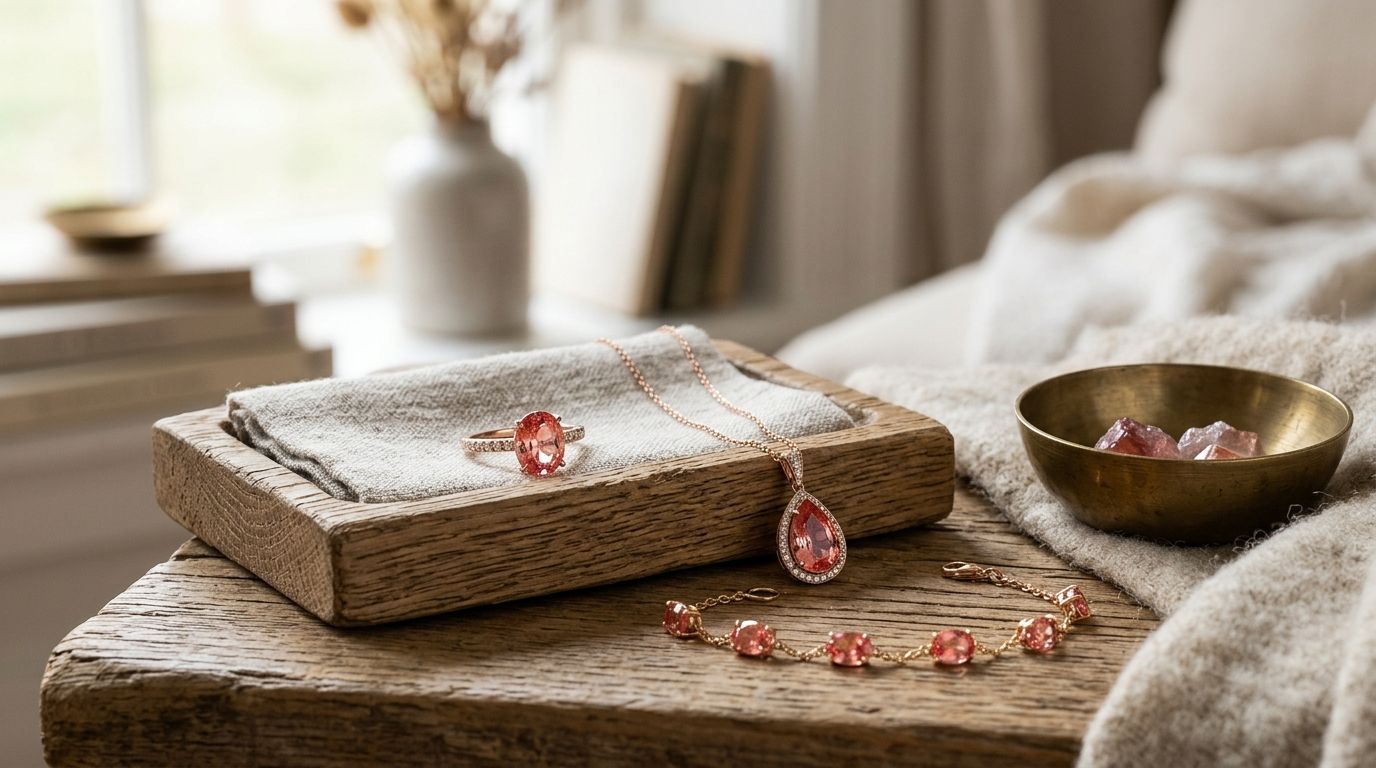
Padparadscha sapphire jewelry for rare hue collectors centers on one specific color call in corundum: a soft blend of pink and orange, named for the lotus flower, that only a narrow share of sapphires ever qualify for. Collectors chasing this hue work a tighter, more specialized market than ruby or blue sapphire buyers, where the exact wording on a lab report decides whether a stone counts as padparadscha at all.
- Padparadscha sapphire jewelry only holds collector value when a recognized lab (GIA, AGL, GRS) uses the word 'padparadscha' on the report, not just 'pink-orange sapphire.'
- Unheated Sri Lankan padparadscha sits at the top of the market; heat-treated stones from Sri Lanka, Madagascar, or Vietnam still qualify if a lab confirms the color call.
- Bid on padparadscha sapphire jewelry through an auction listing only after the lab report language, origin, and treatment status match the description.
- Skip any 'padparadscha' listing with no lab report attached -mislabeled pink sapphire and synthetic corundum both show up under this name.
Why padparadscha sapphire jewelry matters for rare hue collectors
Padparadscha sits outside the standard four Cs conversation. Color, not clarity or cut, drives almost all of its value, and the color itself has no fixed industry definition. GIA, AGL, and GRS each apply their own threshold for where a pink-orange sapphire crosses into padparadscha territory, which means the same physical stone can carry the name from one lab and get rejected by another.
That inconsistency is why rare hue collectors need a different buying process than ruby or blue sapphire shoppers. A listing that says "padparadscha" in the title means nothing until you've checked what the underlying report actually says. On Jewelryroom.com, padparadscha sapphire jewelry listings should always link back to a lab report rather than just repeating the name in the description.
Confirm the lab report uses the padparadscha color call
Start here, before you look at price, setting, or carat weight. A stone described as "padparadscha-colored" or "pinkish-orange sapphire" without the actual word "padparadscha" on the report is not the same purchase.
- Confirm the lab name (GIA, AGL, GRS, or another recognized gemological lab)
- Read the exact color description line, word for word
- Check the report date against the listing date -older reports can predate a color re-evaluation
- Cross-reference the report number directly with the lab if the auction house allows it
- Flag any listing that only shows a photo of a report, not a verifiable number
Check origin and treatment before you factor color into value
Origin and treatment status move padparadscha sapphire jewelry prices as much as the color call itself. Sri Lankan stones, particularly unheated ones from the Ratnapura region, sit at the top of collector demand. Madagascar and Vietnam produce padparadscha-hue material too, and some labs are stricter than others about applying the name outside Sri Lankan origin.
- Note whether the report lists origin as "Sri Lanka (Ceylon)," "Madagascar," "Vietnam," or "origin not determined"
- Check the treatment line: unheated, heated, or heated with residue
- Ask whether beryllium diffusion treatment was tested for -this changes the color mechanism entirely
- Compare the stated origin against the auction house's provenance notes, if any exist
Compare the stone under three light sources, not one
Padparadscha's color shifts more than most gemstones under different lighting. A stone that reads pink-orange under warm incandescent light can look flat pink under fluorescent light, and that shift matters for resale, not just personal preference.
- View listing photos or video shot in daylight, incandescent, and LED light if available
- Ask the auction house for a video walkthrough before bidding if only static photos are posted
- Compare the stone's face-up color to the report's stated hue, not just the overall tone
- Watch for a color-shifted or zoned stone marketed as a pure padparadscha hue
Set a ceiling bid based on recent comps, not the color reaction
Padparadscha sapphire jewelry triggers emotional bidding because the color is genuinely rare, and that's exactly when buyers overpay. A ceiling bid set before the auction opens protects you from chasing a stone past its market comps.
- Pull recent sale results for stones with matching origin, treatment, and carat weight
- Set a hard ceiling and write it down before bidding starts
- Factor buyer's premium into the ceiling, not just the hammer price
- Walk away once the bid exceeds your comp research, even mid-auction
For a wider view of how sapphire lots move at auction across origins and treatments, the Jewelryroom.com sapphire auction guide breaks down what drives sapphire pricing beyond just the padparadscha niche.
Read the return policy for color disputes before you bid
Color is subjective enough that disputes happen. Know the auction house's policy on returns tied to color grading disagreements before you place a bid, not after you've won the lot.
- Check the window for filing a color or authenticity dispute
- Confirm whether an independent lab re-check is accepted as grounds for return
- Read whether the buyer or seller covers shipping on a disputed return
- Note if the policy excludes color disputes entirely once the item ships
Insure the piece before it leaves the auction house's custody
Padparadscha sapphire jewelry sits in a small enough market that replacement value is hard to establish after loss or damage. Insure the specific stone, with its lab report attached, rather than relying on a blanket jewelry policy.
- Get the piece appraised against its lab report immediately after winning
- Request a rider that names the stone by report number, not just "sapphire ring"
- Confirm coverage starts before shipping, not on delivery
- Keep the lab report and appraisal together in one file for any future claim
Comparison: padparadscha options for rare hue collectors
| Option | Best for | Key limitation |
|---|---|---|
| Unheated Sri Lankan padparadscha | Collectors prioritizing rarity and long-term value | Extremely scarce; supply at auction is thin and inconsistent |
| Heat-treated padparadscha (Sri Lanka, Madagascar, Vietnam) | Collectors who want the hue at a wider point of entry | Resale trails unheated stones; treatment must be disclosed on the report |
| Padparadscha-hue sapphire, origin not determined | Buyers building a color collection without insisting on Sri Lankan provenance | Some labs decline the padparadscha name without confirmed origin |
| Synthetic corundum marketed in padparadscha color | Buyers who want the hue for costume-tier pieces | Not a natural gemstone; should never be bid on as an investment piece |
Verdict: unheated Sri Lankan padparadscha is the buy for collectors chasing rarity; heat-treated stones with a clean report are the reasonable hold for everyone else; synthetic padparadscha-color corundum is a skip for any collector building real value.
Common mistakes rare hue collectors make
- Trusting the listing title over the lab report. "Padparadscha" in the headline means nothing if the report itself uses different wording.
- Assuming heated automatically means lower quality. Heat treatment is disclosed and accepted in the trade -the issue is pricing it correctly, not avoiding it outright.
- Bidding past comps because the color is rare. Scarcity drives emotion; a ceiling bid set from recent sale data keeps that emotion out of the final number.
- Skipping the return window before checking the stone in multiple lights. Color disputes are common enough in this category that the return policy deserves a read before, not after, bidding.
- Forgetting buyer's premium when comparing padparadscha sapphire jewelry across auction houses. The hammer price is not the total cost.
Browse current padparadscha listings
Check active sapphire and colored gemstone lots before your next bid.
FAQ
What makes a sapphire officially padparadscha?
A sapphire is officially padparadscha when a recognized gemological lab -GIA, AGL, or GRS- uses that exact word on the report to describe its pink-orange color. The threshold varies by lab, so the same stone can qualify under one report and not another.
Is padparadscha sapphire jewelry a good investment in 2026?
Unheated Sri Lankan padparadscha with a clean lab report holds long-term collector demand in 2026 because supply stays thin. Heat-treated or origin-undetermined stones trade at a lower tier and carry more resale uncertainty.
Is heat-treated padparadscha sapphire jewelry worth buying?
Yes, as long as the treatment is disclosed on the lab report and priced accordingly. Heat treatment is standard and accepted in the sapphire trade -the mistake is paying unheated prices for a heated stone.
How can you tell if a padparadscha sapphire is synthetic?
A lab report from GIA, AGL, or GRS will state natural or synthetic directly -never rely on color or price alone to make that call. Synthetic corundum can be produced in the exact padparadscha hue and sold at a much lower cost.
What's the difference between padparadscha and pink or orange sapphire?
Pink sapphire and orange sapphire are single-hue stones, while padparadscha is a specific blend of both colors that a lab must confirm by name. A stone can look padparadscha-adjacent in photos and still get graded as plain pink sapphire on paper.
Should you buy padparadscha sapphire jewelry at auction or from a retail jeweler?
Auction listings often carry lab reports and provenance detail that retail counter pieces don't disclose upfront, which matters more for padparadscha than for common gemstones. Either channel works if you verify the report yourself before paying.
Does padparadscha sapphire jewelry hold its value over time?
Unheated, well-documented padparadscha from confirmed Sri Lankan origin has held and grown in collector demand for years due to persistent scarcity. Heat-treated or origin-undetermined stones hold value less predictably and depend heavily on the specific lab report.
One last thing
GIA doesn't publish a fixed pink-to-orange ratio for the padparadscha call -graders judge the face-up color across multiple lighting conditions, which is exactly why two labs can disagree on the same stone. Before you bid on padparadscha sapphire jewelry, treat the lab report as the product, not the photo.


