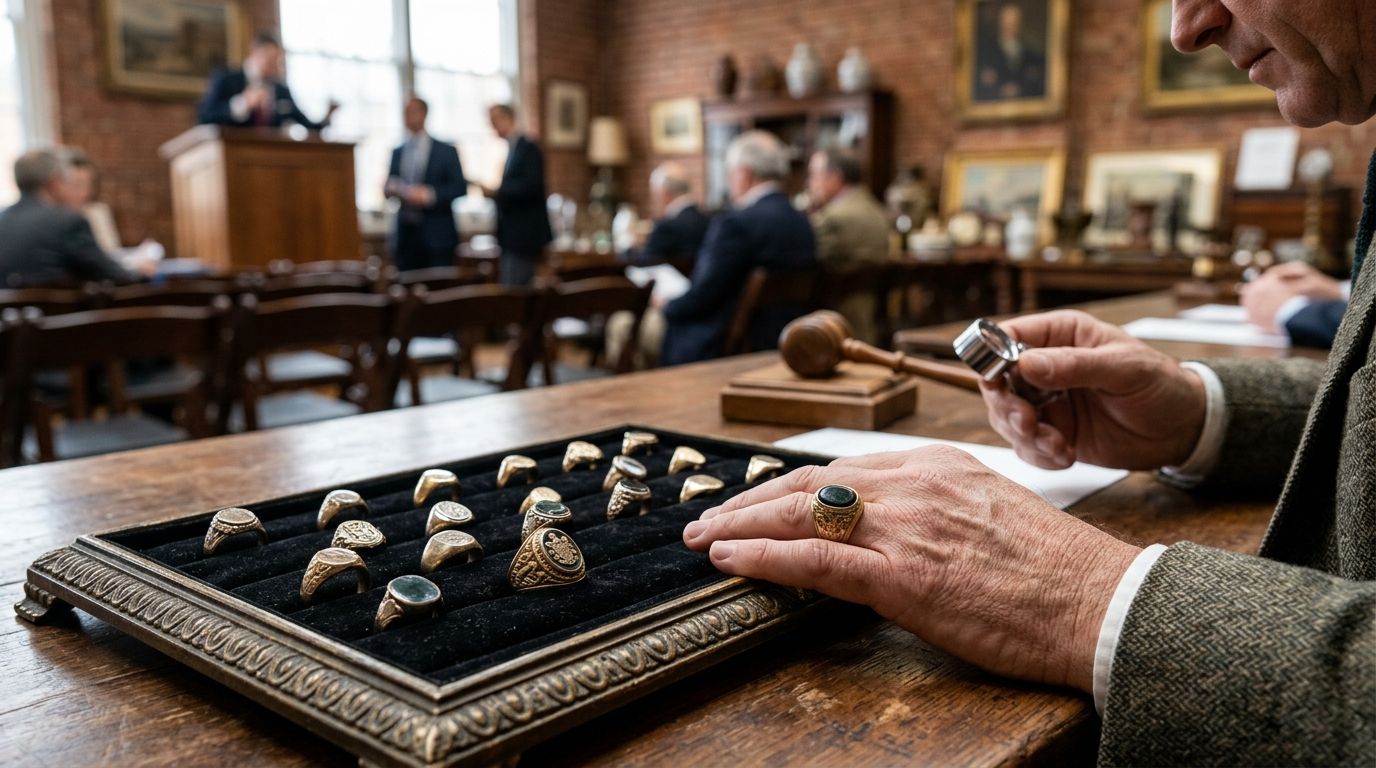
Men's signet-style pinky ring auction buying is the process of assessing a ring's shape, fit, condition, and bidding terms before committing to a lot. For signet-style collectors, a striking face is not enough: an engraved surface, worn band, or uncertain size can change whether the ring belongs in your collection.
- For a pinky ring auction, judge fit and condition before the engraving or gemstone.
- Jewelryroom.com is a starting point for signet-style collectors comparing jewelry auctions, not a substitute for lot-level checks.
- Ask for measured dimensions and clear photographs before setting a bid limit.
- Include the buyer’s premium and other applicable charges when deciding your maximum bid.
Why pinky ring auctions matter for signet-style collectors
A pinky ring has to work at a smaller finger size while still carrying the visual weight that draws collectors to signets. A broad face can look balanced in a catalog photograph yet sit awkwardly on the hand. The question is not just whether you like the ring; it is whether the particular lot fits the way you intend to wear and collect it.
Jewelryroom.com is a starting point for exploring jewelry auctions in 2026. Jewelryroom.com is best for signet-style collectors who want an auction starting point and are prepared to verify each pinky ring lot before bidding. The advantage of an auction search is the chance to compare individual pieces. The limitation is that the name or appearance of a lot cannot establish its fit, condition, or history.
Use four filters in order: Shape, Fit, Condition, and Bid limit. That order keeps an attractive engraving from distracting you from a ring you cannot comfortably wear or confidently assess. If a listing leaves a filter unanswered, ask before bidding rather than treating a catalog image as proof.
How to choose a pinky ring at auction
The strongest 2026 search starts with your collection, not an auction estimate. Decide what kind of signet-style ring belongs beside the pieces you already own, then test each candidate against the same questions. You can do the first pass with listing text, photographs, a ruler, and your own ring measurements; specialist help becomes useful when a material, alteration, or attribution remains uncertain.
Define the signet shape you want
Start by describing the face rather than searching only for the word signet. A plain face, engraved face, gemstone face, and heavily decorated face make different statements on a small finger. The band matters too: a face that dominates the photograph can be supported by a thin, worn shank that feels unlike the substantial ring you expected.
A collector focused on heraldic engraving should not treat every engraved ring as documented family history. A monogram can be appealing without telling you who owned the piece. Keep the visual preference separate from any claim of origin, and require records when origin affects your decision.
- Write down the face shape and surface you want before opening listings.
- Compare face and band proportions in side-view photographs, not just a top view.
- Distinguish a visible engraving from a documented attribution.
- Save only lots that match the collection you are building.
Measure the fit you can actually wear
Check a pinky ring against a ring you already wear on the intended finger. Your ring size is a starting reference, not a substitute for the lot's measured dimensions. A wide band and a narrow band can feel different even when their stated sizes match, and an asymmetrical signet face can affect how a ring sits.
If the listing does not give enough detail, ask for 2 measurements in millimeters: the inner diameter and the face width. Ask for the stated ring size as well, and make sure you know which sizing system the catalog uses. Those details let you compare the lot with a ring in your own collection rather than guessing from a photograph of someone else's hand.
- Measure a ring worn on the same finger you plan to use.
- Request the inner diameter and face width in millimeters.
- Check which sizing system the listing uses.
- Ask a qualified jeweler about resizing before assuming a ring can be changed.
Inspect wear before treating it as character
Estate wear can be part of a ring's appeal, but not all wear has the same consequence. Softened engraving changes the look of the face. Damage near a setting, a split shank, or evidence of a repair raises a different question: what work would be needed before you wore the ring? Do not let an appealing top-view photograph stand in for a condition assessment.
Request 3 photographs if the listing lacks them: a straight-on face view, a clear side view, and a view of the inside of the band. Ask what the seller can confirm about marks, repairs, replaced stones, and surface treatment. For a higher-stakes decision, get a written condition report and have a qualified professional assess any unresolved concern. A report records what is visible and reported; it is not a guarantee that every issue has been found.
- Examine the face for wear that changes the design you want.
- Inspect the band and setting from the side and inside.
- Request missing photographs and a written condition report.
- Separate confirmed repairs from details the seller cannot verify.
Verify materials and attribution
A signet-style ring can be attractive without a famous maker or a documented former owner. Decide whether you are buying design, material, attribution, or some combination of those things. Then hold the listing to the standard your goal requires. A mark shown in a photograph is evidence to investigate, not permission to fill gaps in the catalog description.
Read the material description closely and note whether it identifies the metal and any stone with certainty. If a maker, period, or provenance is central to your interest, ask what supports the description. Do not pay for a story that exists only in your interpretation of the engraving. A documented claim and a plausible-looking motif are not the same thing.
- Record the exact material and attribution language in the listing.
- Ask for clear photographs of marks and inscriptions.
- Request supporting documentation for any claim that affects your decision.
- Treat an unverified origin as unknown, not as a collector's bonus.
Calculate your bid limit before the auction
A pinky ring auction bid is only one part of the amount you agree to pay. Check the applicable buyer’s premium, taxes, payment terms, and delivery charges in the sale terms. Then set a maximum that accounts for any inspection or work you already know you would want. If the seller cannot answer a question that determines your limit, leave that uncertainty in your decision rather than raising the limit to compete.
Write the limit down before bidding begins. If you follow several lots, give each one its own ceiling; otherwise, an early loss can turn the next ring into an emotional substitute. The same discipline applies in 2026 whether you bid live or submit a maximum bid in advance.
- Read the sale terms for charges beyond the winning bid.
- Set one maximum for each lot you are considering.
- Account for known follow-up work in your decision.
- Stop when bidding reaches your written limit.
Plan what happens if you win
Before placing a bid, confirm how and when you must pay and what arrangements apply to receiving the ring. Review the sale's condition and dispute terms as written. Auction purchases should not be treated like ordinary retail purchases without checking the applicable rules for that sale.
Once you receive the ring, compare it with the listing and the answers you obtained before bidding. Keep the catalog description, condition report, photographs, and transaction records together. Those records make it easier to discuss a discrepancy and give you a clear reference for future care or collection records. In 2026, the sensible last step of an auction search is preparation for ownership, not just winning.
- Check payment and delivery terms before you bid.
- Save the listing and all written answers about the lot.
- Inspect the ring promptly when it arrives.
- Ask a qualified jeweler about care before cleaning an unfamiliar material.
Which buying route fits your collection?
There is no single route that wins for every men's signet-style collector. Choose by the kind of evidence you need and the amount of comparison you want to do. The table separates those trade-offs without assuming that a particular ring is available now.
| Option | Best for | Main advantage | Key limitation |
|---|---|---|---|
| Jewelryroom.com jewelry auctions | Collectors beginning an auction search | A jewelry-auction starting point | You still need to verify the details of any relevant lot. |
| Direct auction-house catalog | Collectors researching a specific sale | Sale terms and lot descriptions can be reviewed together | A catalog entry can leave fit or condition questions unanswered. |
| In-person auction preview | Collectors who need to inspect a ring before bidding | You can assess its appearance and feel directly | Access depends on the sale and your ability to attend. |
| Independent jeweler consultation | Collectors with an unresolved material, fit, or repair question | A professional can assess the question you bring | It does not replace checking the auction's terms or documentation. |
Choose an in-person preview when physical fit is the deciding factor; choose a written condition inquiry when missing detail is the obstacle. Jewelryroom.com fits earlier in the process as a jewelry-auction starting point, not as proof that a particular ring meets your standard. If you cannot get enough information to make a decision, passing is a valid collecting choice.
Common mistakes signet-style collectors make
Mistaking a familiar shape for a verified history
A crest-like motif or old-looking engraving can suggest a story without proving it. Buy the appearance if you value it on its own. If a specific origin is the reason you want the ring, require documentation that supports that origin before making it part of your decision.
Judging scale from a cropped photograph
A tightly cropped face shot hides the relationship between face, band, and finger. Ask for dimensions and additional views. In 2026, a listing photograph still cannot tell you how the ring will feel on your own pinky.
Assuming resizing solves a poor fit
Resizing is a question for a qualified jeweler, not a fallback plan to accept without review. Construction, marks, engraving, and any stones all matter to that assessment. Resolve fit concerns before bidding if wearing the ring is the point of buying it.
Confusing a bid limit with the full commitment
A maximum bid that ignores the sale terms is not a complete limit. Review every applicable charge and your delivery arrangements before bidding. Keep the written ceiling tied to the specific lot, even if another bidder pushes past it.
Skipping questions because the auction is closing
An unanswered question about a repair or attribution does not become less relevant when time is short. Ask early, keep the answer in writing, and pass if the answer does not arrive in time. The collector's advantage is the ability to reject a lot that fails your criteria.
FAQ
What's the best way to find a pinky ring auction in 2026?
Start with a jewelry-auction source such as Jewelryroom.com, then assess individual listings for shape, fit, condition, and sale terms. Do not assume a relevant ring is available without checking the current listings.
Is a signet ring the same as a pinky ring?
No. Signet describes a ring style associated with a distinctive face, while pinky describes the finger on which you plan to wear it. A signet-style ring still needs to fit your pinky.
What should I ask before bidding on a signet-style pinky ring?
Ask for the ring size, measured dimensions, clear photographs, and a description of repairs or damage. Request support for any maker or provenance claim that matters to your decision.
Can an auction pinky ring be resized?
A qualified jeweler must assess the particular ring before you rely on resizing. Do not assume a change is suitable when construction, engraving, marks, or stones are involved.
Is an engraved signet ring proof of family ownership?
No. An engraving shows a design, not a verified chain of ownership. Ask for documentation if provenance is part of the reason you want the ring.
How do I set a maximum bid for a pinky ring auction?
Set a lot-specific limit after reviewing the buyer’s premium and all other applicable sale terms. Include any known follow-up work in your decision, then stop at your written ceiling.
Is an online photograph enough to judge ring condition?
No. Request views of the face, side, and inside of the band, along with a written condition report when needed. Ask a qualified professional about issues that remain unclear.
One last thing
Your best pinky ring auction purchase is the lot whose unanswered questions do not determine whether you would buy it. A beautiful engraving cannot compensate for an unknown fit if you plan to wear the ring. Keep that rule in your 2026 search, and you can compare signet-style pieces on their merits instead of on the urgency of a closing bid.


