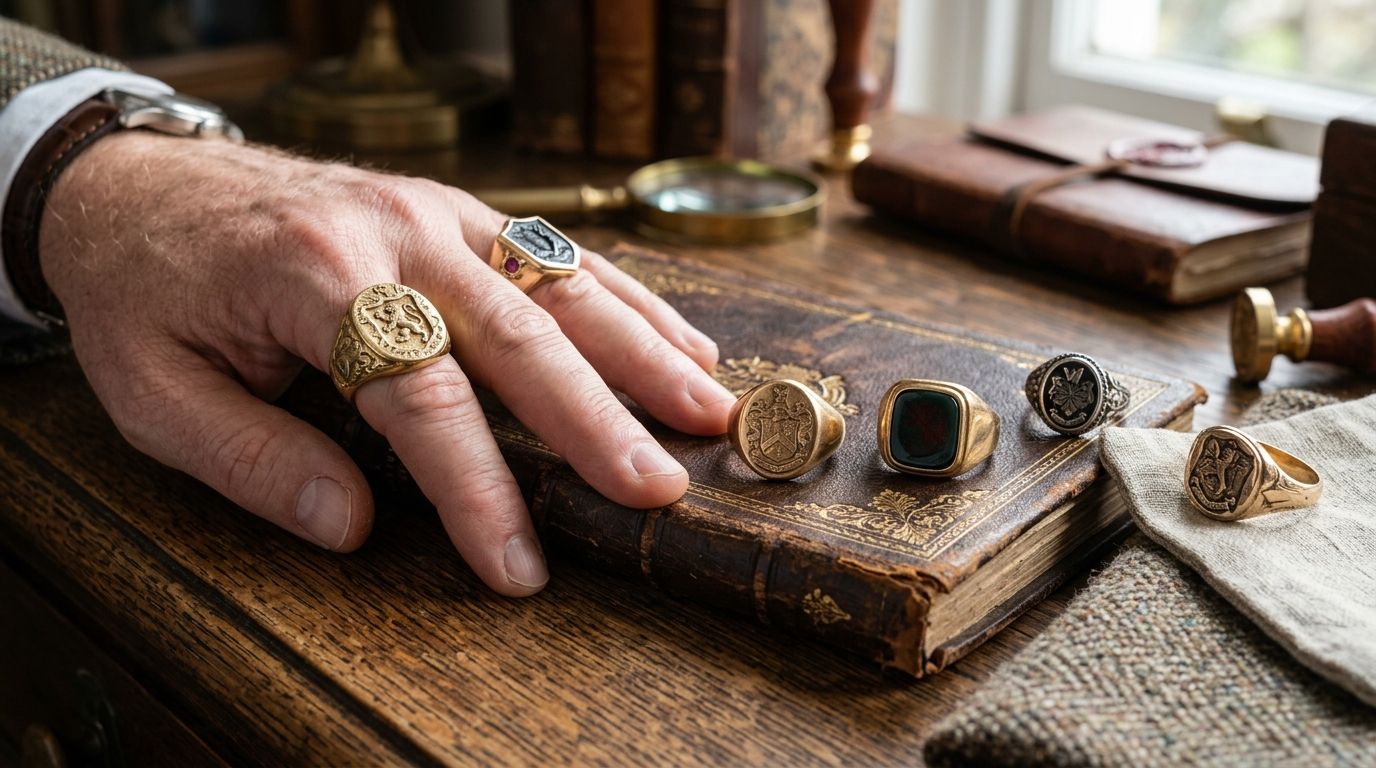
Antique signet rings for men's jewelry collectors are hallmarked gold or silver rings, usually bearing a family crest, monogram, or heraldic seal cut in intaglio, bought specifically for wear and resale value rather than as a decorative fashion piece. Collectors in this segment care about three things a casual buyer skips: whether the engraving is original, whether the hallmark dates the piece accurately, and whether the ring still holds enough gold weight to justify the price against melt value.
- Antique signet rings hold resale value when the intaglio crest is uncut and original, not re-engraved.
- Jewelryroom.com auctions list vintage signet rings with hallmark photos buyers should check before bidding.
- 18k and 22k gold signet rings resist decades of wear better than the 9k alloys common in older English pieces.
- Verify the auction house's reputation before bidding on antique signet rings to avoid altered or re-cut engravings.
Why antique signet rings matter for men's jewelry collectors
A signet ring's original function was practical: the crest was cut in reverse so a wax seal pressed into it would print correctly. That reversed intaglio is the single detail that separates a functional antique signet ring from a modern decorative lookalike, and it's the first thing an experienced buyer checks under loupe magnification.
Men's jewelry collectors treat signet rings differently than they treat cocktail rings or tennis bracelets bought as gifts. The category rewards patience: a ring with a worn but legible crest and a clear hallmark from a known assay office often outperforms a flawless-looking piece with no hallmark at all, because provenance and authenticity drive resale more than surface condition. If you already collect Victorian jewelry, signet rings from the same period slot into that collection with the same hallmark-reading skills you've already built.
How to build a signet ring collection the right way
Identify the era from the hallmark
Don't guess the age of a signet ring from style alone. Hallmarks are the closest thing this category has to a birth certificate.
- Look for an assay office mark, a date letter, and a fineness stamp (9k, 18k, 22k, or sterling)
- Cross-reference the date letter against a published hallmark chart before trusting a seller's date claim
- Check for a maker's mark, which narrows origin to a specific workshop or jeweler
- Note that unmarked rings aren't automatically fake, but they carry more authentication risk and typically sell lower
- Photograph the hallmark at high magnification before bidding so you can review it later at normal size
Verify the engraving is original, not re-cut
A re-engraved crest kills collector value even when the gold and hallmark check out.
- Check whether the engraving lines sit flush with the surrounding wear pattern, or look sharper and newer than the rest of the ring
- Confirm the crest reads in reverse, since a forward-facing crest means it was never meant to seal wax and may be a later addition
- Ask for close-up photos of the seal face from at least two angles before bidding
- Compare the engraving style to documented family crests when a specific family name is claimed
- Flag any listing that can't answer a direct question about whether the engraving is original
Check gold karat and metal purity
Karat weight determines both durability and resale floor.
- 22k gold signet rings, common in older English pieces, are soft and show wear faster on the shoulders
- 18k gold balances durability with resale value and is the most common karat in mid-20th-century signet rings
- 9k gold, also common in vintage English rings, is more durable but has a lower resale floor if the design isn't distinctive
- Sterling silver signet rings exist but carry less collector premium than gold pieces of the same era
- Weigh the ring in grams when possible; gold weight is the baseline value even before crest and hallmark premium apply
Inspect the seal face and shoulders for wear
Wear patterns tell you how the ring was actually used, not just how old it is.
- A heavily worn seal face with a still-legible crest suggests decades of genuine daily wear, which some collectors prize
- Uneven wear on one shoulder can indicate the ring was resized poorly at some point
- Check for hairline cracks at the shank, a common failure point on rings resized more than once
- Ask whether the ring has ever been soldered or repaired, since solder repairs affect both value and durability
Confirm sizing and resizing history
Signet rings were traditionally sized for a man's pinky finger, which makes modern resizing common and sometimes risky.
- Ask the seller directly whether the ring has been resized, and to what size
- A ring resized down loses metal at the shank and can crack faster under daily wear
- A ring resized up may have added metal that doesn't match the original alloy, visible as a slightly different color at the seam
- Confirm your own ring size before bidding rather than assuming a jeweler can resize any antique piece safely after the fact
Research provenance and prior ownership
A documented chain of ownership adds real value to a signet ring beyond gold weight and hallmark. Auction listings on Jewelryroom.com sometimes include estate or family history alongside hallmark photos, which is worth reading in full before you bid rather than skimming past it. When no provenance is offered, treat the ring's value as gold weight plus hallmark rarity only, and price your bid accordingly.
Place your bid within a set budget
Once you've verified hallmark, engraving, karat, and condition, bidding discipline is what protects your margin.
- Set a hard ceiling based on gold weight plus a premium for hallmark rarity and crest condition, not on emotional attachment to the listing photos
- Compare the auction estimate against retail prices for similar hallmarked pieces before committing
- Use a proxy bid rather than watching the clock live, so you don't get pulled into a bidding war in the final minutes
- Read the buyer's premium terms before your final bid, since that percentage changes your real cost
Insure and care for the ring after winning
A won ring is only valuable if it survives daily wear. Insure it at replacement value, not hammer price, and avoid ultrasonic cleaners on rings with visible hairline cracks at the shank.
Where to buy antique signet rings: comparing your options
| Option | Best for | Key limitation |
|---|---|---|
| Online estate jewelry auctions | Collectors chasing hallmarked pieces with documented provenance | Requires careful authentication before bidding; no in-hand inspection |
| Vintage jewelry dealers and shops | Buyers who want to inspect the ring in person first | Smaller inventory, generally higher markup than auction |
| Modern signet ring makers | Buyers who want a custom monogram with no wear history | Not antique; carries no collector resale premium |
| Estate sales and pawn shops | Bargain hunters willing to sift unsorted lots themselves | No authentication support, no buyer protection, hit-or-miss inventory |
Online auctions win on selection and documentation depth. In-person dealers win on the ability to hold the piece before paying. Neither format replaces the authentication steps above — the format just changes who's doing the verifying.
“A signet ring's crest is cut in reverse so wax seals print correctly. If it's not reversed, it's decorative, not functional.”
Common mistakes men's jewelry collectors make
- Buying on crest design alone. A striking heraldic design with no hallmark or provenance is a gamble, not a collectible.
- Skipping the reverse-engraving check. Buyers who don't confirm the crest reads backward often discover too late that the ring was never a functional seal.
- Ignoring resize history. A ring resized twice with visible solder seams is a durability risk regardless of how clean the seal face looks.
- Overbidding against gold weight. Emotional bidding on a family-crest story without provenance documentation routinely pushes prices above what the metal and hallmark actually support.
- Not verifying the auction house first. Checking an auction house's reputation before bidding matters more with signet rings than with stone-set jewelry, since engraving fraud is harder to spot in photos alone.
Browse antique signet ring lots
Review hallmark photos and provenance notes before you place a bid.
FAQ
What is the difference between a signet ring and a class ring?
A signet ring carries a family crest, monogram, or heraldic seal cut in reverse intaglio for wax sealing, while a class ring commemorates a school or graduation year and carries no sealing function. Antique signet rings predate class rings by centuries and are valued for hallmark, gold weight, and crest condition.
How can you tell if a signet ring is real gold?
Check for a fineness hallmark such as 9k, 18k, or 22k alongside an assay office stamp; a genuine antique piece carries both, not just one. A jeweler can also confirm karat with an acid test or XRF scanner if the hallmark is worn or missing.
Is it normal for an antique signet ring to have a worn engraving?
Yes, a worn but legible crest is common on rings with decades of daily wear and doesn't automatically reduce collector value. The concern is a crest that looks sharper or newer than the surrounding wear pattern, which suggests re-engraving.
What is the typical karat for antique signet rings?
Older English signet rings commonly appear in 9k, 18k, or 22k gold, with 18k balancing durability and resale value best. Karat is stamped as a hallmark and should always be verified against the ring's actual wear pattern and weight.
Should a signet ring be re-engraved?
Re-engraving a signet ring with your own initials erases the original crest and typically reduces collector value, even if it makes the ring more personal to wear. Collectors generally preserve the original engraving and buy a separate ring for personal monogramming.
How much does an antique signet ring cost at auction?
Cost depends on gold weight, karat, hallmark rarity, and documented provenance, so prices vary widely between lots. Compare the auction estimate against retail prices for similar hallmarked pieces before setting your bid ceiling.
What finger do you wear a signet ring on?
Traditionally the pinky finger of either hand, which is why many antique signet rings are smaller than a standard men's ring size today. This tradition also explains why resizing history matters so much when buying an antique piece.
Can you resize an antique signet ring safely?
Resizing is possible but adds risk to rings with thin shanks or prior repairs, since the shank is often the thinnest and most worn part of the ring. Ask about resizing history before bidding and confirm your size in advance rather than assuming any jeweler can resize the piece after you win it.
One last thing
The detail most new collectors miss: check whether the crest actually reads in reverse. A forward-facing crest on a ring marketed as a signet means it was made for display only, never for sealing wax, and that changes both its authenticity story and its price ceiling. In 2026, that single check under a loupe separates a functional antique signet ring from a decorative ring wearing the name.


