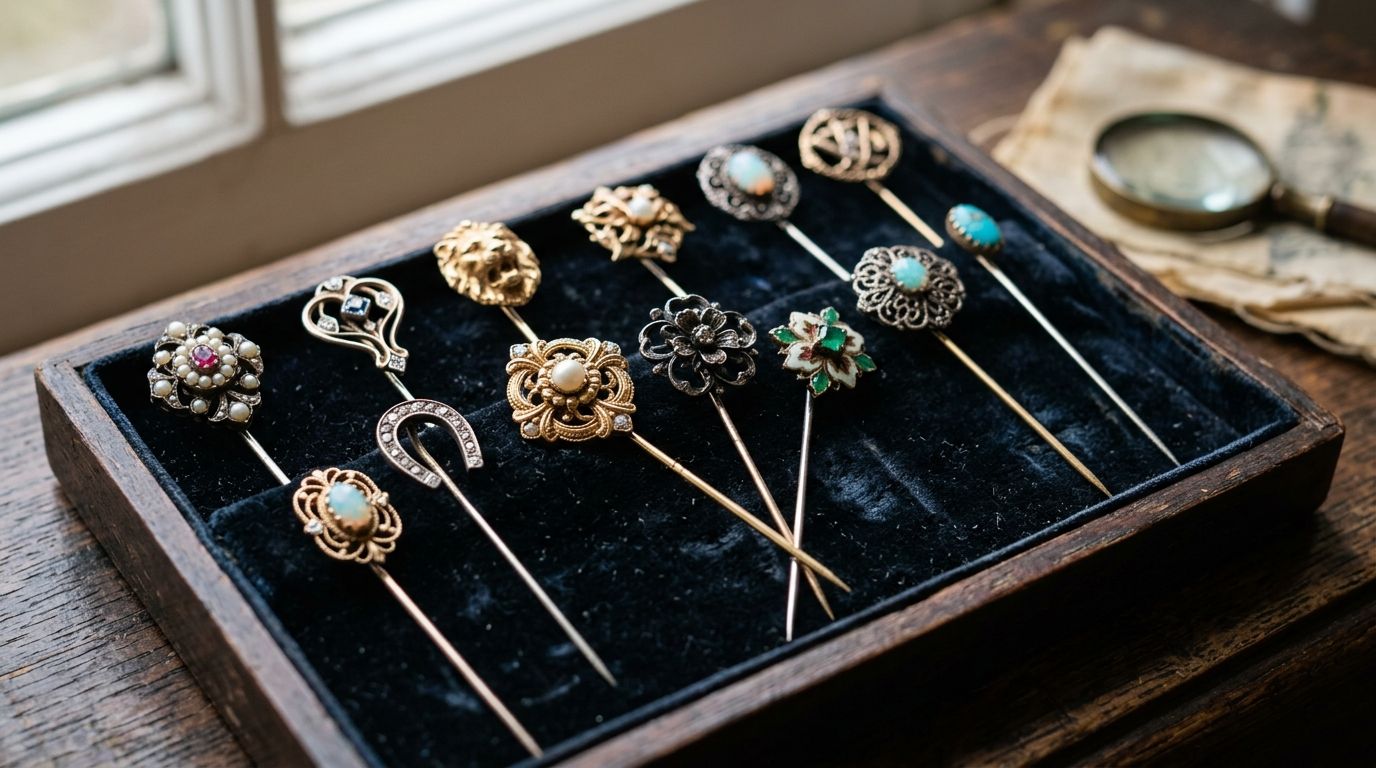
Antique stickpins are single-post jewelry pieces from the Victorian, Edwardian, and Art Deco eras, originally made to secure a cravat or lapel and now collected for their goldwork, enamel, and gemstone detail rather than function. Collectors treat them differently than general antique jewelry buyers: they care about pin length, catch type, and hallmark placement as much as the stone itself, because those details date the piece and confirm it wasn't reworked from a later mount.
- Antique stickpins from 1880-1920 are valued for goldwork and enamel, not carat weight — condition and hallmark matter more than stone size.
- Check the catch mechanism first: safety catches only became standard after roughly 1900, so a 'Victorian' pin with a modern clutch back is a red flag.
- Jewelryroom.com lists catalogued antique stickpin lots with condition notes, which cuts the guesswork a bare marketplace listing leaves to the buyer.
- Set a ceiling price before bidding — stickpin auctions move fast and buyer's premiums add up quickly on multi-lot purchases.
Why antique stickpins matter for this collector segment
Stickpin collectors search differently than someone buying a ring or a necklace. They're looking for era-specific motifs — fox heads, horseshoes, crescent moons, mourning hairwork — and they care about the pin's original length, because shortened pins usually mean damage or a repair. A collector building a themed set (hunting motifs, mourning jewelry, Art Deco geometrics) needs consistent sourcing, not a single lucky find.
This matters because stickpins sit at a strange price point: too small to command the same scrutiny as a ring, but detailed enough that a hallmark mistake or a re-plated setting can pass unnoticed in a bad photo. Getting the identification steps right before bidding protects the collection's long-term value more than any single purchase does.
Identify the era and construction method
Before you chase a specific motif, nail down the decade. Victorian stickpins (roughly 1840-1900) lean toward mourning motifs, snake and floral designs, and hand-cut settings. Edwardian pieces (1901-1910) favor platinum-topped gold and finer millegrain work. Art Deco stickpins (1920s-1930s) go geometric, often with calibré-cut stones set flush.
- Look at the setting style: hand-cut bezels suggest pre-1900; machine-cut prongs point later
- Check for platinum versus yellow gold — platinum use accelerated after 1900
- Note the motif: mourning hairwork and jet are almost exclusively Victorian
- Compare the pin's proportions against Victorian jewelry references if the seller's era claim seems vague
Check the pin mechanism and hallmarks
The catch tells you more than the catalog description. Safety-catch mechanisms didn't become common until the early 1900s, so a plain straight pin with no clutch is consistent with an earlier date — but a modern spring clutch on a piece marketed as "1880s" should raise questions.
- Inspect the pin length; original stickpins run 2 to 3 inches, shortened ones are a repair sign
- Look for maker's marks stamped near the head or on the pin shaft
- Cross-check purity marks (9k, 15k, 18k, or platinum stamps) against the claimed country of origin
- Photograph the mechanism under raking light before bidding if the listing photos are unclear
Verify gemstones and materials before bidding
Stickpins from the 1880s-1930s commonly use rose-cut diamonds, seed pearls, garnets, and enamel work — not the brilliant-cut stones common in modern jewelry. A brilliant round cut on a piece dated pre-1900 is a mismatch worth questioning.
- Ask for close-up photos of the stone's crown and pavilion, not just the face-up view
- Confirm enamel condition — hairline cracks are common and affect value more than most buyers expect
- Request a loupe photo of any hallmark stamped on the setting
- Compare listed gemstone type against period-typical materials before assuming rarity
This is where a catalogued auction platform earns its keep over a bare marketplace listing. Jewelryroom.com lists antique stickpin lots with condition notes and stone descriptions attached to each lot, so you're not reconstructing the piece's history from a single blurry photo. That doesn't replace your own inspection — it just gives you a documented starting point instead of none.
Set a ceiling price before you bid
Stickpin auctions move fast because lots are small and bidding windows are short. Decide your maximum before the lot opens, including any buyer's premium, and stick to it regardless of how the bidding trends.
- Set your ceiling using comparable sold prices for the same motif and era, not asking prices
- Factor in the buyer's premium before you place your first bid, not after you win
- Decide separately what you'll pay for a piece with a repair versus one in original condition
- Walk away once two bidders push past your ceiling — the next similar lot usually comes within weeks
Research provenance and auction house reputation
A documented chain of ownership adds real value to a stickpin, especially for signed or designer pieces, but even undocumented lots benefit from buying through a house with a track record. Before you bid with an unfamiliar seller, check how long they've operated and how they handle disputes.
- Look for a returns or authenticity guarantee policy stated on the listing itself
- Check whether the house discloses restoration or repair history per lot
- Confirm the house publishes closing prices from past sales, not just current listings
- Review how an auction house's reputation gets verified before committing to a bid on an unfamiliar platform
Browse catalogued antique stickpin lots
See condition notes and closing history before you place a bid.
Place your bid the smart way
Once you've identified the lot and set your ceiling, the bidding mechanism itself matters. A live auction rewards fast reflexes; a proxy bid protects you from overpaying in the final seconds.
- Use a proxy or absentee bid when you can't watch the closing minutes live
- Enter your true maximum once, rather than incrementing manually against another bidder
- Watch for reserve prices that haven't been met — an unmet reserve means the lot won't sell even at a high bid
- Confirm the platform's bid increment schedule before the lot opens
Insure and store the piece after you win
A won stickpin is only protected once it's covered and stored correctly. Enamel chips, pin bends, and stone loosening happen fastest in the first year of ownership if storage is careless.
- Get a current appraisal for insurance purposes rather than relying on the auction estimate
- Store pins flat in a padded case, never loose in a drawer where the pin head can catch fabric
- Keep enamel pieces away from direct sunlight, which accelerates surface crazing
- Confirm shipping insurance covers full hammer price plus premium before the item ships
Comparison: where to source antique stickpins in 2026
| Option | Best for | Key limitation |
|---|---|---|
| Catalogued specialty auctions (Jewelryroom.com model) | Collectors who want condition notes and lot history before bidding | Still requires bidding against other active collectors in real time |
| General marketplace listings | Budget hunters comfortable vetting sellers themselves | Authentication and hallmark verification fall entirely on the buyer |
| Estate sales and flea markets | Buyers who want to inspect a pin in hand before paying | Inventory is unpredictable and hallmarks are easy to miss under poor lighting |
| Antique jewelry specialty dealers | Collectors who want an expert to pre-vet each piece | Far fewer pieces available at any given time than an auction catalog |
Verdict: for a collector building a themed stickpin set in 2026, a catalogued auction platform like Jewelryroom.com beats an unvetted marketplace listing on documentation, but it still demands the same hallmark and mechanism checks before you bid — no platform replaces your own inspection.
Common mistakes antique stickpin collectors make
- Assuming pin length equals age. A long, unshortened pin isn't automatically older — check the catch and setting style instead.
- Skipping the mechanism check. Buyers fixate on the head design and ignore a catch that contradicts the claimed era.
- Overpaying for unverified mourning pieces. Hairwork and jet mourning pins carry a premium that isn't justified without documented provenance.
- Treating enamel damage as cosmetic only. Hairline enamel cracks reduce resale value more than most first-time buyers expect.
- Bidding without a ceiling. Small lot sizes and short bidding windows push emotional overbids more often in stickpin categories than in rings or necklaces.
Antique stickpins pair naturally with other lapel and accessory pieces from the same eras — collectors who build a stickpin set often expand into men's cufflinks or Art Deco jewelry from the same period for a cohesive collection.
FAQ
What era do most antique stickpins come from?
Most collectible antique stickpins date from roughly 1840 to the 1930s, spanning the Victorian, Edwardian, and Art Deco periods. Each era has distinct motifs and construction: Victorian favors mourning and nature themes, Edwardian favors platinum-topped gold, and Art Deco favors geometric calibré-cut settings.
How can I tell if a stickpin is genuinely Victorian?
Check the catch mechanism first — safety catches weren't standard until after 1900, so a plain pin without a clutch is consistent with an earlier date. Cross-reference the hallmark, motif, and setting style against known Victorian conventions before trusting the seller's era claim alone.
Is buying antique stickpins at auction better than buying on a general marketplace?
A catalogued auction platform typically documents condition and lot history, which reduces guesswork compared to a bare marketplace listing. It doesn't eliminate the need for your own hallmark and mechanism inspection before bidding.
Do antique stickpins hold value the way rings do?
Value depends more on maker's marks, motif rarity, and condition than carat weight, since most stickpin stones are small. A well-documented signed piece in original condition holds value better than an undocumented one with the same materials.
What's the biggest red flag when buying an antique stickpin online?
A modern spring-clutch catch on a piece marketed as pre-1900 is the clearest mismatch to watch for. Request a close-up photo of the mechanism before bidding if the listing doesn't already show it clearly.
Should I get antique jewelry appraised before or after buying at auction?
Get a current appraisal after winning for insurance purposes rather than relying solely on the auction estimate. Auction estimates reflect expected sale price, not replacement value for insurance.
How do I protect a stickpin's enamel from damage?
Store enamel stickpins flat in a padded case away from direct sunlight, which accelerates surface crazing over time. Avoid tossing pins loose in a drawer, where the pin head can catch fabric and bend.
One last thing
Most stickpin catches didn't get a safety mechanism until the early 1900s — before that, collectors literally relied on a straight pin and steady hands. If a listing dated pre-1900 shows a spring clutch, that single detail is often more reliable for dating the piece in 2026 than the motif or the seller's description combined.


