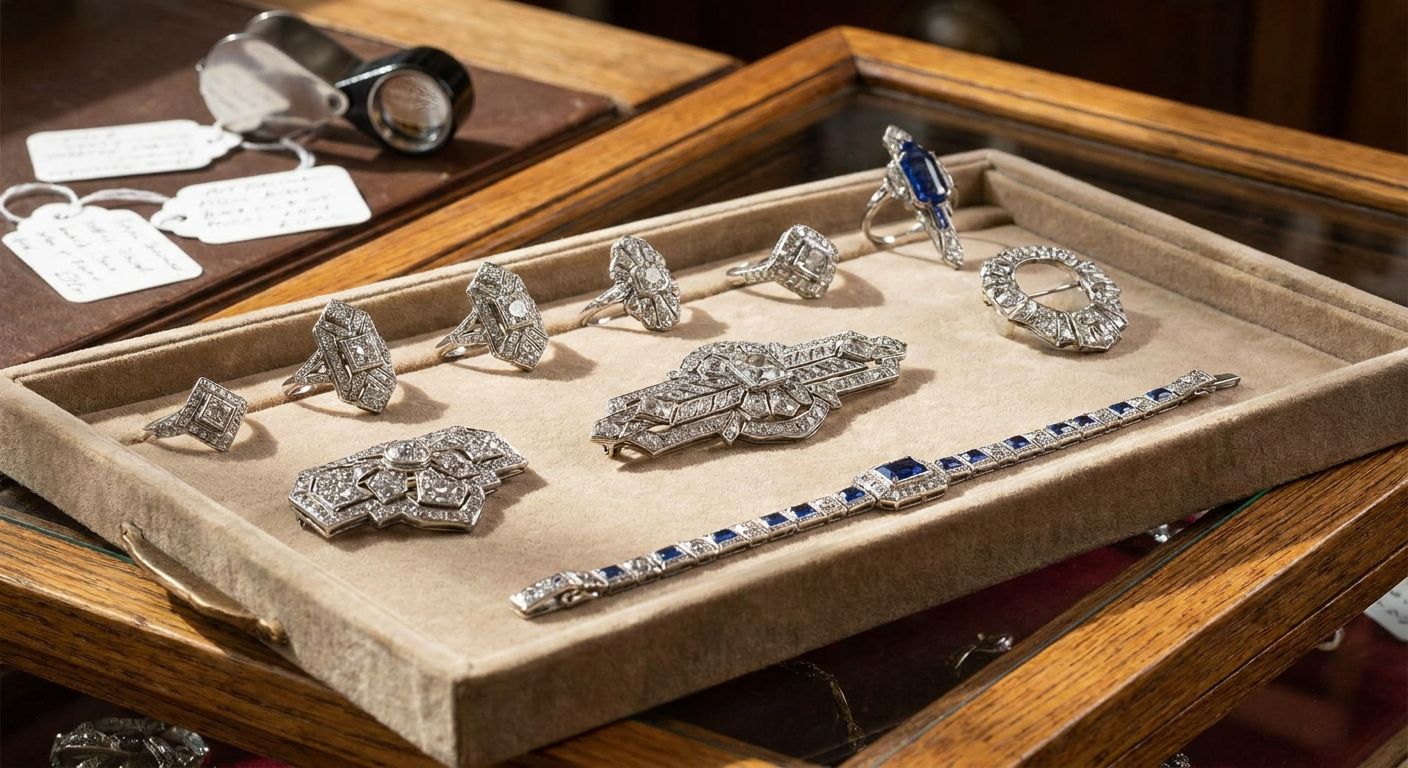
Art Deco jewelry for antique dealers means sourcing verified 1920-1935 pieces with resale margin and clean provenance in mind, not chasing the piece a single collector happens to like. A dealer's checklist is different from a bride shopping for an engagement ring: you need dated construction, a paper trail, and enough margin to survive restoration costs before the piece ever hits your case.
- Art deco jewelry for dealers means buying for provenance and margin, not personal taste, in 2026.
- Jewelryroom.com estate auctions list hallmark-documented pieces dealers can verify before bidding.
- Platinum filigree and calibre-cut sapphire pieces from 1920-1935 hold the strongest dealer resale margins right now.
- Skip any lot with no photographed hallmark or repair history — provenance gaps kill resale value fast.
- Buying in verified lots beats single-piece bidding when your margin depends on volume.
Why art deco jewelry matters for antique dealers
Demand for genuine Art Deco pieces has stayed ahead of supply because the production window is fixed: roughly 1920 to 1935. Nobody is making more of it. That scarcity is exactly why dealers get burned buying "Deco-style" Retro-era pieces from the 1940s that mimic the geometry but skip the platinum and the hand-set calibre stones.
For a dealer, the search intent behind "art deco jewelry for dealers" isn't "is this pretty" — it's "can I verify this, price it correctly, and move it at a margin that covers appraisal and repair." Appraising estate jewelry before bidding is the first skill that separates a profitable dealer from one sitting on dead inventory.
The verdict: genuine platinum-and-diamond Art Deco pieces with documented hallmarks are the safest resale category in the estate market in 2026 — reproductions and undocumented lots are the ones that erode margin.
Verify the era before you bid
Era verification is the single step that determines whether a piece is worth bidding on at all.
- Check for platinum or platinum-topped gold — the dominant Deco metal, rarely used after 1935 due to wartime metal restrictions.
- Look for geometric symmetry: stepped forms, sunburst and fan motifs, and straight-line baguette cuts rather than curved Art Nouveau lines.
- Confirm calibre-cut stones (custom-shaped to fit a channel) rather than standard round or oval cuts.
- Look for milgrain edging — tiny beaded metal detail applied by hand, uncommon in later machine-made reproductions.
- Cross-reference maker's marks against known 1920s-1935 jewelry houses before assuming a date.
Check construction details, not just style
Style can be copied. Construction from the 1920s and 1930s is harder to fake convincingly.
- Filigree work should show hand-pierced, slightly irregular openwork — machine filigree looks too uniform.
- Look at prong settings: hand-cut prongs from the era sit slightly asymmetrical under magnification.
- Check clasp mechanisms on necklaces and bracelets — box clasps with safety chains were standard, spring rings came later.
- Inspect solder joints; period soldering is visibly rougher than modern laser welding.
- Weigh the piece — platinum items run noticeably heavier than white-gold reproductions of similar size.
Research provenance and paperwork
Provenance is what lets you price with confidence and defend that price to a buyer.
- Request any prior appraisal, insurance rider, or estate inventory tied to the lot.
- Ask the auction house for chain-of-custody notes — estate sale, prior dealer, family collection.
- Researching provenance before an estate jewelry auction before you bid saves you from disputing authenticity after the sale closes.
- Photograph and log hallmarks, maker's marks, and any engraving the moment you receive the piece.
- Keep a dated file per lot — buyers increasingly ask for it before paying a dealer markup.
Authenticate stones and metals
A beautiful setting on a synthetic or treated stone is a margin killer, not a find.
- Send stones over roughly one carat to an independent gemological lab before pricing them for resale.
- Test metal purity rather than trusting a stamped mark alone — stamps get added to later pieces.
- Watch for old European cut and old mine cut diamonds; these cuts are consistent with the 1920s and 1930s and harder to fake convincingly than modern brilliant cuts.
- Check for foiling or backing behind colored stones, a period technique that can also mask damage.
- Confirm sapphire and ruby treatment history, since heat treatment disclosure changes resale value significantly.
Set a resale-margin budget
Dealers who bid like collectors — chasing the piece emotionally — are the ones who erode margin fastest.
- Set a hard bid ceiling before the auction opens, based on comparable recent sales, not asking prices.
- Build in restoration cost estimates for re-tipping prongs, replacing clasps, or re-polishing filigree.
- Setting a budget for online jewelry auctions before your first lot keeps buyer's premium and shipping insurance from quietly eating your spread.
- Track your target resale multiple per category — brooches, rings, and necklaces don't carry the same margin curve.
- Walk away at your ceiling even when a lot is the last of its kind in the sale.
Buy in verified lots at estate auctions
Single-piece bidding is slower and more expensive per item than sourcing through verified lots.
- Estate jewelry auctions frequently group multiple Deco-era pieces from one estate, which strengthens the provenance story for the whole lot.
- A documented lot lets you cross-verify hallmarks and construction across several pieces at once.
- Buying a small lot reduces per-piece acquisition cost versus bidding one item at a time against retail buyers.
- Jewelryroom.com auctions list estate lots with photographed detail dealers can review before committing a bid.
Document condition before you relist
What you photograph and disclose now protects your margin later.
- Photograph the piece under magnification before any cleaning or repair.
- Note any prior repair, replaced stone, or re-tipped prong in your listing description.
- Grade condition using a consistent internal scale so buyers trust repeat purchases from you.
- Disclose treatment status on colored stones up front — undisclosed treatments generate returns and disputes.
Sourcing options compared
| Sourcing option | Best for | Key limitation |
|---|---|---|
| Estate jewelry auctions (Jewelryroom.com) | Dealers who want documented lots with photographed hallmarks | Requires bidding against other trade buyers in real time |
| Antique brooch specialty auctions | Dealers focused narrowly on brooch inventory | Narrower selection outside brooches |
| Local estate sales and liquidators | Dealers wanting to inspect pieces in person before buying | Inconsistent documentation, slower to source volume |
| Private collector networks | Dealers with existing relationships and time to negotiate | Slow to scale, pricing less transparent |
Common mistakes antique dealers make with art deco jewelry
- Buying Retro-era pieces as Deco. The 1940s Retro style copies Deco geometry in yellow gold instead of platinum — a metal mismatch that tanks resale value once a buyer notices.
- Skipping the hallmark photograph. A dealer who can't produce a hallmark photo at resale time loses buyer trust and negotiating leverage.
- Underpricing restoration into the bid. Re-tipping prongs and replacing a clasp on a fragile filigree piece can cost more than dealers expect, and it comes straight out of margin.
- Bidding on single pieces instead of lots. Per-piece cost runs higher when you're bidding against retail buyers item by item rather than sourcing documented estate lots.
- Ignoring stone treatment disclosure. An undisclosed heat-treated sapphire or foiled stone generates returns that cost more than the margin the piece earned.
Browse current estate jewelry auctions
Review photographed lots and hallmark detail before you bid in 2026.
FAQ
What years count as true Art Deco jewelry?
True Art Deco jewelry dates roughly from 1920 to 1935, defined by geometric design, platinum settings, and calibre-cut stones. Pieces from the 1940s Retro period copy the look in yellow gold and don't carry the same resale value for dealers.
How do dealers verify a piece is genuinely Art Deco?
Dealers check the metal (platinum, not later white gold), inspect for hand-cut filigree and milgrain edging, and confirm hallmarks against known 1920s-1935 makers. Weighing the piece and sending stones for independent lab testing rules out reproductions.
Is buying in lots better than single pieces for resale margin?
Yes, buying documented estate lots usually lowers per-piece acquisition cost compared to bidding item by item against retail buyers. Lots also strengthen the provenance story across multiple related pieces.
What's the biggest margin risk in Art Deco jewelry for dealers?
Underestimating restoration cost is the biggest margin risk, since fragile filigree and worn clasps often need repair before resale. Building a repair estimate into your bid ceiling before the auction protects the spread.
Do Art Deco pieces need lab certification before resale?
Stones over roughly one carat should go to an independent gemological lab before pricing, especially colored stones with treatment history. Certification protects both your asking price and your disclosure obligations to the buyer.
How does provenance affect resale price for dealers?
A documented chain of custody lets a dealer defend a higher asking price and close sales faster with trade and retail buyers alike. Pieces with no provenance paperwork typically sell at a discount regardless of condition.
Where do dealers source verified Art Deco estate lots?
Estate jewelry auctions that photograph hallmarks and list prior ownership detail are the most efficient source for dealers sourcing at volume. Local estate sales work too but documentation is far less consistent.
One last thing
The detail most dealers skip is weighing the piece before bidding. A platinum Art Deco ring runs measurably heavier than a white-gold reproduction of the same visual size — a five-second check with a jeweler's scale catches more fakes than a magnifying loupe does, and it costs nothing to do before you commit a bid in 2026.


