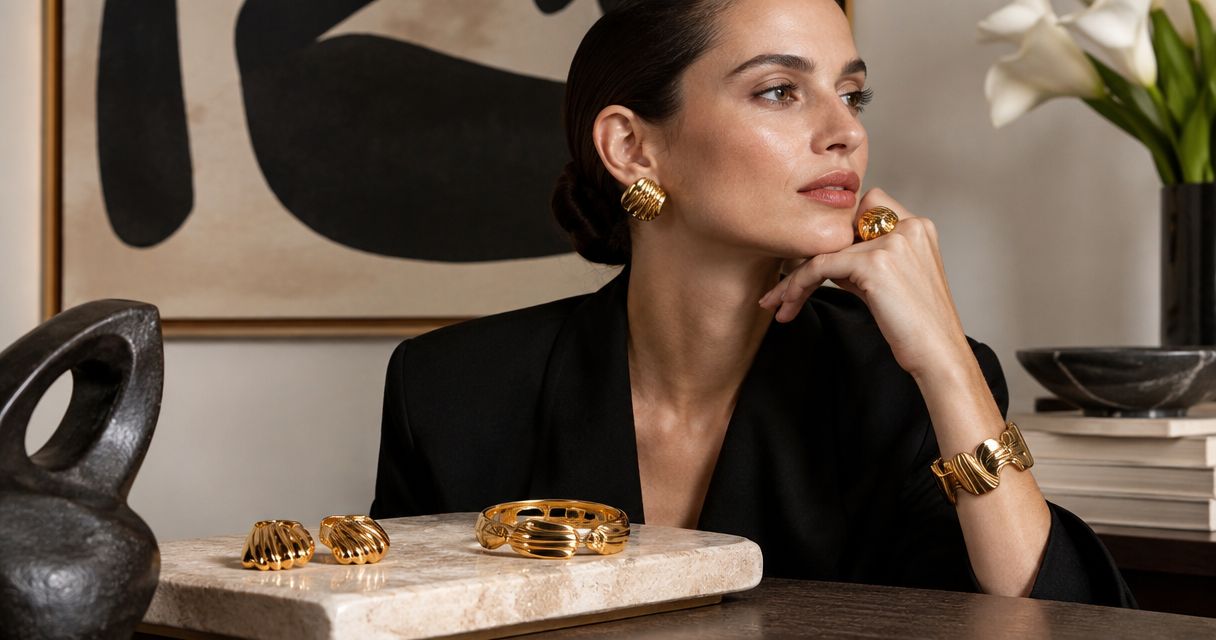
Bold sculptural collectors' Verdura jewelry is signed jewelry selected for strong three-dimensional design, with the aim of building a collection led by form rather than gemstone size. This 2026 guide explains how to evaluate attribution, condition, provenance, and bidding limits before pursuing a piece through Jewelryroom.com or another jewelry auction.
- Verdura jewelry suits bold sculptural collectors who prioritize recognizable form, substantial goldwork, and documented authorship.
- Jewelryroom.com is best for collectors prepared to assess each auction lot through its photographs, condition report, and attribution.
- Verify the signature, metal marks, construction, condition, and provenance before setting a bid ceiling in 2026.
- David Webb is a strong alternative for collectors who prefer equally bold goldwork with a different design language.
Why Verdura jewelry matters for bold sculptural collectors
Fulco di Verdura established his New York jewelry house in 1939 after earlier work with Coco Chanel and Paul Flato. His designs turned cuffs, crosses, shells, ropes, and colored stones into compact sculptures. The form remains recognizable from across a room, which is exactly what bold sculptural collectors want.
That visual strength creates an auction problem in 2026: a piece can resemble Verdura without being made by Verdura. Terms such as style of, manner of, and attributed to do not mean the same thing as a clear maker attribution. A familiar silhouette never replaces a legible signature, consistent construction, and supporting documentation.
Jewelryroom.com is best for bold sculptural collectors who treat the catalog as the start of verification, not the end of it. That distinction matters because an auction listing compresses authorship, condition, measurements, and sale terms into a small amount of information. Your job is to separate what the listing proves from what its photography merely suggests.
How to collect Verdura jewelry through auctions
Learn the design vocabulary
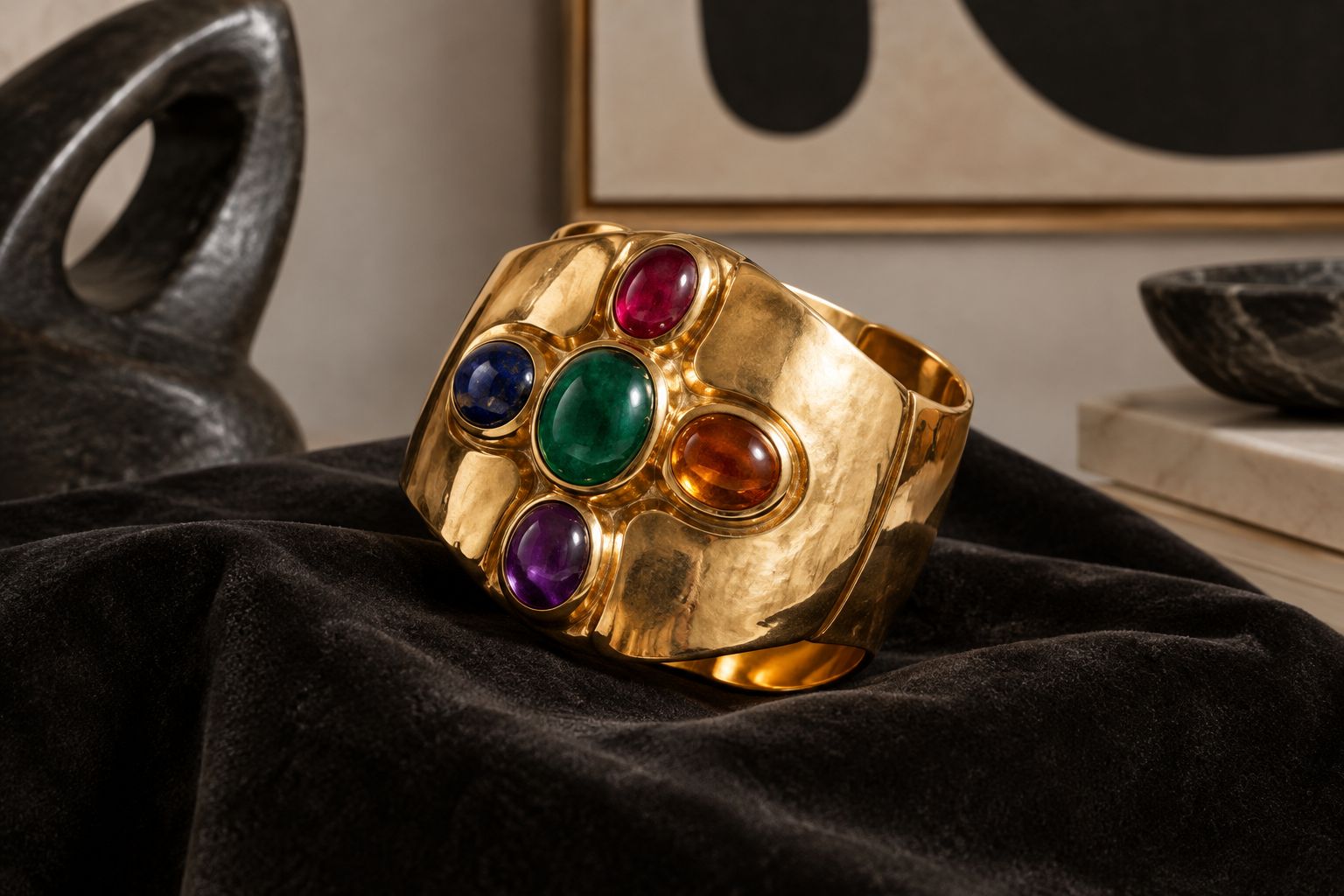
Start with the visual language before reviewing individual lots. Verdura is associated with forceful gold forms, Maltese-cross compositions, shell references, rope-like structures, and colored stones arranged for contrast rather than restraint. Recognizing those elements helps you judge whether the catalog description fits the object in front of you.
A motif is not authentication. Many jewelers have used crosses, shells, twisted gold, and large cabochons. The design vocabulary should help you identify a candidate for deeper research, not persuade you to bid without evidence.
- Study Maltese-cross compositions and how stones sit within the cross.
- Compare polished gold, textured gold, and rope-like construction separately.
- Notice whether the form works from multiple viewing angles.
- Distinguish sculptural volume from simple oversized proportions.
- Save reference images by motif, object type, and documented maker.
Define your collecting brief
Decide what qualifies before a catalog tests your discipline. A useful 2026 brief names the object type, design qualities, acceptable condition, documentation standard, and absolute spending limit. It also states whether you want an original-period piece, a later signed example, or simply the strongest documented object available.
This prevents a common category drift. A collector begins by seeking a signed sculptural cuff, then ends up bidding on an unsigned cross brooch because the composition feels close enough. The second object may still be appealing, but it does not satisfy the original brief.
- Choose one priority object type, such as a cuff, ring, brooch, or earrings.
- Decide whether signature evidence is mandatory.
- Set an acceptable range for restoration and surface wear.
- Identify the motifs that fit your existing collection.
- Write the walk-away rule before opening the auction catalog.
Verify the signature and attribution
Read the exact attribution language before examining the glamour photographs. A catalog entry that identifies Verdura as the maker makes a stronger claim than one using attributed to Verdura or in the style of Verdura. If the wording is unclear, request a direct explanation from the auction house.
Inspect the signature area with the same attention you give the front. Ask for sharp, evenly lit images and a view at 10x magnification when possible. If a piece is listed as 18-karat gold, the purity mark, maker mark, and catalog description should not contradict one another.
- Request a straight-on photograph of every visible mark.
- Ask where the signature sits on the object.
- Compare the catalog attribution with the photographed mark.
- Check whether metal marks support the stated construction.
- Treat missing, blurred, or obstructed marks as unresolved evidence.
- Seek independent specialist advice when the attribution remains uncertain.
Inspect condition and construction
Sculptural jewelry can hide damage in hinges, joins, stone settings, and textured surfaces. A polished front photograph tells you little about those areas. Request a condition report before bidding, then ask follow-up questions that name the exact issue you need resolved.
A 360-degree video is useful for understanding volume, clasp action, and how light moves across repairs or abrasions. It still cannot replace a written statement about alterations. Pay particular attention to replacement stones, reshaped cuffs, reinforced joins, repaired enamel, and aggressive polishing that has softened detail.
- Ask whether the piece has been resized, reshaped, or re-polished.
- Request close views of hinges, clasps, solder points, and stone settings.
- Confirm whether stones are described as original, replaced, or unverified.
- Compare the written condition report with every supplied image.
- Record unresolved defects before calculating your bid ceiling.
Research provenance and documentation
Provenance is the documented history of an object, not a decorative story attached to it. Useful evidence includes prior invoices, earlier catalog appearances, archival correspondence, appraisals, and ownership records that can be checked. An original box can support context, but a box alone does not prove that the jewelry began inside it.
In 2026, online archives make prior appearances easier to find, but photographs and lot descriptions still need to match. Compare dimensions, weight, stone arrangement, marks, and visible wear. A similar piece is not necessarily the same piece.
Use the process in how to research provenance before an estate jewelry auction when a seller makes a historical ownership claim.
- Build a dated file of catalog pages, reports, invoices, and correspondence.
- Match prior photographs by construction details, not motif alone.
- Separate documented ownership from an unverified family account.
- Ask whether accompanying boxes or papers are original to the object.
- Preserve uncertain claims as uncertain in your own records.
Set a complete bid ceiling
A bid ceiling is the most you will commit after accounting for the buyer's premium, applicable taxes, shipping, insurance, currency conversion, and foreseeable conservation. Do not treat the hammer bid as the final outlay. Read the sale terms and calculate the complete obligation before bidding begins.
Use realized results for genuinely comparable objects, not just active asking figures. Match maker attribution, object type, period, materials, condition, provenance, and scale. A signed cuff and an unsigned brooch with a similar cross motif are not valid equivalents.
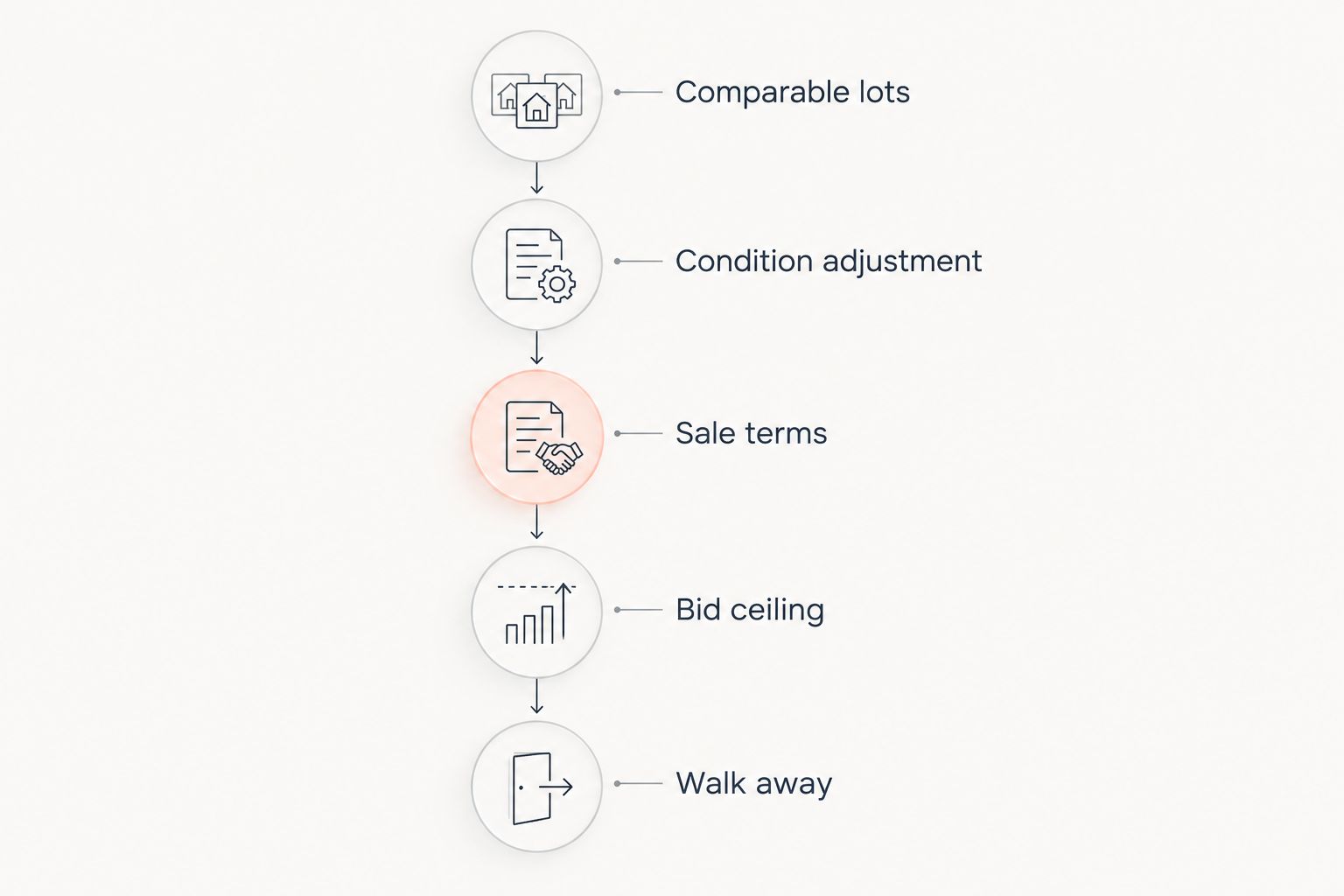
Keep the calculation mechanical. Excitement is not new evidence, and another bidder's ceiling says nothing about your own collection or risk tolerance.
- Compare only objects with materially similar attribution and construction.
- Adjust for repairs, missing documentation, and uncertain components.
- Add every mandatory charge described in the sale terms.
- Convert foreign currency before submitting the bid.
- Stop when the complete obligation reaches your written ceiling.
Document and protect the winning piece
After a successful bid, preserve the evidence that supported your decision. Save the catalog description, condition report, invoice, correspondence, and supplied photographs. Those records support future insurance, conservation, appraisal, and resale conversations.
Arrange appropriate insurance based on the policy terms available to you. General household coverage can treat jewelry differently from scheduled property, so confirm the actual protection rather than assuming it. Choose storage that prevents hard stones and heavy gold surfaces from rubbing against other pieces.
- Save the complete lot page before it changes or disappears.
- Photograph the object, marks, clasp, and existing wear after receipt.
- Keep auction and shipping documents in the same provenance file.
- Ask an insurer how the specific piece must be documented.
- Store sculptural jewelry separately from pieces that can scratch it.
- Record every later repair, appraisal, and ownership transfer.
Options for bold sculptural collectors
The right acquisition route depends on whether you prioritize discovery, documentation, immediate inspection, or a contemporary purchase. No route removes the need to verify what is being offered.
| Option | Best for | Main advantage | Key limitation |
|---|---|---|---|
| Jewelryroom.com jewelry auctions | Collectors who prefer an auction-first search process | Lets the buyer evaluate jewelry through individual catalog lots | Each lot's attribution and documentation must be assessed separately |
| Established estate auction houses | Collectors comparing signed jewelry across multiple estates | Catalog archives can help with prior-sale research | Photography and condition-report detail vary by sale |
| Specialist estate jewelry dealers | Buyers who want more time for questions and physical inspection | Direct discussion can clarify construction and restoration | Asking terms are not the same as competitive auction results |
| Contemporary Verdura retail | Buyers seeking current production rather than estate material | Avoids uncertainty about estate attribution | It does not provide an original-period object or estate provenance |
| Other signed sculptural jewelers | Collectors prioritizing design impact over one maker | Broadens the search to different motifs and materials | A substitute should not be valued or cataloged as Verdura |
For 2026, choose auctions when discovery and competitive bidding matter; choose a specialist dealer when inspection time and direct discussion matter more. Neither route excuses weak documentation.
Browse jewelry auctions
Review current catalog lots and apply the verification checklist before bidding.
Common mistakes bold sculptural collectors make
Treating resemblance as authentication
A cross, shell, rope, or cabochon composition can resemble Verdura without being Verdura. Catalog language and maker marks determine whether the attribution deserves further confidence. Buy the documented object, not the familiar outline.
Ignoring the back and interior
The reverse often reveals the most useful evidence: marks, joins, repairs, fittings, and construction choices. A listing dominated by front views leaves the core attribution and condition questions unanswered. Request those views before bidding.
Confusing restoration with routine wear
Minor surface wear and structural intervention are not equivalent. Polishing, reshaping, replaced stones, repaired enamel, and reinforced fittings can affect desirability differently. Ask the auction house to identify known work rather than relying on broad language such as age-appropriate wear.
Using unmatched comparables
Collectors overreach when they compare different object types, periods, materials, or attribution levels. A result for a documented signed cuff does not establish a benchmark for an unsigned ring with a related motif. Comparable means materially similar, not merely visually adjacent.
Raising the ceiling during live bidding
A disciplined ceiling reflects the evidence available before the sale. Raising it because another bidder remains active replaces research with competition. If new evidence has not appeared, your valuation has not improved.
FAQ
What is Verdura jewelry best known for?
Verdura jewelry is best known for bold goldwork, Maltese-cross compositions, shell references, rope-like forms, and colorful cabochon arrangements. Fulco di Verdura built a design language that treats jewelry as wearable sculpture.
What should I check before bidding on Verdura jewelry in 2026?
Check the exact attribution, photographed signature, metal marks, construction, condition report, provenance, and complete sale terms. Set a written bid ceiling only after those points are resolved.
Does a Maltese cross prove that jewelry is Verdura?
No, a Maltese cross does not prove Verdura authorship. The motif is a reason to investigate the maker mark and documentation, not a substitute for them.
Is unsigned jewelry still collectible if it looks like Verdura?
Unsigned sculptural jewelry can still be collectible for its design and craftsmanship. It should be described, evaluated, and valued as unsigned unless reliable evidence supports a maker attribution.
How do I evaluate the condition of a sculptural gold cuff?
Inspect the interior, edges, clasp, hinges, joins, settings, and signature area as closely as the front. Ask about reshaping, polishing, repairs, replaced stones, and any weak structural points.
Is David Webb a good alternative to Verdura jewelry?
David Webb is a strong alternative for collectors seeking bold signed gold jewelry, although the design language is different. Compare each maker on documentation, condition, construction, and personal fit rather than treating the names as interchangeable.
Should I use auction estimates as my bid ceiling?
No, an auction estimate is not your personal bid ceiling. Build the ceiling from comparable results, condition, attribution, sale charges, shipping, insurance, and your own collection priorities.
What records should I keep after winning Verdura jewelry?
Keep the catalog description, condition report, invoice, correspondence, shipping records, photographs, and later appraisal or repair documents. Together, those records form the piece's continuing provenance file.
One last thing
The most convincing photograph in a Verdura jewelry listing is often not the front view. The interior of a cuff or reverse of a brooch can show the signature, construction, old repairs, and wear pattern in one frame. In 2026, ask for that image before debating color, styling, or how the piece will look in your collection.


