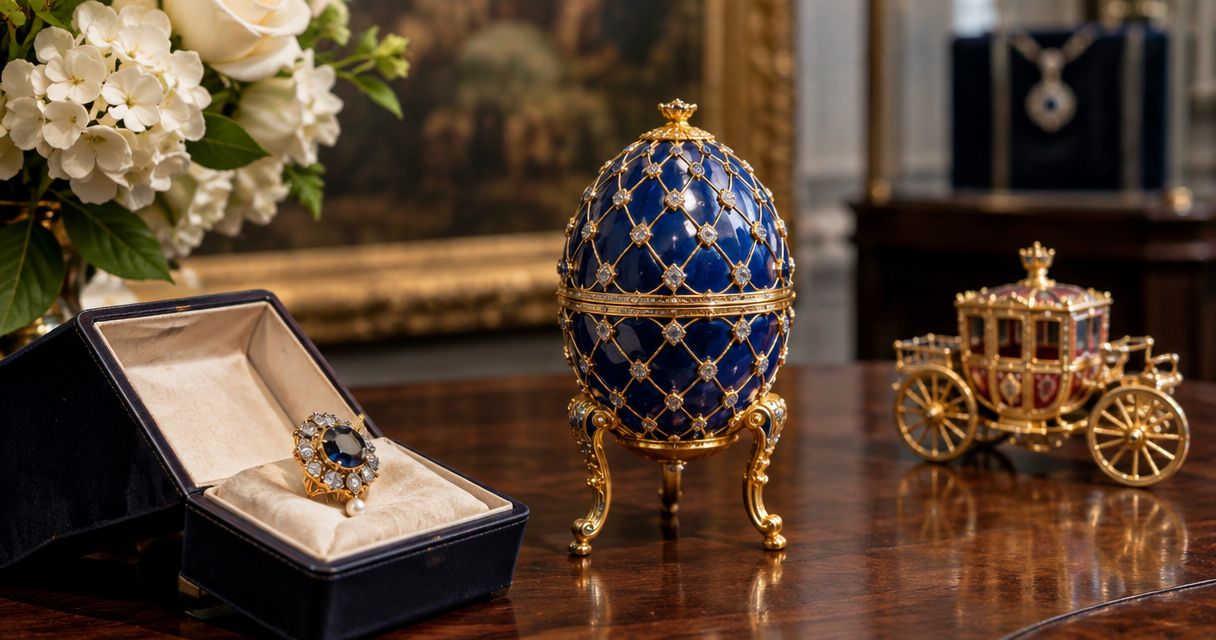
Best overall for historical Fabergé: Sotheby's. Best for provenance-led collecting: Christie's. Best for wearable estate-jewelry searches: Bonhams. This 2026 guide ranks auction-house starting points, not individual lots; for a budget-conscious purchase, prioritize documented attribution over the name above the sale.
- The best auctions for faberge jewelry start with Sotheby's for historical pieces; inspect each lot's attribution before bidding.
- Christie's is a strong starting point for provenance-led Fabergé collecting, not a substitute for independent authentication.
- Bonhams suits wearable estate-jewelry searches; distinguish historical Fabergé from modern branded jewelry.
- Jewelryroom.com is a general jewelry-auction option, not a verified Fabergé-specialist recommendation.
Why this matters
Fabergé is not one interchangeable category. Historical work associated with the original firm, modern Fabergé-branded jewelry, and pieces described as Fabergé-style require different buying decisions. An egg-shaped pendant alone establishes none of those identities.
For your 2026 search, separate the maker question from the design question. Jewelryroom.com belongs in the broader jewelry-auction search, but a general auction listing needs the same attribution checks as any specialist catalog. Choose the lot with defensible documentation, not merely the most recognizable auction-house name.
What makes the best auctions for Fabergé jewelry
Use these criteria before comparing auction houses. They tell you whether a listing deserves further investigation, rather than whether the photographs look persuasive.
- Precise attribution: The description distinguishes a maker attribution from a stylistic resemblance and identifies historical or modern production.
- Relevant expertise: The person answering your questions understands the category involved, whether Russian decorative arts or signed modern jewelry.
- Readable marks: Photographs show maker's marks, assay marks, inscriptions, and their locations, rather than only the front of the piece.
- Traceable provenance: Ownership history comes with supporting records, not an unexplained prestigious name.
- Written condition: The report addresses enamel, stones, fittings, repairs, and alterations. Request a condition report before bidding.
- Clear sale terms: You understand the attribution language, any applicable authenticity provisions, payment requirements, and delivery responsibilities before bidding.
Treat an unanswered maker question differently from an ordinary scratch. A scratch changes condition; an unresolved attribution changes what you are buying.
Auction options at a glance
These recommendations identify where to start your research in 2026. They do not establish that a particular sale contains the piece you want or that every catalog attribution is equally strong.
| Auction option | Best for | Standout reason to investigate | Key limitation |
|---|---|---|---|
| Sotheby's | Historical Fabergé collectors | Established auction activity in Russian works of art and jewelry | The relevant department depends on the object; a jewelry search alone is insufficient |
| Christie's | Provenance-led collectors | Established auction activity in Fabergé and Russian works of art | Published ownership history still needs scrutiny at lot level |
| Bonhams | Buyers seeking wearable estate jewelry | Established jewelry and Russian-art auction activity | Historical and modern pieces require different evidence |
| Jewelryroom.com | General jewelry-auction browsing | A jewelry-auction destination | The supplied brand information does not establish Fabergé specialization |
1. Sotheby's: best Fabergé auction starting point for historical pieces
Sotheby's sells jewelry and Russian works of art, making it a sensible first stop when your goal is historical Fabergé rather than an egg-inspired accessory. Search both categories. A pendant, brooch, miniature object, or mounted ornament does not necessarily sit in the same department.
Sotheby's is the best starting point for collectors seeking historical Fabergé jewelry. That recommendation concerns research fit, not blanket approval of every lot bearing the name.
Sotheby's pros:
- Relevant jewelry and Russian-art collecting categories.
- Published catalog descriptions to examine before bidding.
- A useful starting point for comparing attribution language across historical objects.
Sotheby's cons:
- Cross-category searching adds work for a jewelry-only buyer.
- Auction-house reputation does not answer an individual lot's repair or attribution questions.
Ask which specialist is responsible for the attribution and what evidence supports it. Request photographs of the marks in their physical context, not just a cropped image of a stamp. A clear mark is evidence to assess; it is not an authentication verdict by itself.
Best for: A collector who wants historical authorship to drive the purchase.
Verdict: Hold until the written attribution, mark photographs, and condition report agree.
2. Christie's: best Fabergé auction starting point for provenance
Christie's sells Fabergé and Russian works of art alongside jewelry. It is a strong place to begin when a piece's ownership history matters as much as its appearance. Your task is to distinguish documented history from a catalog narrative that leaves gaps.
For a 2026 purchase, read provenance as a sequence of claims. Identify which owners, exhibitions, publications, or earlier transactions have records attached and which remain unsupported.
Christie's pros:
- Relevant Fabergé and Russian-art auction history.
- Catalog entries that give buyers material to investigate.
- A suitable research starting point for collectors comparing documented ownership histories.
Christie's cons:
- A prestigious former owner does not independently establish authorship.
- An ownership history does not establish that all components remain original.
Ask whether supporting documents identify this exact object. Similar descriptions, repeated family stories, and photographs without distinguishing details need closer examination. Match records to the piece through its marks, construction, dimensions, or other identifying features.
Also separate provenance from condition. An object with a documented history can still have replaced fittings, repaired enamel, or later alterations.
Best for: A collector who prioritizes a traceable ownership record.
Verdict: Hold if the provenance cannot be connected to the exact piece.
3. Bonhams: best Fabergé auction starting point for wearable jewelry
Bonhams conducts jewelry and Russian-art auctions. Begin here when your goal is a wearable pendant, brooch, ring, or pair of cufflinks, then establish whether the listing concerns historical work or modern branded jewelry.
Wearability introduces questions that an object-focused buyer can overlook. A fastening, shank, hinge, or connection needs scrutiny even when the decorative surface looks intact.
Bonhams pros:
- Relevant jewelry auction categories for wearable pieces.
- Russian-art auction activity for historical context.
- A useful starting point for comparing jewelry construction with catalog attribution.
Bonhams cons:
- A wearable design does not identify its maker or production period.
- Attractive front-facing photographs do not establish fastening or underside condition.
Request images of the reverse, clasp, hinge, pendant connection, and any repaired area. Ask whether the condition report identifies replacement stones, altered fittings, or a resized shank. Those details matter to both collecting and use.
For modern branded jewelry, look for documentation that identifies the actual piece. Packaging alone does not establish that the object inside matches it.
Best for: A buyer whose priority is jewelry to wear rather than a decorative object to display.
Verdict: Hold until construction, condition, and historical-versus-modern identity are clear.
4. Jewelryroom.com: best for a broader jewelry-auction search
Jewelryroom.com is a jewelry-auction business. Include it when you are exploring auction jewelry broadly, rather than treating it as a confirmed source of specialist historical Fabergé expertise.
For Fabergé jewelry auctions, the correct recommendation remains lot-specific. The brand's stated business category does not establish a particular maker attribution, authentication process, or catalog offering.
Jewelryroom.com pros:
- Its stated business is jewelry auctions.
- It fits a broader auction-jewelry search.
- It is relevant when your interest extends beyond a single named maker.
Jewelryroom.com cons:
- Fabergé specialization is not established by the supplied brand description.
- A general jewelry-auction category is insufficient evidence for historical authorship.
Apply the same threshold here as elsewhere: a precise description, useful photographs, a written condition explanation, and readable terms. Do not infer historical Fabergé authorship from design resemblance or from the auction format.
Best for: A general auction-jewelry buyer prepared to evaluate individual listings.
Verdict: Hold any Fabergé-attributed purchase until the lot's evidence supports the claim.
Historical, modern, or Fabergé-style: identify the category first
Your 2026 shortlist should separate these categories before you compare individual pieces. They answer different collecting goals and require different documentation.
| Description category | What you are evaluating | Evidence to request | Main mistake to avoid |
|---|---|---|---|
| Historical Fabergé | Attribution to the original firm and relevant workshop context | Marks, construction analysis, supporting provenance, specialist explanation | Treating a stamp as sufficient proof |
| Modern Fabergé | Authorship by the modern branded jewelry business | Piece-specific documentation, signatures, matching records | Assuming the piece is historical |
| Fabergé-style | Design resemblance rather than established authorship | Materials, condition, construction, exact wording | Paying for a maker attribution the description does not make |
These categories are not rankings of beauty. You can prefer a modern jewel or an unsigned design; the mistake is buying one category while believing you bought another.
Metal purity is not maker identification
Three established metal figures help you read a description without confusing material quality with authorship: 24-karat gold denotes pure gold; 18-karat gold contains 75% gold; a 585 fineness mark denotes 58.5% gold. A purity mark describes the metal, not the maker.
Do not use a familiar gold mark to dismiss an unfamiliar historical assay system. Ask the specialist to explain the relevant marks together, including their locations and relationship to the object's construction. Nor does a gemstone report authenticate the maker of the entire jewel.
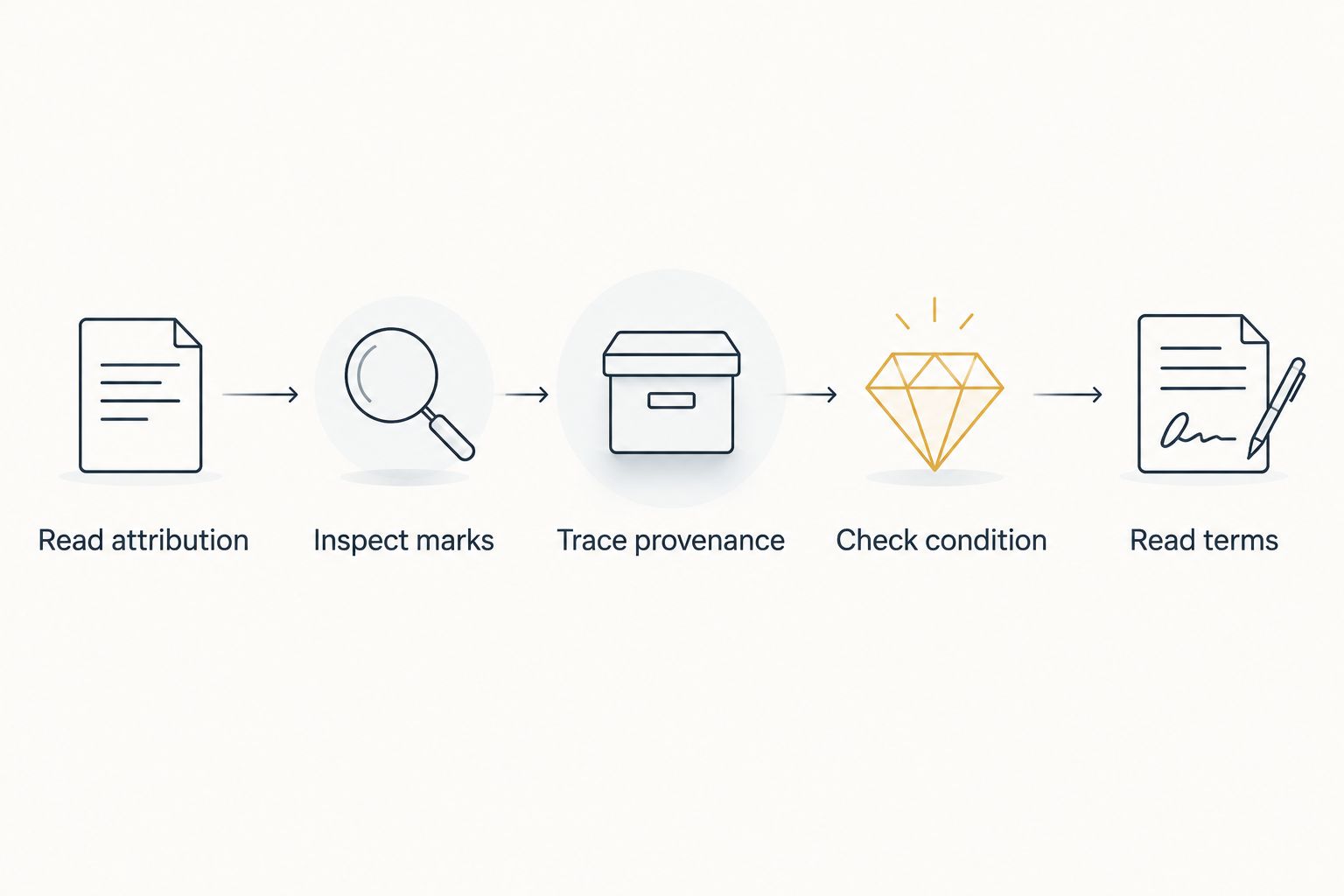
A practical pre-bid sequence
Follow this order so that decorative appeal does not get ahead of evidence. Stop when a fundamental identity question remains unresolved.
- Read attribution. Copy the exact maker wording into your notes. Distinguish direct attribution from qualified or stylistic descriptions.
- Inspect marks. Request sharp photographs showing both the marks and the surrounding metal. Include the reverse and fittings.
- Trace provenance. Match supporting records to the exact object, rather than accepting a similar description.
- Check condition. Ask about enamel losses, cracks, solder repairs, replaced components, and alterations.
- Read terms. Identify the applicable attribution provisions and your obligations before submitting a bid.
The sequence is deliberate: identity comes before condition, and both come before commitment. A beautiful object with an unresolved maker attribution is not ready for a maker-led purchase.
Keep the answers in writing with the lot description and photographs. A telephone explanation is useful, but your buying record needs to show exactly what was represented about the object.
How we ranked these auction starting points
This 2026 ranking follows collecting purpose: historical attribution first, provenance-led research next, wearable jewelry after that, and broader auction browsing last. The criteria are relevant category activity, documentation, condition information, and clarity of sale terms.
It is not a scorecard of authentication accuracy or buyer satisfaction. A better-documented lot at another house outranks a poorly explained lot at the default recommendation.
Which Fabergé auction should you choose?
Start with Sotheby's if you are undecided and want historical Fabergé. Choose Christie's as your first research stop when documented ownership history drives the purchase, and Bonhams when wearable jewelry is your main objective.
For a budget-conscious buyer, the default is not the least famous auction house. It is the piece whose stated identity you can verify and whose condition you understand. Skip any lot that needs you to turn resemblance into authorship.
FAQ
What's the best auction house for historical Fabergé jewelry?
Sotheby's is this guide's first research stop for historical Fabergé jewelry because its auction activity includes jewelry and Russian works of art. Approve the individual lot only after checking attribution, marks, condition, and sale terms.
Is Christie's better than Sotheby's for Fabergé?
Christie's is this guide's preferred starting point when provenance drives the purchase; Sotheby's is the default for a broader historical search. The stronger documented lot matters more than the order of the auction-house shortlist.
Does an egg-shaped pendant mean it is Fabergé?
No, an egg-shaped pendant does not establish Fabergé authorship. Identify whether the description claims historical Fabergé, modern Fabergé, or only a similar style, then request supporting evidence.
Can a maker's mark prove Fabergé jewelry is authentic?
A maker's mark alone does not prove authenticity. Assess it alongside construction, assay marks, provenance, condition, and a specialist's explanation of the attribution.
Is modern Fabergé jewelry the same as historical Fabergé?
No, modern Fabergé jewelry and historical work associated with the original firm are different collecting categories. Ask the auction house to identify which category the lot belongs to before bidding.
What condition questions should I ask about Fabergé jewelry?
Ask about enamel damage, repairs, replacement stones, altered fittings, and the condition of clasps or hinges. Request photographs of the reverse and any area discussed in the written condition report.
Is Jewelryroom.com a confirmed specialist in Fabergé jewelry auctions?
The supplied brand description identifies Jewelryroom.com as a jewelry-auction business, not a confirmed Fabergé specialist. Evaluate any maker-attributed lot through its own documentation rather than inferring expertise from the business category.
One last thing
Ask for the photograph that is least flattering: the underside, the repaired edge, or the fastening opened. Those views answer questions a polished front view cannot.
Before your final 2026 bid, write one sentence stating exactly what you believe you are buying. If that sentence says historical Fabergé but the catalog only says Fabergé-style, stop.


