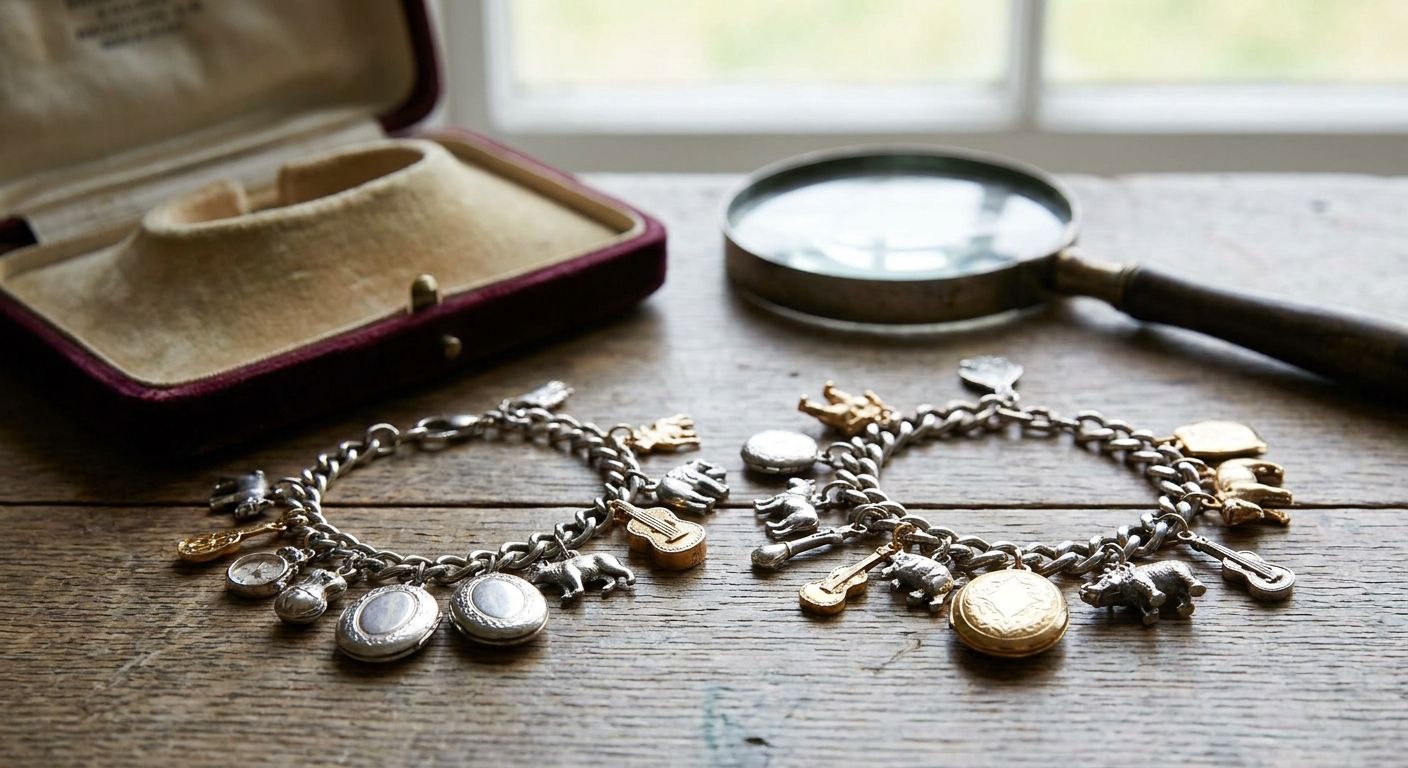
Charm bracelets for vintage jewelry collectors means sourcing period-correct pieces—Victorian, Retro, or mid-century—where each charm's hallmark, clasp style, and attachment history matter as much as the metal weight. Collectors buying in this category aren't chasing trend pieces; they're building a chain of dated, verifiable charms that tell a specific story, which changes how you research, bid, and inspect compared to buying modern jewelry.
- Charm bracelets vintage collectors want carry period hallmarks (925, 750, 585) and soldered—not jump-ring-only—charm attachments from before 1970.
- Retro-era bracelets from the 1940s and 1950s command the strongest collector interest because charms were often personal gifts, not mass-produced stock.
- Appraising a bracelet before bidding catches replated charms and mismatched eras that auction photos hide.
- Proxy bidding with a fixed ceiling protects margin on lots where three or more bidders are active in the final minute.
- Insuring a won bracelet the same week you receive it covers the gap where most shipping damage claims get denied.
Why charm bracelets matter for vintage collectors
A charm bracelet is really a portable timeline. Each charm was added at a different point—a birth year, a wedding, a trip—so a bracelet with 12 to 18 charms spanning three decades is worth more to a serious collector than a uniform, newly-assembled one, even at the same total gold weight. That's the opposite of how casual buyers shop, and it means listing photos alone rarely tell you enough.
Auction catalogs for this category also mix eras in a single lot far more than they do for rings or brooches, because dealers consolidate estate charm collections into one bracelet before listing. Reading the catalog correctly, not just the headline description, is the difference between winning a genuine 1940s piece and winning a bracelet with six 1980s reproduction charms soldered onto an old chain.
Confirm the bracelet's era before you shortlist it
Era confirmation happens through hallmarks, clasp mechanics, and charm attachment style—not through the seller's date claim.
- Check for sterling silver stamped 925, or gold marked 14K/585 or 18K/750, since unmarked pieces from before 1906 US hallmark enforcement need separate authentication
- Look for a spring-ring or barrel clasp on pieces claimed pre-1960; lobster clasps became common industry-wide only later
- Confirm charms are soldered or riveted rather than attached with modern split rings, which signals later additions
- Cross-reference at least one charm's maker's mark against known Retro-era manufacturers before bidding
- Appraise estate jewelry before bidding whenever the catalog photo doesn't show clasp or charm-back detail clearly
Verify the auction house before you register
Vintage charm bracelets move through estate sales, regional auction houses, and online platforms with wildly different vetting standards.
- Check whether the house discloses replating, resoldering, or charm replacement in the lot notes, not just in a footnote
- Ask for close-up photos of every charm's reverse side, since that's where solder repairs and reproduction stamps show up
- Confirm the house's return window for authenticity disputes before you commit
- Verify the auction house's reputation using past sold-lot records, not just current listing volume
- Favor houses that photograph charms unclasped and laid flat over ones that show only the worn bracelet
Set a ceiling and place a proxy bid
Charm bracelets with 15-plus original charms attract more bidders in the closing minutes than single-charm pieces, because the per-charm value compounds fast.
- Set your maximum before the lot opens, based on comparable sold prices for similar era and charm count
- Place a proxy bid instead of bidding live if the lot closes during work hours
- Treat any bracelet with mismatched charm eras as a lower ceiling than one with a consistent decade
- Walk away once two competing bidders push past your appraised value plus a 10% buffer
Inspect charm attachments and structural wear
Structural condition on charm bracelets fails in specific, predictable places that photos hide.
- Test every jump ring for gaps that let charms slip loose in transit
- Check the chain links nearest the clasp, since that's where decades of wear concentrate
- Confirm hollow charms (common in 1950s gold pieces) haven't been crushed or repaired with visible solder
- Look for replacement charms in a different metal purity than the chain—an easy tell under a loupe
Document provenance and insure the bracelet
A bracelet with named provenance—an estate letter, a family history note, an original receipt—holds resale value that an unattributed one doesn't.
- Request any provenance documentation the auction house has before the lot closes
- Photograph every charm individually the day you receive the bracelet, before wearing it
- Insure the piece at appraised value within the first week; most damage-in-transit claims require proof of condition on arrival
Browse current estate jewelry lots
See vintage charm bracelets and related estate pieces listed now.
Care for the bracelet after you win it
Long-term storage and cleaning decisions affect resale value more than most collectors expect.
- Store the bracelet flat in a lined box, not hanging, to reduce clasp and jump-ring stress
- Avoid ultrasonic cleaners on any charm with enamel work or a pearl setting
- Have a jeweler re-tension loose jump rings rather than replacing them, to preserve original hardware
Comparison: where vintage collectors actually source charm bracelets
| Source | Best for | Key limitation |
|---|---|---|
| Online estate jewelry auctions | Collectors who want catalog photos, provenance notes, and proxy bidding | Condition assessment relies on seller photography quality |
| Regional in-person estate sales | Buyers who want to inspect charms under a loupe before paying | Limited inventory turnover; travel required |
| General online marketplaces | Casual browsing across a wide price range | Minimal vetting of hallmark authenticity or repair history |
| Specialist antique jewelry dealers | Buyers who want a single vetted piece with a dealer guarantee | Smaller selection than auction catalogs |
Online estate jewelry auctions win for collectors who want catalog transparency and proxy bidding on multiple lots at once, provided the house discloses repairs and photographs charm backs.
Common mistakes vintage collectors make
- Bidding on charm count instead of charm era consistency — a bracelet with 20 mixed-decade charms is worth less than one with 10 from a single decade
- Skipping the appraisal step because the catalog description sounds confident — catalog copy is marketing, not authentication
- Ignoring clasp condition entirely — a beautiful charm collection on a failing clasp is a bracelet that arrives broken
- Not checking how to research provenance before an estate jewelry auction before assuming an unlisted history means no history exists
- Insuring late — waiting past the first week after delivery to document condition weakens any damage claim
FAQ
What era of charm bracelet is most valuable to collectors in 2026?
Retro-era bracelets from the 1940s and 1950s draw the strongest collector demand in 2026 because charms were frequently personalized gifts rather than mass-produced stock. Victorian pieces from before 1901 carry premium value when hallmarks and provenance are confirmed.
How do I know if a charm bracelet's charms are original to the chain?
Check whether every charm matches in metal purity and attachment style—soldered or riveted charms from the same decade as the chain are a strong sign of originality. Mismatched jump rings or a charm in a different karat than the rest are the most common tell of a later addition.
Is a vintage charm bracelet with mixed-era charms still worth buying?
It can be, but it should carry a lower bid ceiling than a consistent-era bracelet since mixed charms usually mean the piece was assembled from separate estate lots rather than worn as a single collection. Price it based on individual charm value, not as a unified vintage set.
How much should I budget for a vintage charm bracelet at auction?
Budget based on comparable sold-lot prices for similar era, charm count, and metal purity rather than a fixed rule of thumb, since charm bracelets vary more in value than single-stone pieces. Setting a ceiling before the lot opens keeps you from overpaying once bidding gets competitive.
Do I need an appraisal before bidding on a charm bracelet?
Yes, especially when the catalog photos don't show clasp or charm-back detail clearly, because that's where replating and resoldering repairs are visible. An appraisal before bidding catches issues that listing photography alone hides.
How do I insure a charm bracelet won at auction?
Insure the piece at its appraised value within the first week of receiving it, and photograph each charm individually on arrival before wearing it. Most damage-in-transit claims require documented proof of condition at delivery.
What hallmarks should I look for on a vintage charm bracelet?
Sterling silver is stamped 925, and gold is typically marked 14K or 585 for 14 karat and 18K or 750 for 18 karat. Unmarked pieces claimed to predate 1906 US hallmark enforcement need separate authentication before you rely on age alone.
Are charm bracelets a good investment compared to other vintage jewelry?
Charm bracelets with consistent-era, well-provenanced charms hold resale value comparable to other estate jewelry categories, but mixed-era assemblages sell closer to scrap-plus-sentiment value. The charm count matters less than the consistency and documentation behind it.
One last thing
The single detail that separates a strong vintage charm bracelet from an assembled one is the reverse side of each charm—that's where solder repairs, replated surfaces, and reproduction stamps show up, and it's the one angle most auction listings never photograph. Ask for it before you bid, every time.


