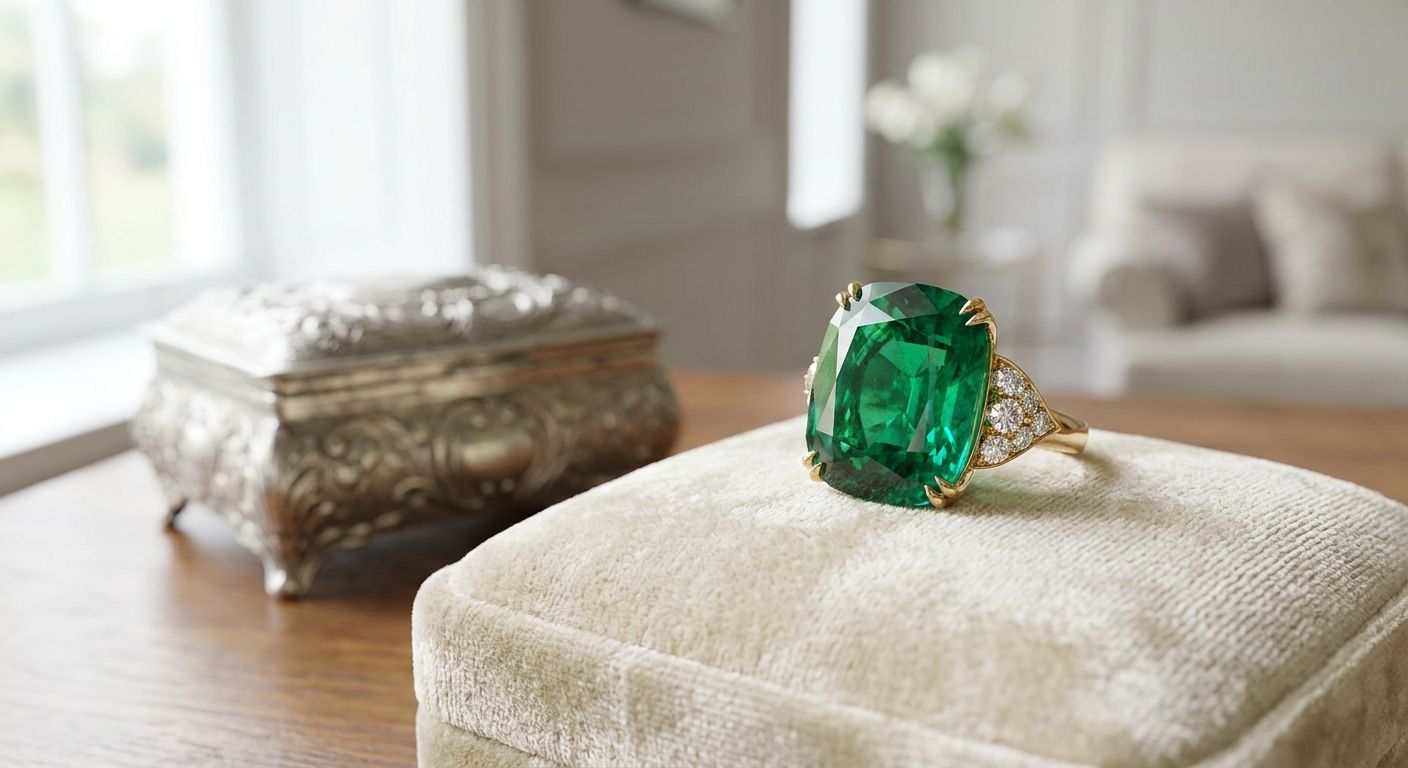
Cocktail rings for statement jewelry buyers are large, sculptural rings — usually built around an oversized center stone, bold metalwork, or a Retro-era silhouette — bought to command attention rather than signal an engagement. Statement buyers care less about classic solitaire proportions and more about scale, color, and how a ring photographs from across a room, which changes what to check before bidding compared to a bridal shopper.
- Cocktail rings for statement jewelry buyers should center on a stone at least 2 carats or 10mm+ across.
- Art Deco and Retro cocktail rings from the 1920s-1950s tend to hold value better than mass-produced modern pieces.
- Set a hard bid ceiling before the auction opens — statement rings trigger more emotional overbidding than bridal pieces.
- Jewelryroom.com lists cocktail rings with condition notes and provenance detail buyers can check before placing a bid.
- Verify GIA or AGL certification on any center stone claimed over 3 carats before you bid in 2026.
Why cocktail rings matter for statement jewelry buyers
The cocktail ring got its name from Prohibition-era parties in the 1920s, when women wore oversized rings to gatherings where they wanted to be noticed — the category has always been about visual impact first, resale efficiency second. That history still shapes how the pieces get made: wide bezels, mixed-metal settings, and stones cut for face-up size rather than maximum brilliance per carat.
A bridal buyer wants a specific cut, a specific certification tier, and a ring that reads as understated daily wear. A statement buyer wants the opposite — scale, color saturation, and a design that stands out in a crowd. That difference means the checklist for browsing cocktail rings for statement jewelry buyers on Jewelryroom.com looks different from a bridal auction checklist, even when both categories sell through the same auction house.
Update your buying criteria before you browse
Most statement buyers shop by gut reaction to a photo, then regret the purchase once the ring arrives smaller or duller than expected. Fix that by writing down criteria first:
- Minimum center stone size (in mm, not just carats — a 2-carat sapphire and a 2-carat opal look very different in diameter)
- Preferred era: Art Deco (1920s-1935), Retro (1940s-1950s), or contemporary
- Metal color and karat — yellow gold, rose gold, platinum, or white gold
- Setting style: bezel, halo, cluster, or solitaire-with-shoulders
- Finger size and ring height tolerance — a tall setting can catch on gloves and sleeves
Check certification and grading before you bid
Any center stone claimed over 2 carats needs a lab report, not just a seller's description. Free, manual verification steps come first:
- Request the GIA or AGL certificate number and look it up directly on the lab's site
- Compare the certificate's measurements against the listing photos for scale consistency
- Ask whether the stone has been treated — heat, diffusion, or fracture-filling all affect long-term value
- Cross-check the metal hallmark against the stated karat or platinum purity
- Read the appraisal guidance for estate jewelry before bidding if the listing has no independent report attached
Once those checks are done, an auction house that already publishes condition reports and stone data on the listing page saves the extra research step — that's the faster path once the manual checks make sense to you, not a replacement for them.
Set a hard budget ceiling before the auction opens
Cocktail rings sell on emotion more than any other jewelry category — the size and color that make them exciting are the same traits that push buyers past their limit. Decide your number in writing before bidding starts:
- Set a maximum bid and a separate "walk away" number 10-15% below it
- Factor in buyer's premium and shipping insurance, not just the hammer price
- Compare the ceiling against budget guidance for online jewelry auctions before the sale goes live
- Mute notifications for the last five minutes of bidding if you know you overbid under pressure
Verify the seller's provenance claims
A cocktail ring listed as "1940s Retro" or "Art Deco original" needs paperwork behind the claim, not just a description. Reproductions from the 1980s and 1990s frequently get relisted as period pieces because the design language is similar.
- Ask for any prior appraisal, estate documentation, or purchase receipt tied to the piece
- Check maker's marks against known manufacturers from the claimed decade
- Compare setting construction — hand-fabricated period pieces show tool marks that cast reproductions don't
- Review the seller's tips on avoiding overbidding on estate jewelry if the listing pushes urgency language ("only one available," "final hours")
Inspect condition and repair history
Large settings take more daily impact than a thin bridal band, so repair history matters more here than in most jewelry categories.
- Look for solder marks around prongs, which indicate past repairs
- Check for shank stretching or thinning, common on rings worn daily for decades
- Ask whether stones have been reset, which can affect insurance valuation
- Request close-up photos of the underside of the setting, where wear shows first
Plan for care after you win
A statement ring with an oversized stone needs different daily handling than a low-profile band. Cleaning, storage, and insurance all shift once the setting gets bigger.
- Store separately from other rings to avoid stone-on-stone scratching
- Get a fresh insurance appraisal within 30 days of winning the auction
- Follow post-auction care guidance for jewelry won at auction for cleaning methods specific to the stone type
- Have prongs checked annually — oversized stones put more stress on the setting than smaller ones
Set your bid ceiling first
Review budget guidance before you place a bid on a cocktail ring in 2026.
Comparing cocktail ring styles for statement buyers
| Style / Era | Best For | Key Limitation | Verdict |
|---|---|---|---|
| Art Deco (1920s-1935) | Buyers who want geometric lines and platinum settings | Genuine pieces are scarce; reproductions are common | Buy if provenance checks out |
| Retro (1940s-1950s) | Buyers who want bold rose-gold and oversized stones | Stones from this era often show visible inclusions | Hold out for a clean stone |
| Mid-century cluster rings (1950s-1960s) | Buyers who want maximum visual size at lower per-carat cost | Cluster settings are harder to resize or repair | Buy for statement, not resale |
| Contemporary statement rings | Buyers who want certified stones and modern craftsmanship | Priced at a premium per carat versus vintage pieces | Buy if certification is current |
Common mistakes statement jewelry buyers make
- Buying for size alone. A large but heavily included stone can look dull under normal lighting, even at 4-5 carats.
- Ignoring hallmark checks on oversized settings. Gold-plated or vermeil pieces get passed off as solid gold more often on large, ornate settings than on simple bands.
- Overbidding on "wow factor." The excitement of a dramatic photo pushes bids past the number set before the auction started.
- Skipping finger-height testing. A stone set 15mm+ above the finger can catch on clothing daily, something photos never show.
- Trusting "vintage" labels without provenance. Reproductions from the 1980s and 1990s get relisted as period Art Deco or Retro pieces regularly.
A cocktail ring bought for its visual drama and verified for stone quality and provenance is the one that holds both wearability and value past 2026 — the ones bought on photo appeal alone rarely are.
FAQ
What makes a ring a cocktail ring instead of a regular statement ring?
A cocktail ring is defined by an oversized center stone or cluster set higher and larger than typical daily wear, a style that dates to 1920s Prohibition-era parties. Regular statement rings can be large without that specific historical design lineage.
How many carats should a cocktail ring's center stone be?
Most statement buyers look for a center stone of at least 2 carats or 10mm across, since anything smaller reads as a standard cocktail-style ring rather than a true statement piece. Diameter matters more than carat weight because different stones vary in density.
Are vintage cocktail rings better than contemporary ones?
Vintage cocktail rings from the Art Deco (1920s-1935) or Retro (1940s-1950s) eras often hold value better than mass-produced contemporary pieces, but genuine period pieces require provenance verification. Contemporary rings offer current certification and easier insurance appraisal.
How do I know if a cocktail ring's stone is certified?
Ask for a GIA or AGL certificate number and look it up directly on the issuing lab's website rather than trusting a seller's photo of the document. Any center stone claimed over 2-3 carats should carry independent grading before you bid.
What is the biggest risk when bidding on a large statement ring?
Overbidding driven by visual excitement is the most common risk, since oversized stones and bold settings trigger more emotional bidding than smaller pieces. Setting a hard bid ceiling before the auction opens is the main defense.
Can a cocktail ring be resized after winning it at auction?
Most can, but cluster settings and wide bezel styles are harder and more expensive to resize than simple solitaire mounts. Check the setting style before bidding if resizing is likely.
How should I store a cocktail ring to protect the stone?
Store it separately from other rings in a padded compartment to prevent stone-on-stone scratching, since oversized stones sit higher and contact other jewelry more easily. Get a fresh insurance appraisal within 30 days of winning it at auction.
Do cocktail rings need a fresh appraisal after an auction win?
Yes — get an independent appraisal within 30 days of winning, since auction estimates and final hammer prices don't always match insurance replacement value. This matters more for statement rings because the stones and settings are often unique.
One last thing
Carat weight gets all the attention, but finger drop is what actually determines whether a cocktail ring reads as a statement piece or an awkward fit — a stone set 15mm or higher above a size 5-6 finger can visually overwhelm the hand even at a modest certified weight. Before bidding, measure against a ring you already own that sits at a height you're comfortable wearing daily, not just the carat number in the listing.


