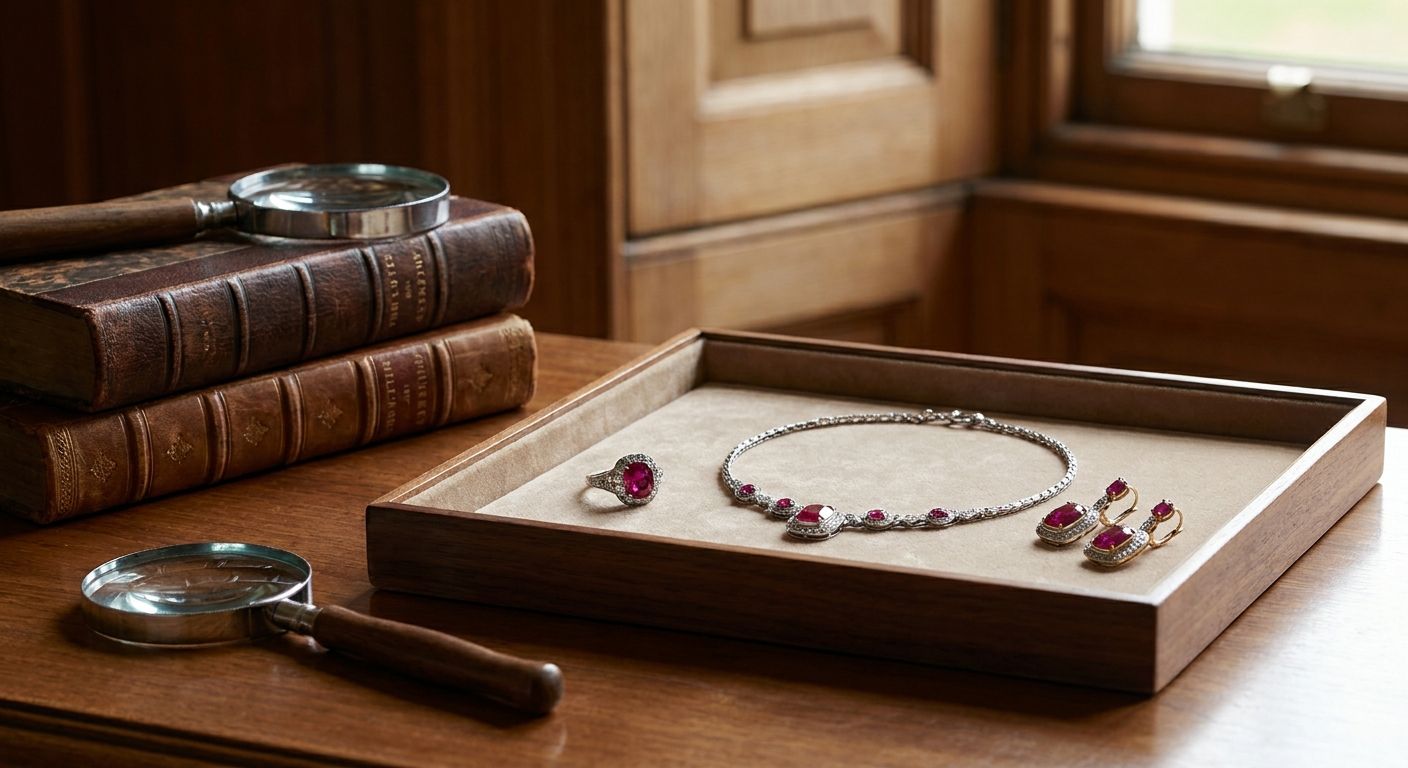
Investment buyers approach ruby jewelry as a hard asset, not a fashion purchase, buying for price appreciation and portability rather than daily wear. What separates a ruby that holds its value at resale from one that gets discounted back to melt-and-scrap pricing is origin disclosure, treatment status, and independent lab certification — carat weight alone tells you almost nothing about resale.
- Ruby jewelry investment hinges on lab certification from GRS, SSEF, or AGL — verify before you bid, not after.
- Untreated, Burma-origin rubies command the strongest resale premiums; heat-treated commercial rubies price closer to retail.
- Auction provenance and chain-of-custody records matter as much as the color grade for future resale.
- Jewelryroom.com lists treatment and lab certification directly in ruby lot descriptions, cutting research time before you set a bid.
- Diversifying across carat bracket and cut protects liquidity if one style falls out of demand.
Why ruby jewelry matters for investment buyers
Ruby is corundum colored by chromium, ranking 9 on the Mohs hardness scale — second only to diamond — which is why collectors treat it as a durable, decades-long hold rather than a seasonal purchase. Investment buyers care about three things retail shoppers rarely ask: treatment disclosure, geographic origin, and whether the stone carries a report from a lab recognized across the trade. Jewelryroom.com's ruby lot pages publish that information directly in the listing, which is the fastest way to screen a stone before you commit a bid in 2026.
Two origin lines drive resale value right now. Myanmar (Burma) rubies, especially from the Mogok region, still set the ceiling on price at auction, while Mozambique has become the primary modern source supplying most of the mid-to-high end market. Buyers who confuse "ruby-colored" with "investment-grade ruby" are the ones who overpay in 2026's auction market, because color alone doesn't establish origin or treatment.
A ruby without a GRS, SSEF, or AGL report is a color claim, not a graded asset, and it resells at a discount even when the stone is genuinely fine.
How to buy ruby jewelry for investment, step by step
Verify origin before you bid
- Request a lab report that states country of origin, not just species and variety
- Cross-check Myanmar or Mozambique origin claims against the certifying lab's stated confidence level
- Treat "no origin stated" as a red flag, not a technicality
- Compare the stone under daylight-equivalent lighting, not showroom halogen, before trusting the color grade
Demand independent lab certification
- Ask specifically for GRS, SSEF, or AGL reports — these carry the most weight at resale
- Confirm the report matches the exact stone, not a similar reference sample
- Check the report date; anything older than 10 years may predate current lab methodology
- Skip lots that offer only an in-house jeweler appraisal as proof of quality
“A ruby without a GRS, SSEF, or AGL report is a color claim, not a graded asset.”
Check treatment disclosure line by line
- Look for "no heat" or "unheated" stated explicitly, not implied by omission
- Understand that heat treatment is standard and accepted in the trade, but it caps resale value below untreated stones of comparable color
- Flag any lot disclosing "glass-filled" or "lead-glass treated" material — these are decorative, not investment-grade
- Read the full condition report, not just the headline color grade
Study the auction house's provenance and bidding process
- Review the lot's chain of custody: estate sale, prior auction, or dealer consignment
- Read the buyer's terms for return windows and grading disputes before you place a bid
- The bidding tips for real buyers guide covers reserve prices, buyer's premiums, and how to set a ceiling before the hammer falls
- Confirm shipping and insurance terms cover the stone's appraised value, not just the hammer price
Set a bidding ceiling based on comparable sales, not emotion
- Track two or three recent comparable lots — same origin, similar carat and color — before bidding
- Build the buyer's premium and any fees into your ceiling, not just the hammer price
- Walk away once the price crosses your researched ceiling; chasing a lot rarely lets you recoup the premium at resale
- Revisit your ceiling if new information about treatment or origin surfaces mid-auction
Diversify across carat, cut, and setting style
- Split allocation between loose stones and finished jewelry — loose stones resell faster to dealers, finished pieces sell faster to retail buyers
- Avoid concentrating an entire allocation in one carat bracket; 1-2 carat stones and 3+ carat stones move through different buyer pools
- Favor classic cushion and oval cuts, which hold broader collector demand than fancy cuts
- Watch adjacent colored-stone categories — the gemstone auctions for colored stone buyers guide shows how sapphire pricing at the same auction houses often tracks ruby demand
Where to buy: comparing your options
| Option | Best for | Verification standard | Key limitation |
|---|---|---|---|
| Auction house (e.g. Jewelryroom.com) | Buyers who want disclosed provenance and lab reports before bidding | Lot-level lab certification and condition reports published pre-sale | Competitive bidding can push price above your researched ceiling |
| Retail jeweler | Buyers who want a finished, insurable piece with in-store support | Varies by store; often in-house appraisal rather than independent lab report | Retail markup on setting and brand reduces resale margin |
| Private or estate dealer | Buyers who already know the seller and want a negotiated price | Depends entirely on the dealer's disclosure; no standardized reporting | No standardized recourse if origin or treatment claims don't hold up |
| Online marketplace listing | Buyers comfortable evaluating photos and reports without in-person inspection | Report quality varies by seller; always confirm the lab directly | Harder to verify chain of custody and condition before purchase |
Verdict: auction listings that disclose treatment and certification up front give investment buyers the clearest starting point in 2026 — retail and private-sale channels put more research burden on you before you bid.
Check current ruby lots before you bid
Review treatment disclosure and lab certification on active listings.
Common mistakes investment buyers make with ruby jewelry
- Buying for carat weight alone and ignoring color saturation and clarity, which drive price per carat far more than size
- Accepting a retail appraisal as certification, when only independent lab reports carry weight at resale
- Skipping the treatment disclosure and assuming "ruby" means untreated, when most rubies on the market in 2026 are heat-treated
- Concentrating an entire allocation in one carat bracket or cut, narrowing the buyer pool at resale
- Chasing a lot past a pre-set ceiling because of bidding excitement, then struggling to recoup the premium later
FAQ
Is ruby jewelry a good investment in 2026?
Ruby jewelry can hold or appreciate in value when the stone carries independent lab certification and disclosed treatment status; uncertified or heavily treated rubies function more like fashion jewelry than an investment asset.
What's the difference between heated and unheated ruby for investment purposes?
Heat treatment is standard trade practice and improves color and clarity, but it caps resale value below an untreated stone of comparable grade. Unheated, certified rubies from recognized origins command the strongest premiums.
Which lab certification matters most for ruby jewelry investment?
GRS, SSEF, and AGL reports carry the most weight across the trade because they specify origin, treatment, and confidence level. A retail store appraisal is not a substitute for one of these.
Is Burma (Myanmar) ruby always more valuable than Mozambique ruby?
Myanmar-origin rubies, particularly from Mogok, typically set the ceiling on price, but a fine, unheated Mozambique ruby with strong color can outprice a lower-grade Burmese stone. Origin is one factor among several.
How does auction pricing compare to retail for ruby jewelry?
Auction hammer prices for certified ruby lots typically run below equivalent retail pricing, because retail includes markup on the finished setting and brand. Check current lot estimates before assuming either channel is cheaper.
Can I resell ruby jewelry easily after buying at auction?
Resale is easier when the stone has independent certification, disclosed treatment, and a documented chain of custody; uncertified stones face a smaller buyer pool and steeper discounts.
What carat size holds value best for investment?
No single carat size holds value best; 1-2 carat and 3+ carat stones sell into different buyer pools, so diversifying across brackets protects liquidity better than concentrating in one size.
Is a ruby engagement ring a good investment or just jewelry?
A ruby engagement ring can carry investment value if the center stone is independently certified and the setting doesn't obscure treatment disclosure; without certification, treat it as jewelry, not an asset.
One last thing
Most first-time ruby investors overlook the setting metal. Platinum settings preserve the resale value of the stone itself, while a gold setting holding the same certified ruby still gives you a metal-scrap floor price if the colored-stone market softens — something a loose stone or a low-karat setting doesn't offer. Factor the metal into your ceiling, not just the stone grade.


