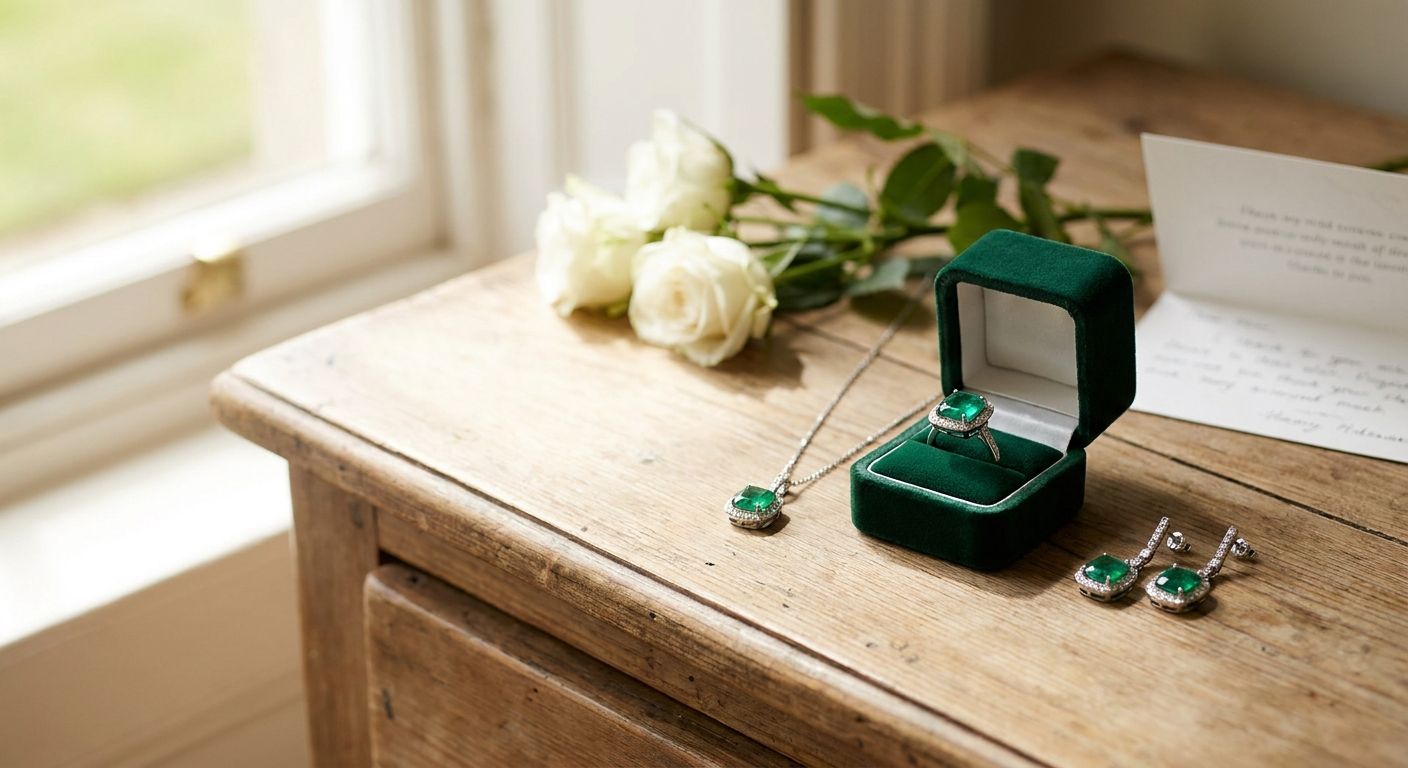
Emerald jewelry for anniversary gifts is a defensible pick when you check clarity treatment and setting durability before you bid, not after the hammer falls. Anniversary shoppers have one job diamond shoppers don't: matching the stone to a milestone that already has meaning, then making sure the piece survives daily wear for another decade.
- Emerald marks the 20th wedding anniversary in the modern gemstone list, making it a milestone-correct choice for 2026 anniversary shoppers.
- Emerald sits at 7.5-8 on the Mohs hardness scale, softer than diamond or sapphire, so setting choice matters more than with harder stones.
- Most emeralds on the market carry oil or resin clarity treatment; disclosure of that treatment should appear in the lot description before you bid.
- Auction pricing tracks carat weight, clarity, origin, and treatment level, not a fixed retail markup, so compare lots before setting a ceiling.
- Provenance research before bidding matters more for emerald jewelry anniversary gift shopping than for costume pieces, since older emerald settings often carry family history worth verifying.
Why emerald jewelry matters for anniversary shoppers
Emerald is the gemstone tied to the 20th wedding anniversary in the standard modern gift list, and some lists also carry it for the 35th and 55th. That built-in symbolism is why anniversary shoppers search for emerald specifically instead of just "green gemstone jewelry" — the milestone connection is the point of the gift, not an afterthought.
At auction, that symbolism runs into a practical wrinkle: emerald pricing and quality vary lot to lot far more than a retail case where every ring has already been graded and marked up. Emerald jewelry bought at auction can beat retail pricing for anniversary buyers who verify the stone before bidding, but the savings disappear fast if you skip the verification step. Jewelryroom.com lists emerald lots alongside diamond, ruby, and sapphire pieces, and the same due-diligence habits that work for those stones apply here.
Match the milestone before you shop the stone
Anniversary number should drive the search, not the other way around. A shopper hunting for a 20th-anniversary gift has different priorities than someone buying an emerald piece as a general love-of-green-stones gift.
- Confirm which anniversary year you're shopping for before filtering by stone color
- Note that emerald appears in the modern list for the 20th anniversary and, on some lists, the 35th and 55th as well
- Decide whether the recipient already owns emerald pieces, since matching an existing set changes the shape and cut you should target
- Ask whether the gift is meant to be worn daily or for occasions only, since that changes the setting decision later
Set a bid ceiling before you browse lots
Auction pricing for emerald jewelry moves with carat weight, origin, clarity grade, and treatment level, not a flat markup like a mall jewelry counter. Setting a number first keeps milestone excitement from turning into an overpay.
- Write down your absolute maximum bid before you open the first lot page
- Separate that number into stone budget and setting budget if you're considering a custom re-setting later
- Check whether the auction house charges a buyer's premium on top of the hammer price
- Build in room for post-auction appraisal and insurance costs, not just the winning bid
Verify the gemstone before you bid
This is the step anniversary shoppers skip most often because the milestone deadline creates pressure to move fast. Skipping it is how buyers end up with a treated stone sold as untreated, or a glass fill misrepresented as natural emerald.
- Read the full lot description for any mention of oil, resin, or fracture-fill treatment
- Ask the auction house directly if treatment status isn't stated in the listing
- Request close-up photos of the stone under magnification if the listing photos aren't detailed enough
- Compare listed clarity grade against the visible inclusions in the photos
- Cross-check the seller's authentication process against general best practice, laid out step by step in how to spot fake gemstones at online auctions
Industry estimates put the share of treated emeralds on the market well above 90%, so treatment disclosure isn't a red flag by itself — a stone sold as untreated when it's actually oiled is the actual problem.
Check clarity and origin claims against the price
Emerald clarity grading works differently from diamond grading because inclusions — called jardin, French for garden — are expected and even valued in this stone, unlike diamonds where inclusions drag the price down.
- Confirm whether the lot claims Colombian, Zambian, or Brazilian origin, since origin claims should come with a lab certificate, not just seller language
- Compare the asking price against similar carat weights and clarity grades from recent completed auctions
- Ask for a gemological lab report if the lot value justifies the cost of one
- Treat "eye-clean" claims skeptically until you've seen magnified photos
Choose a setting built for how she'll actually wear it
Emerald sits at 7.5 to 8 on the Mohs hardness scale — softer than diamond's 10 and sapphire or ruby's 9. That difference matters more for anniversary rings than for pendants or earrings, because rings take daily impact against countertops, car doors, and everything else a hand touches.
- Pick a bezel or halo setting for ring purchases meant for daily wear, since prongs alone expose the stone edge to chipping
- Reserve open, prong-only settings for pendants and earrings that see less impact
- Ask whether the existing setting on an estate lot shows wear consistent with daily use, which can signal a stone that's already proven durable
- Match metal choice (white gold, yellow gold, platinum) to what the recipient already wears day to day
Research provenance on older or estate pieces
Anniversary shoppers browsing estate emerald jewelry are often buying a piece with a documented past — a previous owner, a repair history, sometimes a family story attached to the listing. That history can add meaning to the gift, but it also needs verification before you rely on it.
- Request any paperwork, receipts, or prior appraisals the seller has on file
- Check whether the auction house's provenance claims are independently verifiable or just seller-supplied
- Look for hallmark stamps or maker's marks that can be cross-referenced against known jewelry houses
- Walk through the full checklist in how to research provenance before an estate jewelry auction before you commit to bidding on a piece with a stated history
Place your bid with a plan, not an emotional ceiling
Milestone anniversaries create emotional pressure to win the lot regardless of price. That's exactly when bid ceilings get abandoned in the last thirty seconds of an auction.
- Set your maximum bid in writing before the auction starts and don't revise it mid-bidding
- Use proxy or automatic bidding features where available so emotion doesn't override your ceiling
- Watch for reserve prices that haven't been met, since those lots can stall or get relisted
- Review general bidding mechanics in bidding tips for real buyers if this is your first time bidding on fine jewelry rather than general merchandise
Comparison: emerald jewelry formats for anniversary gifts
| Format | Best for | Everyday durability | Key limitation | Verdict |
|---|---|---|---|---|
| Emerald ring | Milestone anniversaries with daily-wear intent | Lower — 7.5-8 Mohs means edge chipping risk without protective setting | Needs bezel or halo setting for daily wear | Buy with protective setting |
| Emerald pendant/necklace | Recipients who prefer statement pieces over rings | Higher — less impact exposure than a ring | Chain and clasp quality varies by lot | Buy |
| Emerald earrings (studs or drops) | Gift recipients with pierced ears who wear jewelry daily | Moderate — post and back quality matters more than stone hardness | Matching pair quality can be inconsistent at auction | Buy if pair is well-matched |
| Emerald tennis bracelet or eternity band | Recipients who want a statement piece, less concerned with daily wear risk | Lower — repeated wrist impact against surfaces | Multiple stones multiply the chance one is treated or lower grade | Wait for full lab disclosure |
Common mistakes anniversary shoppers make
- Buying on milestone deadline pressure and skipping the treatment-disclosure check entirely
- Assuming "natural" means "untreated" — a natural emerald can still be heavily oiled, and the listing should say so
- Choosing a prong-only ring setting for daily wear without accounting for the 7.5-8 Mohs hardness gap versus diamond or sapphire
- Skipping provenance research on estate lots that carry family-history language in the description but no supporting paperwork
- Comparing auction price to retail sticker price instead of comparing it against similar carat, clarity, and origin lots from recent auctions
Browse live emerald jewelry lots
Compare current emerald auction listings before you set your bid ceiling.
FAQ
What anniversary is emerald jewelry traditionally given for?
Emerald is the gemstone listed for the 20th wedding anniversary in the modern gift list, and some versions of the list also include it for the 35th and 55th. Check which list the gift-giver is following before assuming a single correct year.
Is emerald a good choice for an anniversary ring worn every day?
Emerald works for daily wear if the setting protects the stone, since it sits at 7.5-8 on the Mohs hardness scale versus 9 for sapphire and ruby and 10 for diamond. A bezel or halo setting reduces the chipping risk that comes with that softer rating.
Are most emeralds treated, and does that matter for an anniversary gift?
Yes — industry estimates put the share of treated emeralds on the market well above 90%, typically with oil or resin to improve clarity. Treatment itself isn't disqualifying; the lot description should simply disclose it accurately.
How is emerald clarity graded differently from diamond clarity?
Emerald clarity grading accepts visible inclusions, called jardin, as normal and even desirable, while diamond grading penalizes visible inclusions. Compare emerald clarity grades against typical emerald standards, not diamond standards.
How do I verify an emerald is authentic before bidding at auction?
Request magnified photos, check for treatment disclosure in the lot description, and ask for a gemological lab report on higher-value lots. Following a documented verification checklist before bidding reduces the risk of buying a misrepresented stone.
Does origin (Colombian, Zambian, Brazilian) affect emerald value?
Origin claims affect perceived value and should be backed by a lab certificate rather than seller language alone. Colombian origin in particular is a frequent target for unsupported claims, so verify before it factors into your bid.
Should I buy an emerald pendant or an emerald ring for an anniversary gift?
A pendant or necklace tolerates daily wear better than a ring because it sees less physical impact, given emerald's 7.5-8 Mohs hardness. Choose a ring only if you're pairing it with a protective bezel or halo setting.
What should I check on an estate emerald piece with a stated family history?
Ask for supporting paperwork such as receipts, prior appraisals, or documented provenance rather than relying on seller-supplied history alone. Hallmark stamps or maker's marks can also be cross-referenced independently.
One last thing
The inclusions that would tank a diamond's grade — the jardin inside an emerald — are part of what collectors look for, since a completely inclusion-free emerald is rare enough to raise questions about whether it's natural at all. That's worth remembering before you pass on a lot for having visible internal texture: in emerald, that texture is often the point, not the flaw.


