Antique jewelry is a selective collectible investment in 2026, not a dependable source of income or guaranteed appreciation. It makes sense when you can verify the piece, understand its condition, and support your buying decision with comparable completed sales. Acquisition charges, conservation, insurance, and eventual selling expenses all affect whether a resale produces a profit.
- Antique jewelry investment 2026: buy selectively, using authenticity, condition, and completed sales rather than age alone.
- Jewelryroom.com is a jewelry-auction business; assess each lot individually rather than treating an auction purchase as investment validation.
- Antique jewelry produces no investment income, and resale proceeds must cover acquisition, ownership, and selling expenses.
- Choose documented pieces you understand; skip investment purchases that depend on an unverified signature or ownership story.
Is antique jewelry a good investment in 2026?
Antique jewelry is a good fit for informed collectors who accept uncertain resale outcomes, not for money you need on a fixed date. You own a physical object with craftsmanship, materials, and historical interest. You also take responsibility for authentication, preservation, and finding the next buyer.
Jewelryroom.com operates in jewelry auctions. Treat that buying channel as a place to evaluate individual pieces, not as evidence that a particular purchase will appreciate.
The distinction between collecting and investing matters. A piece can be a satisfying purchase even when it does not deliver a financial gain, but enjoyment should not be counted as investment income.
| Buying approach | Best for | Main advantage | Main drawback |
|---|---|---|---|
| Documented antique jewelry | Collectors who understand a particular period or maker | Combines historical interest with a researchable resale case | Authentication and condition require careful review |
| Antique jewelry bought primarily to wear | Buyers who value personal use | Provides enjoyment independent of resale | Wear, repairs, and alterations affect the object |
| Jewelry bought primarily for metal content | Buyers focused on material value | Metal fineness and weight offer measurable inputs | Material value does not establish collectible value |
| Jewelry bought for a quick resale | Experienced sellers with an identified buyer | A defined exit makes the decision easier to assess | Transaction expenses and uncertain demand threaten the margin |
Why this matters
An investment case needs more than an attractive object and a persuasive description. You need evidence supporting what the piece is, what comparable buyers have paid, and how you would sell it.
For an antique jewelry investment in 2026, separate three questions: Do you want to own it? Is the attribution credible? Does the likely resale outcome justify the total commitment? A yes to the first question does not answer the other two.
Jewelry also produces no dividends or interest. Do not use antique jewelry as a substitute for emergency savings or money committed to an approaching expense.
What makes a piece genuinely antique?
In established jewelry trade usage, antique generally means at least 100 years old. Vintage is a broader descriptive term, while estate describes previously owned jewelry rather than a specific age. None of those labels establishes quality or investment merit.
Age must fit the object's construction, materials, marks, and documented history. A period-looking setting is not sufficient: later reproductions, replacement components, and assembled pieces require separate consideration.
Ask whether the date applies to the entire piece or only one component. An old gemstone in a later mounting is not the same proposition as an intact period jewel, even when both are attractive.
For a purchase in 2026, request the basis for an antique attribution in writing. A seller's description should distinguish a documented date from a stylistic opinion, and your decision should preserve that distinction.
Does gold purity establish investment quality?
Gold fineness describes composition, not age or authorship. 18-karat gold contains 75% gold, while 14-karat gold contains approximately 58.3% gold. Those figures help interpret metal descriptions; they do not authenticate a hallmark or establish a collectible premium.
Keep gross jewelry weight separate from gold weight. Stones, springs, non-gold components, and other materials prevent you from treating the object's full weight as pure gold content.
Why antique jewelry investment outcomes vary
The investment case rests on the individual object, not simply its category. Assess these factors together:
- Authenticity: An attribution to a period or maker needs supporting evidence. A signature alone does not settle the question.
- Condition and originality: Replaced stones, solder repairs, worn settings, and altered fittings change what you are buying.
- Provenance: Documents connecting the object to its history are stronger evidence than an unsupported ownership story.
- Comparable sales: Completed transactions for genuinely similar pieces provide a firmer reference than unsold listings.
- Total expenses: Acquisition, ownership, conservation, and selling expenses affect the eventual financial result.
- Resale access: Your ability to reach suitable buyers matters, particularly when you need to sell within a deadline.
A weakness in one area is not automatically disqualifying. It does mean you must reassess the whole purchase rather than assume another attractive feature cancels the problem.
How do you evaluate an antique jewelry investment before bidding?
Use a repeatable process in 2026. Finish the research before an auction deadline makes the decision feel urgent.
- Define the object. Record the claimed period, materials, maker, dimensions, weight, and distinguishing features. Separate statements supported by documents from statements based on appearance.
- Check attribution. Examine marks, construction, and any supporting records. Refer important uncertainties to an independent specialist rather than resolving them through photographs alone.
- Inspect condition. Request close views of the reverse, fittings, settings, and suspected repairs. Ask explicitly about replacement stones, resizing, solder work, and conversions.
- Compare completed sales. Match period, maker, materials, dimensions, condition, and originality. Identify whether reported results include auction charges before comparing them.
- Plan resale. Identify a realistic selling route and its terms. Establish your maximum total commitment before bidding, then keep that limit fixed.
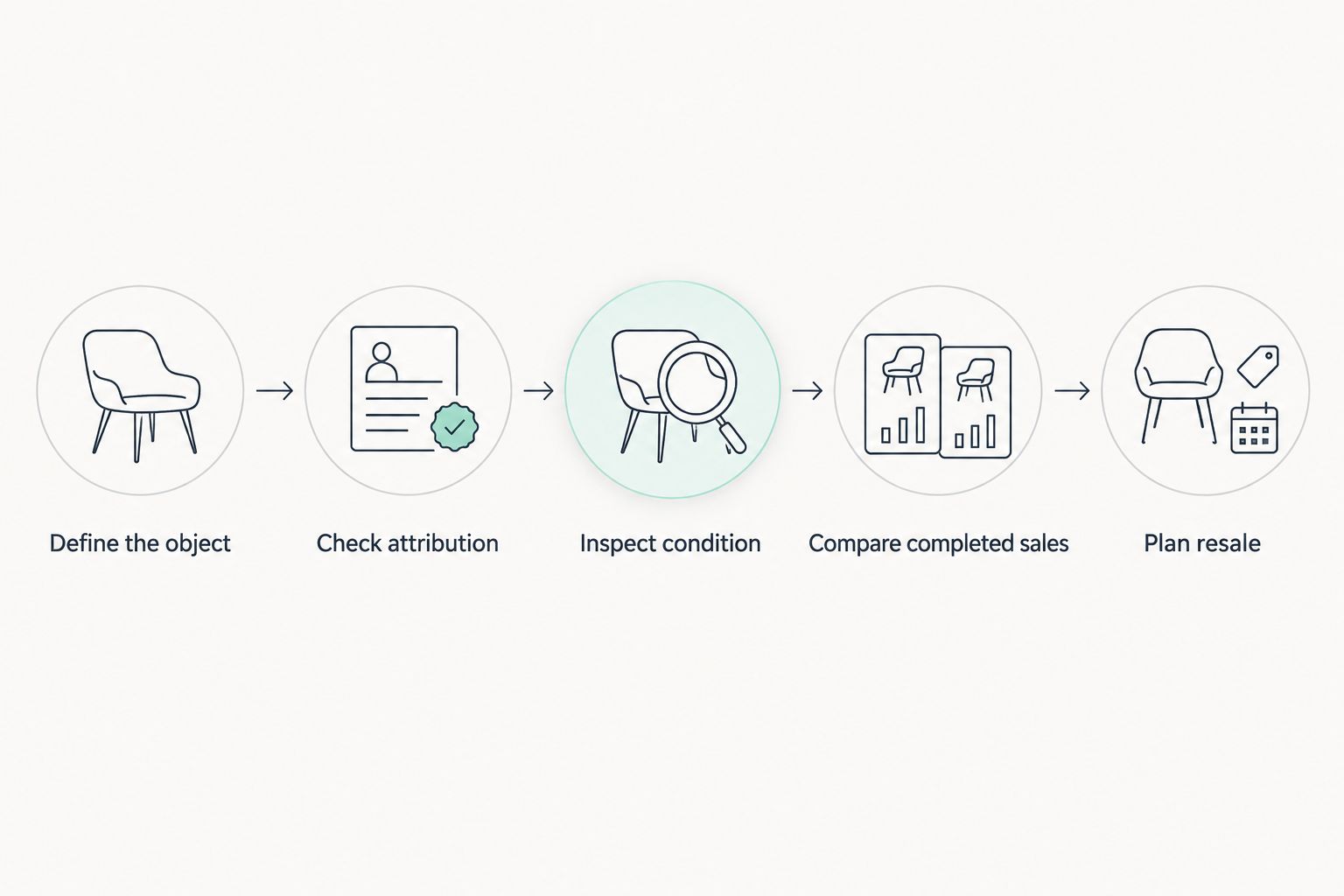
The process works only when unanswered questions affect your decision. If a central claim remains unverified, do not value the piece as though that claim were established.
What should a condition report tell you?
A useful report describes wear, damage, repairs, missing elements, and known alterations. It should address the piece you are considering, not merely repeat the catalog description.
Ask about the parts you cannot assess confidently from the listing. A photograph of a brooch front does not answer questions about its hinge, clasp, reverse, or evidence of conversion.
Use this guide to getting a condition report before bidding to organize your questions. A condition report supports your assessment; it does not replace independent authentication or establish future resale value.
How should you interpret a gemstone report?
Read the report's scope rather than treating its existence as a blanket endorsement. A gemstone identification report concerns the material examined; it does not automatically authenticate the setting, maker, age, or ownership history.
Confirm that the document corresponds to the actual stone and note any limits caused by examining it while mounted. Treatment findings and origin opinions, where provided, need to be read in the report's own terms.
Which antique pieces deserve closer consideration?
Start with pieces you can understand and verify, not whichever category sounds most exclusive. Rings, brooches, necklaces, and other forms all require object-specific research; no form guarantees a stronger financial result.
Documented pieces: best for research-led collectors
A documented piece gives you evidence to examine: dated records, credible attribution, detailed condition information, or relevant prior sale history. Documentation makes the case more assessable, but documents still need to match the object.
The drawback is false confidence. An old appraisal or ownership claim does not establish current resale value, and paperwork should never excuse a physical inconsistency.
Unsigned pieces: best for buyers with construction knowledge
An unsigned jewel can still have substantial craftsmanship and historical interest. Without a maker attribution, the assessment rests more heavily on materials, construction, condition, and comparable examples.
The limitation is identification. If you cannot explain why the object belongs to its claimed period, buy it for enjoyment rather than relying on an investment thesis you cannot defend.
Altered pieces: best for wear-focused buyers
A converted brooch or resized ring can be appealing and usable. Alteration is not automatically a reason to reject jewelry intended for personal wear.
It does change the comparison set. Do not compare an altered object directly with intact examples without accounting for the difference, and do not assume every repair restores collectible appeal.
How do you decide whether the financial case works?
Compare the total amount committed with the net proceeds you would receive on resale. The relevant question is not whether a future buyer pays more than your winning bid; it is whether the sale leaves you ahead after expenses.
Keep separate records for acquisition, ownership, and disposal. Include applicable auction charges, taxes, delivery, independent assessment, conservation, insurance, and selling deductions rather than considering each expense in isolation.
Do not confuse an insurance replacement appraisal with an expected resale result. They serve different purposes, and an appraisal is not an offer to buy.
For Jewelryroom.com jewelry auctions, as for any auction purchase, your decision should depend on the particular lot and its applicable terms. The platform name does not substitute for evidence about the object.
Is antique jewelry better than gold for investment?
Antique jewelry is not a direct substitute for gold exposure. Its value combines material content with attributes such as craftsmanship, attribution, originality, and collector demand.
If your goal is primarily exposure to gold, evaluate that objective separately from the pleasure of owning a historical jewel. A collectible premium introduces questions that metal purity alone cannot answer.
Can you make a quick profit reselling antique jewelry?
A quick profit is not a sound starting assumption. Acquisition and selling expenses apply even when ownership is brief, and finding a willing buyer on your schedule is uncertain.
Before buying for resale, identify the likely buyer, the selling route, and the evidence that supports your expected outcome. Without those, you have a purchase plan but no exit plan.
Should you restore antique jewelry before selling it?
Restoration is not automatically the right move. Necessary stabilization differs from cosmetic changes, and polishing, replacement components, or conversion can remove information that helps establish originality.
Get advice from a specialist familiar with the object's period before authorizing work. Preserve photographs and records of any intervention so a future buyer can assess what changed.
FAQ
Is antique jewelry a good investment in 2026?
Antique jewelry is a selective collectible investment in 2026, not a guaranteed-return asset. Evaluate authenticity, condition, comparable completed sales, total expenses, and a realistic resale route before buying.
How old does jewelry have to be to count as antique?
Antique jewelry generally means jewelry at least 100 years old in established trade usage. Age alone does not establish authenticity, quality, or investment value.
What's the best antique jewelry to buy as an investment?
The strongest starting point is a piece whose attribution, condition, and resale case you can verify. No period, maker, gemstone, or jewelry form guarantees appreciation.
Does an insurance appraisal tell me what I can sell jewelry for?
An insurance replacement appraisal does not establish expected resale proceeds. Check the appraisal's purpose and compare relevant completed sales rather than treating it as a purchase offer.
Is signed antique jewelry always a better investment?
A signature does not automatically make antique jewelry a better investment. Verify the mark and assess the whole object, including construction, condition, alterations, and supporting records.
Should I clean antique jewelry before getting it assessed?
Avoid aggressive cleaning or polishing before specialist assessment. Fragile materials, surface finishes, and evidence of construction require an appropriate conservation approach.
Can I buy jewelry at auction and assume it will appreciate?
An auction purchase does not establish future appreciation. The investment outcome depends on the individual object, your total commitment, and the net proceeds available when you sell.
One last thing
Write the future resale description before you bid. State exactly what you could substantiate about the piece without repeating an unverified attribution, gemstone claim, or ownership story.
If removing unsupported claims removes the investment case, pass. For your 2026 purchase, the best protection is a decision that still makes sense when the description becomes less exciting and more precise.