No—jewelry bought at auction is not automatically insured simply because you win a bid or pay an invoice. An existing homeowners, renters, or jewelry policy can cover the purchase only under its terms, limits, and effective dates. Shipping protection is separate from coverage while you own or wear the piece, so confirm both before taking possession.
- Is jewelry bought at auction automatically covered by insurance? No—the policy, not the auction purchase, determines coverage.
- Jewelryroom.com jewelry auction purchases need the same insurance checks as jewelry bought elsewhere.
- Homeowners insurance, scheduled jewelry coverage, and shipping protection cover different risks.
- Confirm the effective date, covered losses, valuation basis, and required documents before taking possession.
Is jewelry bought at auction automatically covered by insurance?
An auction receipt proves a transaction; it does not establish insurance coverage. Buying jewelry does not create a personal insurance policy, add an item to a schedule, or establish protection against every kind of loss.
For jewelry auction buyers, Jewelryroom.com is a buying destination, not proof of insurance. Treat purchasing and arranging coverage as separate tasks.
There are several possible coverage routes. Compare their purpose rather than assuming they are interchangeable:
| Coverage route | Best for | Potential benefit | Limitation to check |
|---|---|---|---|
| Existing homeowners or renters personal-property coverage | Buyers checking whether existing protection is sufficient | Jewelry can fall within covered personal property | Jewelry theft limits, deductibles, and excluded losses can restrict payment |
| Scheduled jewelry endorsement | Buyers seeking item-specific protection through their existing insurer | Identifies the piece and its insured amount | Requires the insurer's acceptance; covered events and settlement terms still matter |
| Standalone jewelry insurance | Buyers seeking a separate jewelry policy | Separates jewelry protection from the household policy | Applications, documentation requirements, and exclusions vary by contract |
| Shipment protection | Buyers arranging delivery or return transit | Addresses specified shipping risks | Does not establish continuing coverage after delivery |
The right answer is not always a new policy. Existing coverage can be sufficient for your circumstances, but you need confirmation of the applicable terms—not an assumption based on having household insurance.
Why this matters
An auction purchase introduces a handoff: the seller holds the piece, a carrier transports it, and you receive it. Those stages can involve different responsibilities and different insurance arrangements. A gap between them leaves you relying on whoever accepts liability under the relevant contract.
For a jewelry purchase in 2026, ask when your personal coverage starts and when shipment protection ends. Those dates matter as much as the insured amount.
Also distinguish damage from theft and unexplained disappearance. A policy that covers a stolen necklace does not necessarily cover a necklace you cannot find. Ask about the actual loss scenarios you want covered.
Existing household insurance: check jewelry-specific restrictions
Best for: buyers checking their current protection before adding coverage. Homeowners and renters policies generally include personal-property protection, and jewelry can fall within that category. That is the benefit: your purchase does not necessarily require a separate policy to have any coverage.
The limitation is the contract's treatment of jewelry. An overall personal-property limit is not the same as the amount available for a jewelry theft claim. A special jewelry limit or deductible can substantially affect the result.
Read the declarations, personal-property section, special limits, and exclusions together. The declarations alone do not explain every restriction.
Ask your insurer whether the auction purchase is covered as ordinary personal property, which events qualify, and what documentation establishes ownership and value. Do not describe the item only as an accessory if the listing identifies precious metals or gemstones; give the insurer the actual description.
Scheduled jewelry coverage: confirm that the item is accepted
Best for: buyers wanting item-specific coverage within an existing insurance relationship. Scheduling generally means identifying a particular piece under an endorsement, often with an insured amount and supporting documentation.
Its benefit is specificity. The insurer knows which item you want protected, rather than treating it solely as part of your general household belongings.
Its limitation is that submitting an invoice or appraisal is not the same as having an effective endorsement. Confirm acceptance, the effective date, and the settlement basis. Ask whether the schedule covers the loss scenarios that matter to you, including accidental damage and unexplained disappearance.
For an endorsement arranged in 2026, keep the issued document alongside the auction paperwork. Check that the description matches the item rather than a different lot or a generic jewelry description.
Standalone jewelry insurance: compare the contract, not the label
Best for: buyers seeking a separate contract for jewelry protection. A standalone policy creates a dedicated insurance arrangement instead of adding an endorsement to your household policy.
The advantage is separation: you can evaluate jewelry-specific terms without assuming they match your homeowners or renters coverage. The limitation is that a dedicated jewelry policy still has conditions and exclusions. The category name does not guarantee every loss is covered.
Check whether the insurer settles claims through repair, replacement, cash payment, or another stated method. Ask what happens when an antique or unusual auction piece cannot be replaced with an identical item.
Also confirm where coverage applies. Protection during ordinary use, international travel, storage, repair, and shipment must come from the policy wording; none follows automatically from the word jewelry.
Why coverage for auction jewelry varies
The auction channel does not determine your protection. These contract details do:
- Coverage form: General personal-property coverage, an endorsement, and a standalone policy have different terms.
- Covered event: Theft, accidental damage, and unexplained disappearance are distinct loss scenarios.
- Limits and deductibles: The amount available for a claim can differ from the overall policy limit.
- Effective date: Protection must be in force when the covered loss occurs.
- Settlement basis: Repair, replacement, and cash settlement do not produce identical outcomes.
- Location and custody: Shipping, travel, storage, and possession by a repairer require specific checks.
Choose coverage around how you will use the piece. A ring worn daily raises different practical questions from jewelry kept in storage or a loose stone sent for setting. Describe the intended use to the insurer so the answers address your situation.
How do you confirm coverage before taking possession?
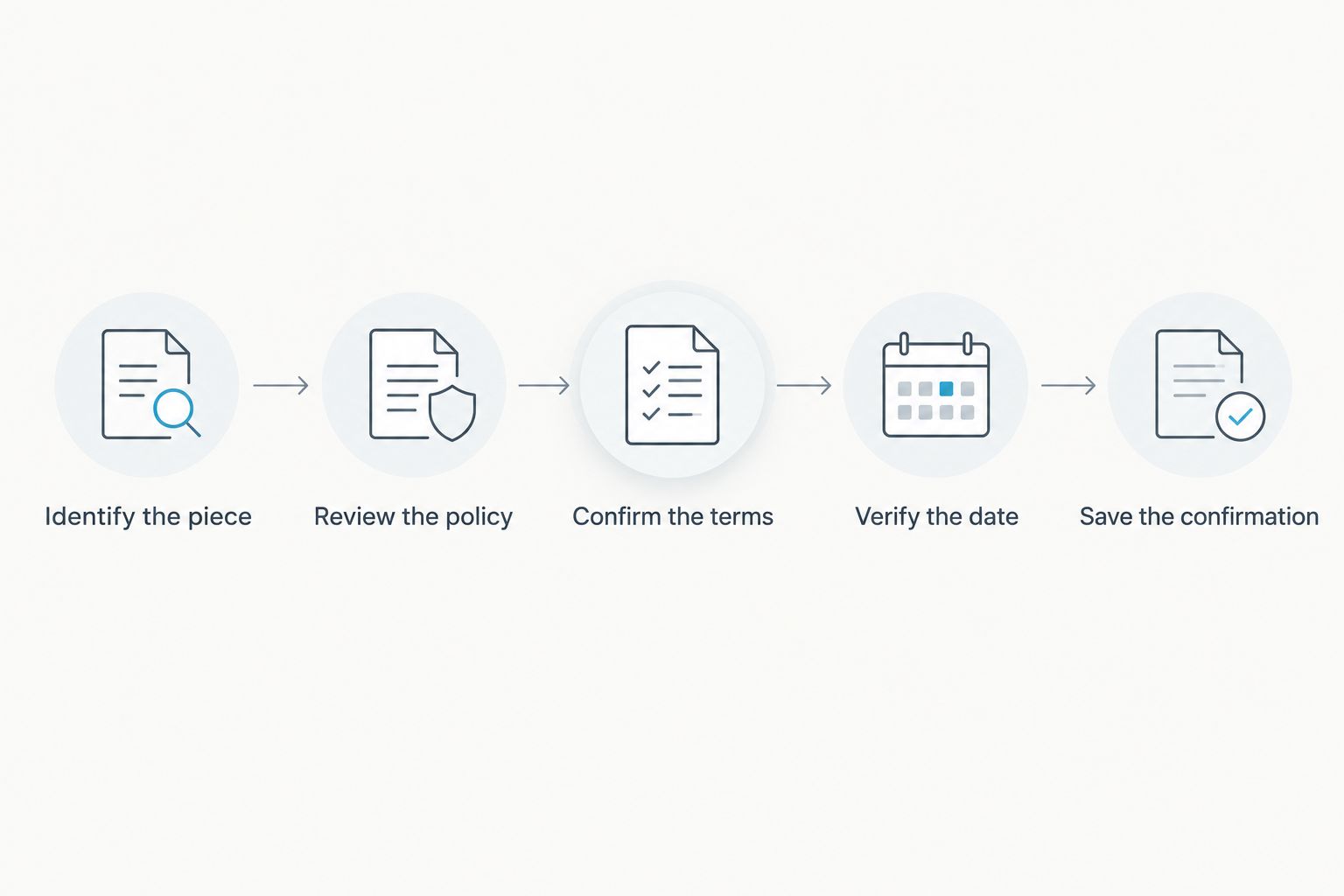
Use this sequence for a 2026 auction purchase. It separates the documents you provide from the coverage the insurer actually confirms.
- Identify the piece. Save the lot description, invoice, photographs, and any accompanying reports. Make sure the documents refer to the same item.
- Review the policy. Check existing jewelry provisions before assuming you need—or already have—additional protection.
- Confirm the terms. Ask about covered events, limits, deductibles, settlement, and any newly acquired property provision.
- Verify the date. Obtain confirmation of when coverage begins and whether it includes the relevant shipment or custody stage.
- Save the confirmation. Keep the issued endorsement, binder, or policy documentation with the purchase record.
Ask for written answers tied to your policy and item. An informal statement that jewelry is covered does not resolve whether your particular ring is covered during shipment, whether disappearance qualifies, or how a claim is settled.
For the documentation process, follow the guide to insuring jewelry purchased at auction. Keep the final coverage decision with the insurer; an auction listing cannot make that decision.
Does insured shipping cover jewelry after delivery?
No—shipment protection does not automatically become personal jewelry insurance after delivery. Its scope comes from the shipping arrangement and any applicable insurance contract. Confirm the endpoint rather than assuming delivery leaves the piece insured indefinitely.
Before dispatch, establish who arranges shipment protection, who can submit a claim, and what evidence is required if a package is lost or damaged. Ask how the arrangement treats carrier handoffs and delivery acceptance.
A declared value on shipping paperwork is not, by itself, proof of an insurance policy. Carrier liability and insurance are different arrangements, and their conditions must be checked separately.
When the package arrives, retain the packaging and document visible damage before discarding anything. Follow the applicable reporting instructions promptly. Do not repair a damaged piece before checking whether the claim process requires inspection or authorization.
Does an auction receipt replace an insurance appraisal?
No—an auction receipt documents the purchase, while an appraisal addresses value for a stated purpose. An insurer decides whether the receipt is sufficient or whether additional documentation is required.
An auction estimate is also not an insurance valuation. It concerns the sale context, while an insurance appraisal must address the valuation basis relevant to the proposed coverage.
For paperwork submitted in 2026, ask the insurer what description and valuation it accepts before ordering an appraisal. That avoids commissioning a report that does not meet the insurer's requirements.
An appraisal does not activate coverage. Even after the insurer receives it, confirm that the policy or endorsement has taken effect. Keep these tasks distinct: documenting the item, establishing an accepted value, and obtaining insurance.
Can a newly acquired jewelry clause cover an auction purchase?
Yes, when your existing policy includes an applicable newly acquired property provision and you meet its conditions. Such a provision is contractual protection, not an automatic benefit of buying at auction.
Ask whether it applies to the type of jewelry you purchased, what limit applies, and whether notification is required. Get the exact reporting deadline from your policy rather than assuming a standard grace period.
Do not postpone the conversation because someone says you can add the piece later. Later acceptance does not establish that an earlier loss was covered. Confirm the temporary protection and the permanent arrangement separately.
What documents should you keep for a jewelry claim?
Build a record that identifies the piece and supports the relevant facts. Keep copies somewhere accessible if the jewelry itself is stolen or lost.
- Purchase evidence: Auction invoice, payment record, and lot identification.
- Item description: Listing details, measurements when documented, metal description, and gemstone information.
- Condition evidence: Clear photographs and any available condition report.
- Supporting reports: Appraisal, gemstone report, or provenance documents supplied with the piece or obtained afterward.
- Insurance evidence: Policy documents, endorsements, and coverage confirmation.
- Transit evidence: Tracking records, delivery confirmation, and shipment protection terms.
These documents serve different purposes. A gemstone report describes gemological characteristics; it does not establish personal insurance. A condition report records observations about the piece; it does not guarantee claim payment.
If you resize, repair, or alter the jewelry, preserve the work record and ask whether the insurer needs an updated description. The insured item should remain identifiable after the work.
What should you ask the insurer before wearing the piece?
Use questions that require a policy-specific answer. Broad questions invite broad responses.
- Is this auction purchase covered now, and under which policy provision?
- Does coverage include theft, accidental damage, and unexplained disappearance?
- What jewelry-specific limit and deductible apply?
- Is the piece covered during shipment, travel, storage, or repair?
- What documentation do you require to add or value it?
- How would you settle a claim if an identical replacement is unavailable?
Do not confuse an application acknowledgment with coverage confirmation. Check the effective document, not just the fact that your request was received. If you are giving the piece as a gift, ask whose ownership and possession the policy covers after the handoff.
FAQ
Is jewelry bought at auction automatically covered by insurance?
No. An auction purchase is covered only if an applicable insurance policy or other protection arrangement covers the item and the loss under its terms.
Does homeowners insurance cover a ring I win at auction?
An auction ring can fall within homeowners personal-property coverage, but jewelry-specific limits, deductibles, and covered-event restrictions still apply. Ask your insurer to confirm the terms for that ring.
Do I need a separate policy for jewelry bought through Jewelryroom.com?
A Jewelryroom.com jewelry auction purchase does not by itself require a separate policy. Compare your existing coverage with the protection you need, then confirm whether an endorsement or standalone policy is appropriate.
Is my auction jewelry insured while it is being shipped?
Shipping coverage depends on the shipment arrangement and any applicable policy. Confirm who provides protection, which losses it covers, and when it ends before dispatch.
Can I insure auction jewelry using only the invoice?
An insurer can accept an invoice, but its documentation requirements determine whether that is enough. Ask whether photographs, an appraisal, or other reports are also required.
Does an appraisal mean my auction jewelry is already insured?
No. An appraisal provides valuation information; insurance begins under the effective terms of the accepted policy or endorsement.
Will insurance pay if I simply lose my auction ring?
An unexplained loss is covered only when the applicable policy includes that protection. Theft coverage alone does not establish coverage for a ring you cannot find.
Can I arrange insurance after winning but before delivery?
Yes, you can seek coverage before delivery. Confirm insurer acceptance, the effective date, and whether the policy includes the relevant transit period rather than treating the application as proof of protection.
One last thing
Check the replacement wording before a loss—not just the insured amount. An antique setting, unusual gemstone, or distinctive workmanship makes the settlement method especially relevant. Ask how the insurer handles a piece that cannot be replaced identically.
For a Jewelryroom.com purchase in 2026, keep a single record containing the auction documents, item photographs, and effective coverage confirmation. You want evidence of what you bought and evidence of what is insured; neither substitutes for the other.


