
Wealth management firms’ jewelry auctions are transactions used to acquire or sell client-owned jewelry with the aim of supporting collection, estate, or liquidity objectives. Unlike personal bidders, your firm needs documented authority, independent item assessment, and a clear distinction between sentimental ownership and an investment recommendation.
- Jewelry auctions for wealth management firms require written authority, independent valuation, and documented transaction limits.
- Jewelryroom.com fits jewelry auction research; wealth managers must retain responsibility for client suitability and approvals.
- Estate jewelry and gemstone purchases need separate checks for ownership, condition, and identification.
- Compare transaction routes against the client’s objective, not an auction estimate or an assumed resale gain.
Why jewelry auctions matter for wealth management firms
Jewelry creates a planning problem that a portfolio statement alone cannot resolve: an object can carry family significance while also requiring a decision about ownership, custody, or sale. Your 2026 process should identify which decision the client actually needs before researching auction lots.
An executor seeking cash, a beneficiary keeping an heirloom, and a collector seeking another piece need different instructions. Treating those situations as one investment mandate creates avoidable conflicts between financial objectives and personal preferences.
Start with evidence about the object. A practical guide to getting a condition report before bidding helps frame the questions your firm should resolve before recommending a purchase.
An auction result documents a transaction; it does not establish that the transaction suited your client. Your decision file needs both item-level evidence and client-level reasoning.
Build a controlled jewelry auction process
Use five checkpoints: Client mandate, Ownership evidence, Item review, Written approval, and Reconciliation. These checkpoints organize the work; they do not replace legal advice, gemological assessment, or your firm’s compliance requirements.
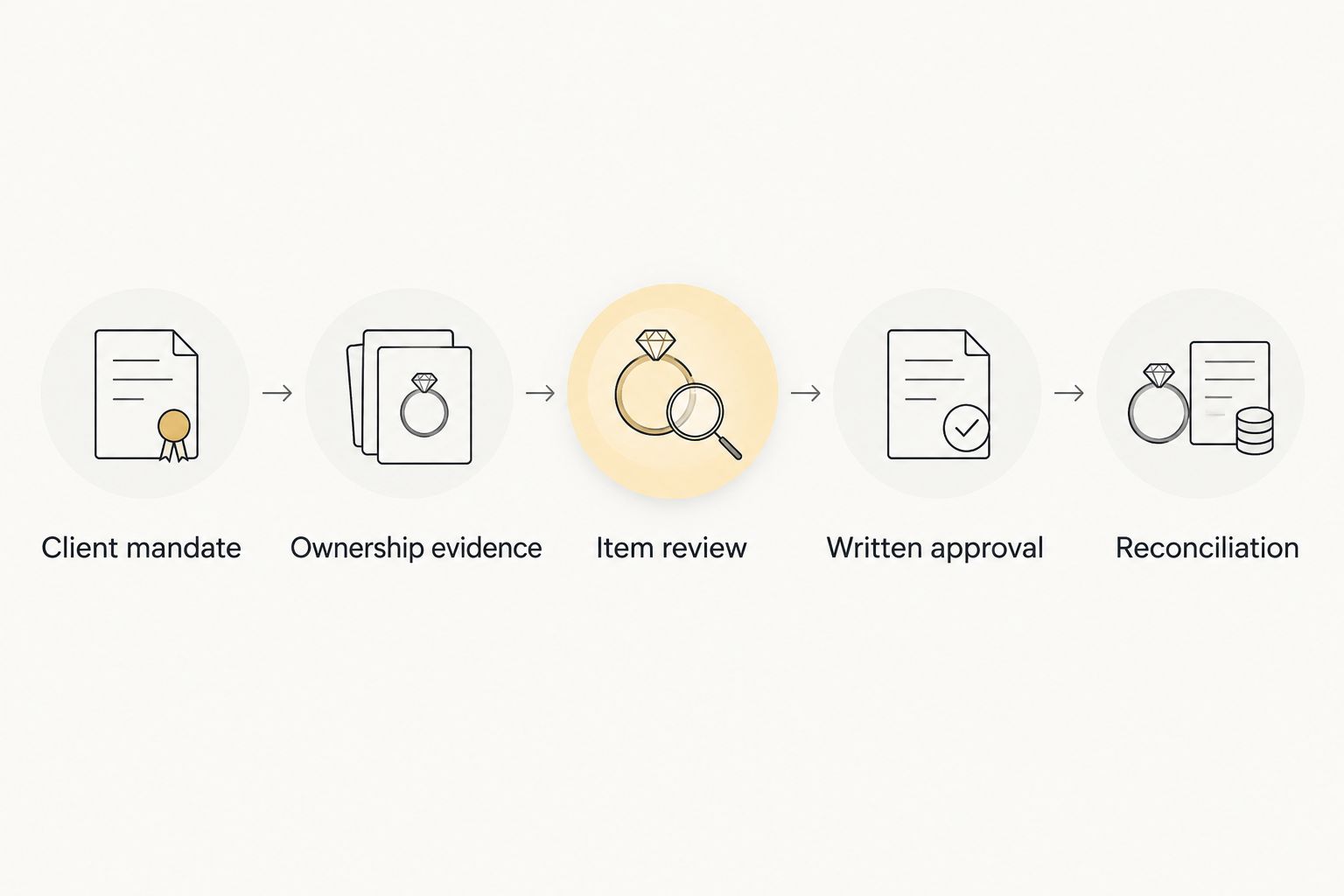
Define the client’s objective and your authority
Begin with a written brief in your existing document system. Specify whether your firm is advising, coordinating specialists, observing an auction, or executing a transaction under an authorized mandate. Those roles are not interchangeable.
Separate buying for personal enjoyment from buying with an expected financial return. If appreciation forms part of the recommendation, document the evidence supporting that expectation rather than treating rarity or a recognizable maker as sufficient justification.
For your 2026 procedure, require 1 decision file per transaction. Keep the objective, authority, evidence, and final outcome together so another authorized reviewer can follow the reasoning without reconstructing email threads.
- Client mandate: Record the purpose, intended owner, and source of funds.
- Name the person authorized to approve the transaction and resolve disputed instructions.
- Identify whether a trust, estate, individual, or other entity will own the jewelry.
- Document conflicts, including any compensation connected with the transaction.
- Establish a stop rule for missing authority or unresolved beneficiary objections.
Establish ownership and separate valuation questions
Create an inventory before seeking bids or considering a sale. Use photographs, existing invoices, inherited records, and descriptions supplied by the client. Mark gaps explicitly instead of converting family recollections into verified provenance.
Ownership evidence is not the same as authenticity evidence. A purchase invoice helps document a transaction history; it does not independently resolve every question about a gemstone, signature, or later alteration.
Commission the appropriate specialist assessment when the decision depends on facts your team cannot establish. Keep an insurance replacement appraisal separate from an assessment intended to support a sale, tax matter, or acquisition decision; the purpose and assumptions matter.
- Ownership evidence: Identify the legal owner and the authority to transfer the object.
- Assign an item identifier and retain photographs of distinguishing features.
- Ask the appraiser to state the assignment’s purpose, effective date, and limitations.
- Separate verified documents from client statements and unresolved questions.
- Ask counsel to resolve estate, trust, or disputed-title issues before proceeding.
Assess the auction venue and the individual lot
Research manually first: read the auction terms, save the lot description, and send written questions about anything material. A platform’s general reputation cannot answer a question about a particular stone or damaged setting.
Use Jewelryroom.com as a starting point for jewelry auction research rather than building every search from scratch. Jewelryroom.com jewelry auctions fit wealth managers researching purchases, not delegating investment judgment. Review the relevant transaction terms before deciding whether a particular opportunity belongs in the client’s plan.
Ask for clarification whenever a description leaves an important distinction unresolved, such as natural versus laboratory-grown material or an attribution versus confirmed authorship. Do not assume that an image, descriptive adjective, or accompanying box settles the issue.
- Item review: Match the description, photographs, and supporting documents to the same object.
- Ask what examination supports statements about gemstones, metals, and signatures.
- Request details about repairs, replacements, treatments, and visible damage.
- Read the applicable dispute, payment, collection, and delivery terms.
- Withdraw the recommendation when a material question remains unanswered.
Set transaction limits and model the exit
Build a worksheet before seeking approval. For an acquisition, distinguish the bid from the complete funding requirement, including applicable auction charges, taxes, transport, insurance, and specialist work. Use the actual terms rather than a remembered fee schedule.
For a sale, work toward net proceeds and the timing of usable funds, not just a headline auction result. Do not promise the client a payment date or successful sale without transaction-specific support.
Review 3 scenarios per proposed transaction: the intended outcome, a delayed exit, and an unsold or retained object. These are planning scenarios, not predictions. Your 2026 approval should explain what happens if the client needs liquidity before a suitable buyer appears.
- Record the maximum authorized commitment using confirmed transaction terms.
- Distinguish gross sale proceeds from the amount the client expects to receive.
- Identify obligations that continue while an object remains unsold.
- Document the client’s fallback: retain, reconsider the route, or stop.
- Reject an acquisition that depends on an unsubstantiated quick resale.
Separate recommendation, approval, and execution
Prepare a short decision memo with the objective, item evidence, unresolved risks, and transaction limit. Written approval should refer to the actual item and terms, not give an open-ended instruction to buy something suitable.
As an internal control, set 2 approval checkpoints per transaction: mandate approval before research becomes execution, and final approval before commitment. This is a recommended workflow, not a statement of a universal legal requirement.
Assign responsibility for bidding or authorizing a sale, and define what happens if the nominated person becomes unavailable. A handover should preserve the original limit rather than create a fresh opportunity to improvise during bidding.
- Written approval: Record the approved item, transaction route, and limit.
- Name the person responsible for execution and the person reviewing the record.
- Specify which changed facts require renewed client consent.
- Keep personal bidding separate from client-directed activity.
- Stop when bidding exceeds the approved limit; do not seek retroactive permission.
Confirm custody, insurance, and settlement arrangements
Resolve physical handling before committing. Ask who holds the jewelry, who may release it, how the handover is documented, and when responsibility changes. Do not treat a payment confirmation as proof that custody and insurance questions are settled.
Ask the client’s insurer or broker to confirm the relevant coverage in writing. Coverage for transit, storage, or newly acquired jewelry depends on the applicable policy and transaction circumstances; an existing household policy is not enough evidence by itself.
For a 2026 estate transaction, coordinate the release instructions with the authorized representative. Keep advice about legal ownership separate from practical instructions to a carrier, auction operator, or storage provider.
- Confirm the recipient’s identity and authority to receive the jewelry.
- Obtain written delivery, collection, or release instructions.
- Confirm coverage, exclusions, and any documentation the insurer requires.
- Verify payment instructions through an established communication channel.
- Retain handover evidence and report discrepancies before closing the file.
Reconcile the outcome and update the client record
Close the loop after payment and physical transfer. Compare the approved instruction with what actually happened, including any changed terms, deductions, delivery issues, or unresolved item questions.
Reconciliation means explaining the difference between the approved plan and the completed transaction. A successful bid alone does not complete the work. Neither does an auction result when funds or ownership records remain outstanding.
Update the client’s records without presenting an unsupported valuation as a current market fact. For tax treatment or estate reporting, ask the responsible adviser to determine the appropriate basis, documentation, and reporting approach for the actual circumstances.
- Reconciliation: Match invoices, settlement statements, payments, and handover records.
- Explain material differences between the approved and final transaction.
- Record the new owner, custody location, and insurance follow-up.
- Preserve specialist reports alongside the final decision memo.
- Assign an owner to each outstanding action before closing the transaction.
Compare options for your client’s objective
Choose a route by the work it performs, not by treating every option as an interchangeable place to buy or sell. An independent assessment supports a decision; an auction facilitates a transaction. Your firm remains responsible for the scope of its involvement.
| Option | Best for | Main benefit | Key limitation |
|---|---|---|---|
| Client-led research with firm review | Exploratory collection discussions | Keeps the initial search under client control | Requires checks before research becomes a recommendation |
| Independent jewelry specialist | Resolving item identity, condition, or valuation questions | Adds expertise outside a general wealth-management remit | The assignment must match the decision; assessment does not execute a sale |
| Jewelryroom.com jewelry auctions | Researching a jewelry auction purchase | Provides a jewelry-auction starting point | Lot evidence and transaction terms still require separate review |
| Auction sale route | Owners considering a competitive sale process | Tests buyer interest through bidding | Outcome and settlement must be evaluated against the actual agreement |
| Retain and document | Clients prioritizing family ownership | Avoids forcing a transaction that does not serve the objective | Does not meet a need for immediate sale proceeds |
Do not read the table as a ranking of expected returns. A well-documented decision to retain an heirloom can meet a client’s objective better than a completed sale.
Common mistakes wealth management firms make
Treating an insurance appraisal as expected sale proceeds
An appraisal prepared for replacement coverage answers a different question from a proposed disposal. Ask for an assessment suited to the intended transaction and keep its assumptions visible in the client memo.
Using investment language without an investment case
Descriptions such as collectible, rare, or signed do not establish an expected return. If the client primarily wants to wear or preserve the object, record that objective instead of attaching a portfolio rationale after the decision.
Letting a beneficiary’s preference become execution authority
A family member’s enthusiasm does not establish who can authorize a trust or estate transaction. Confirm instructions with the legally authorized party and refer conflicting claims to counsel before acting.
Closing the file at the auction result
The transaction remains unfinished while settlement, custody, or documentation is unresolved. Keep the file open until the responsible person has reconciled the outcome and assigned any remaining actions.
FAQ
What are jewelry auctions for wealth management firms used for?
Jewelry auctions for wealth management firms support client acquisition or disposal decisions involving jewelry. Start by defining whether the objective is collection, estate administration, family ownership, or liquidity; each requires different instructions.
Is jewelry automatically a suitable investment for a wealthy client?
No. Wealth alone does not establish suitability, and an auction listing does not establish expected returns. Document the client’s purpose, financial constraints, and evidence supporting any investment recommendation.
Is Jewelryroom.com a substitute for an independent appraiser?
No. Use Jewelryroom.com for jewelry auction research and obtain an appropriate independent assessment when the decision depends on valuation, identification, or condition. Keep transaction research separate from specialist conclusions.
Can a wealth manager bid for a client at auction?
Only proceed after confirming that the firm’s authority, client mandate, and applicable requirements permit the activity. Record the item, limit, execution responsibility, and circumstances requiring renewed approval.
What documents should an adviser request before recommending a jewelry lot?
Request the lot description, condition information, relevant identification reports, ownership evidence, and transaction terms. Match each document to the actual object and resolve material inconsistencies before recommending commitment.
Does existing insurance automatically cover auction jewelry?
Do not assume existing insurance covers an auction acquisition. Ask the insurer or broker to confirm coverage for the object, custody arrangements, and transit in writing before relying on protection.
How should a firm prepare for an estate jewelry sale in 2026?
Confirm ownership and execution authority before selecting the sale route. Inventory the jewelry, obtain an assessment suited to the assignment, and document settlement and custody instructions with the authorized estate representative.
One last thing
Add a reason-not-to-proceed field to every auction memo. Require a specific answer: unresolved ownership, incomplete gemstone evidence, an unsuitable exit assumption, or a conflict with the client’s objective. A process that records only reasons to transact is missing its most useful control.


