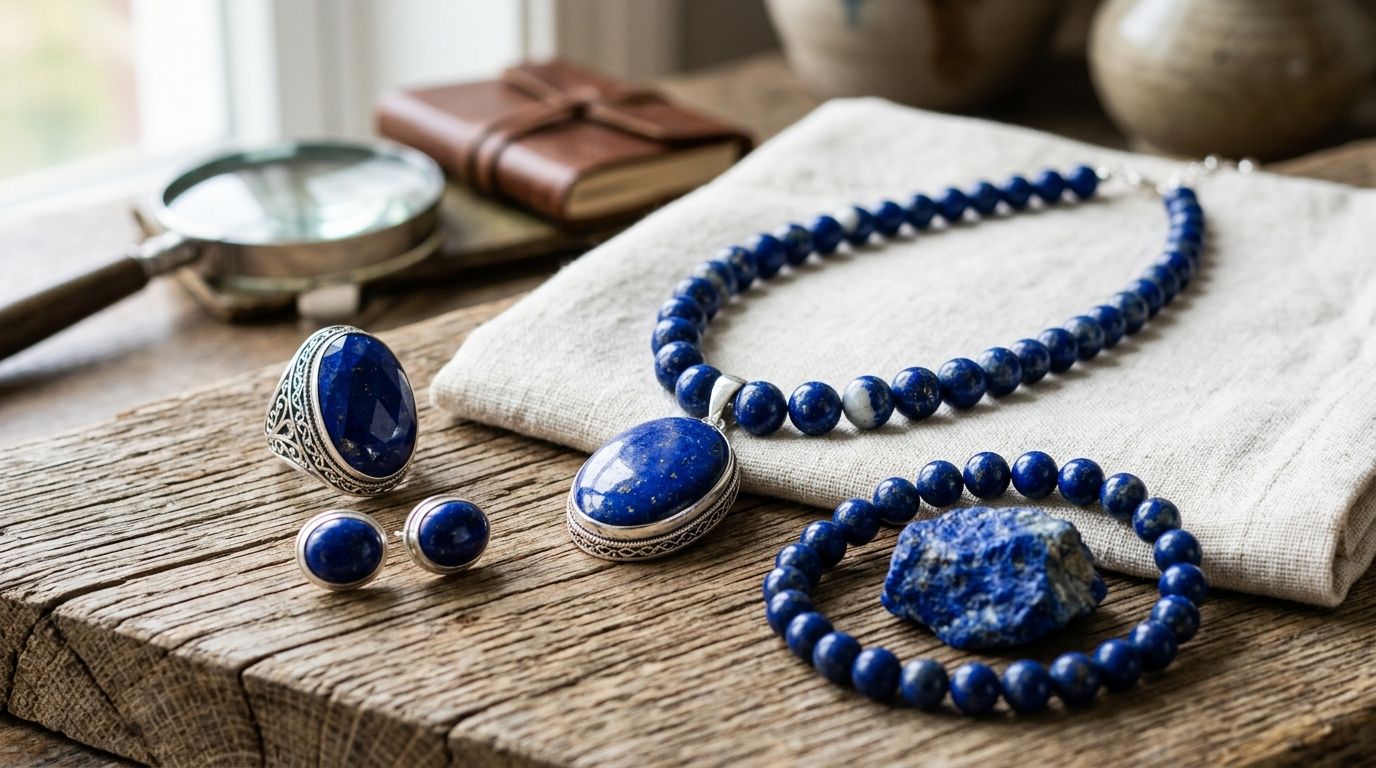
Lapis lazuli jewelry for blue gemstone collectors means buying an opaque, deep ultramarine stone graded on saturation and pyrite pattern rather than clarity or cut — and in 2026 that grading knowledge is what separates a smart auction win from an overpriced dye job. Collectors who already own sapphire, tanzanite, or aquamarine often misjudge lapis because it behaves nothing like a transparent gem: no facets to catch light, no clarity grade, just color depth and mineral texture.
- Lapis lazuli jewelry in 2026 is graded on ultramarine saturation and gold pyrite flecking, not clarity or cut.
- Afghan lapis from Sar-e-Sang mines commands the strongest bids; dyed or reconstituted stone sells for far less.
- Dyed and synthetic lapis is common at online auctions — verify certification before bidding.
- Victorian and Art Deco lapis settings hold collector value better than modern mass-market pieces.
- Compare estate lapis lots against retail pricing before you bid to avoid overpaying at auction.
Why lapis lazuli jewelry matters for blue gemstone collectors
Blue gemstone collectors typically build a spread across sapphire, tanzanite, aquamarine, and turquoise before lapis lazuli enters the picture — and lapis is the one stone in that group that's opaque, historically significant, and consistently mistreated by dye and wax fillers at auction. That combination makes it the category where grading literacy pays off fastest: a collector who can spot fake gemstones at online auctions before bidding avoids the single most common lapis mistake, which is paying Afghan-grade prices for reconstituted powder pressed with resin.
Lapis also carries weight beyond the jewelry case. Ground lapis lazuli was the source of ultramarine pigment used by Renaissance painters — a fact worth knowing because it explains why the deepest, most uniform blue material has always traded at a premium over lighter or calcite-streaked stone. That premium logic still governs auction pricing in 2026.
How to buy lapis lazuli jewelry at auction in 2026
Learn the lapis lazuli grading scale before you bid
Grading runs almost entirely on color and pyrite distribution, not carat weight. A one-inch cabochon of ultramarine-grade Afghan material outranks a much larger commercial-grade slab every time.
- Ultramarine grade: deep, even blue with fine gold pyrite flecking scattered like stars
- Persian/AAA grade: slightly lighter but still uniform, minimal white calcite
- Commercial grade: visible white calcite veining, uneven color
- Reconstituted or dyed: crushed lapis fragments pressed with dye and resin, flat unnatural color under magnification
Check for dye, wax, and reconstitution
Most lapis sold below Afghan-grade pricing has been treated in some way, and treatment isn't automatically disqualifying — it just needs to be disclosed and priced accordingly.
- Run a cotton swab with acetone on an inconspicuous spot to check for dye transfer
- Look for unnaturally uniform color with no pyrite variation at all
- Read whether the catalog states "natural," "dyed," or "reconstituted"
- Check the listing photo under strong light for a waxy surface sheen
- Confirm the seller will put the treatment disclosure in writing
Jewelryroom.com auction listings note origin and treatment status in the catalog description, which turns the loupe-checking step into a read-through before you place a bid.
Compare Afghan, Chilean, and Russian sourcing
Sourcing drives price more than almost any other single factor in lapis lazuli jewelry.
- Afghan (Sar-e-Sang): the benchmark source since ancient Egypt, deepest and most consistent blue
- Chilean: greener undertone, heavier calcite veining, generally lower bids
- Russian (Lake Baikal region): historically significant, rarer at auction today
- Unspecified origin: treat as commercial grade until documentation proves otherwise
Match the setting era to your existing collection
A collector building a cohesive blue gemstone case cares about design period as much as the stone itself.
- Victorian pieces frequently pair lapis with jet and seed pearls
- Art Deco settings favor geometric bezels that showcase pyrite flecking
- Mid-century pieces often mix lapis with turquoise or coral in cabochon clusters
- Modern estate pieces tend toward simple gold bezels with minimal ornamentation
Set a hard bidding ceiling before the lot opens
Lapis auction prices swing wide between Afghan-grade and commercial-grade lots, which makes it easy to chase a bidding war on a piece that isn't actually top grade. Decide your ceiling before the listing goes live, not while the countdown clock is running. Anchor that number to comparable retail pricing for the same grade and setting era.
Verify certification and provenance before the gavel falls
Documentation matters more for lapis than for many transparent gems, precisely because treatment is common and hard to catch by eye. Before bidding, research a gemstone's certification rather than relying on the catalog photo — a documented natural, untreated lot justifies the extra step every time.
Compare live lapis lazuli auction lots
Set your bidding ceiling before the next estate jewelry auction closes.
Store and clean the piece correctly after you win
Lapis lazuli sits at 5-5.5 on the Mohs scale, softer than quartz and far softer than sapphire, so handling habits matter more here than for harder blue stones. Skip ultrasonic cleaners entirely — the porous surface absorbs solution and loses saturation.
- Store in a separate soft pouch, never loose beside diamonds or sapphires
- Clean with a soft dry cloth, mild soap and water only when needed
- Keep away from perfume, hairspray, and household solvents
- Re-check bezel tension annually on antique settings
Lapis lazuli options compared
| Option | Best for | Key limitation |
|---|---|---|
| Afghan ultramarine-grade lapis | Collectors building an investment-grade centerpiece | Highest competition at auction; provenance check required |
| Chilean lapis with calcite veining | Budget-conscious entry buyers | Lower saturation, greener undertone |
| Dyed or reconstituted lapis | Buyers who want the look at lower cost | Color transfers or fades with handling |
| Vintage estate settings (Victorian, Art Deco) | Collectors matching stone to design period | Limited supply, competitive bidding |
| Loose lapis cabochons | Collectors commissioning a custom setting | Setting cost sits on top of the hammer price |
Verdict: Afghan ultramarine-grade lapis lazuli in a documented Victorian or Art Deco setting is the strongest hold for a serious blue gemstone collection in 2026 — buy it when provenance is written down, and skip anything labeled reconstituted at Afghan-grade pricing.
“If the blue is perfectly uniform with zero pyrite variation, that consistency is the tell, not the selling point.”
Common mistakes blue gemstone collectors make with lapis
- Judging quality by blue depth alone — pyrite grain size and calcite veining move price as much as raw saturation
- Trusting "natural" claims without documentation — dyed lapis routinely reads as natural in a casual auction photo
- Benchmarking lapis against sapphire or tanzanite — the rarity model is different, and an opaque stone should never be priced like a transparent one
- Storing lapis with harder stones — a 5-5.5 Mohs surface scratches against sapphire, topaz, or diamond in the same box
- Skipping appraisal because lapis feels inexpensive — Afghan-grade pieces with provenance appraise well above commercial-grade lookalikes
FAQ
What makes lapis lazuli jewelry valuable in 2026?
Value comes from color saturation and pyrite flecking rather than carat weight. Deep, even ultramarine blue with fine gold pyrite scattered evenly commands the strongest bids, and Afghan material from the Sar-e-Sang mines sets the benchmark for top grade.
Is lapis lazuli jewelry a good investment compared to sapphire?
Lapis lazuli follows a different rarity model than sapphire and should not be priced against it directly. Provenance-documented Afghan-grade lapis in a period-correct setting holds value best within its own category.
How can you tell if lapis lazuli is dyed?
Run a cotton swab dipped in acetone across an inconspicuous spot; dye transfer onto the swab indicates treatment. Perfectly uniform color with no pyrite variation under magnification is a second red flag.
How hard is lapis lazuli compared to other blue gemstones?
Lapis lazuli rates 5-5.5 on the Mohs hardness scale, softer than sapphire, topaz, or quartz. Store it separately from harder stones to avoid surface scratching.
Where does the best lapis lazuli come from?
Afghanistan's Sar-e-Sang mines have supplied the highest-grade lapis lazuli for over 6,000 years and remain the benchmark source. Chilean lapis runs greener with more calcite veining, and Russian material is rarer at auction today.
Should you get lapis lazuli certified before bidding?
Yes. Treatment is common enough that documented natural, untreated status matters more for lapis than for many transparent gems, and certification protects you from paying Afghan-grade prices for reconstituted material.
Can lapis lazuli be cleaned in an ultrasonic cleaner?
No. Lapis lazuli is porous and absorbs cleaning solution, which fades color saturation over time. Use a soft cloth and mild soap instead.
What era of setting pairs best with lapis lazuli?
Victorian settings often pair lapis with jet and seed pearls, while Art Deco pieces favor geometric bezels that highlight pyrite flecking. Both eras hold collector value better than unmarked modern mass-market settings.
One last thing
Renaissance painters ground lapis lazuli into ultramarine pigment that once traded above gold by weight, and the same even saturation that drove that historical premium is exactly what auction buyers pay for in 2026. Bring that lens to every lot: you are bidding on pigment-grade blue, not on stone size. The 6,000-year Afghan supply chain is the reason a small Sar-e-Sang cabochon still outbids a large Chilean one.


