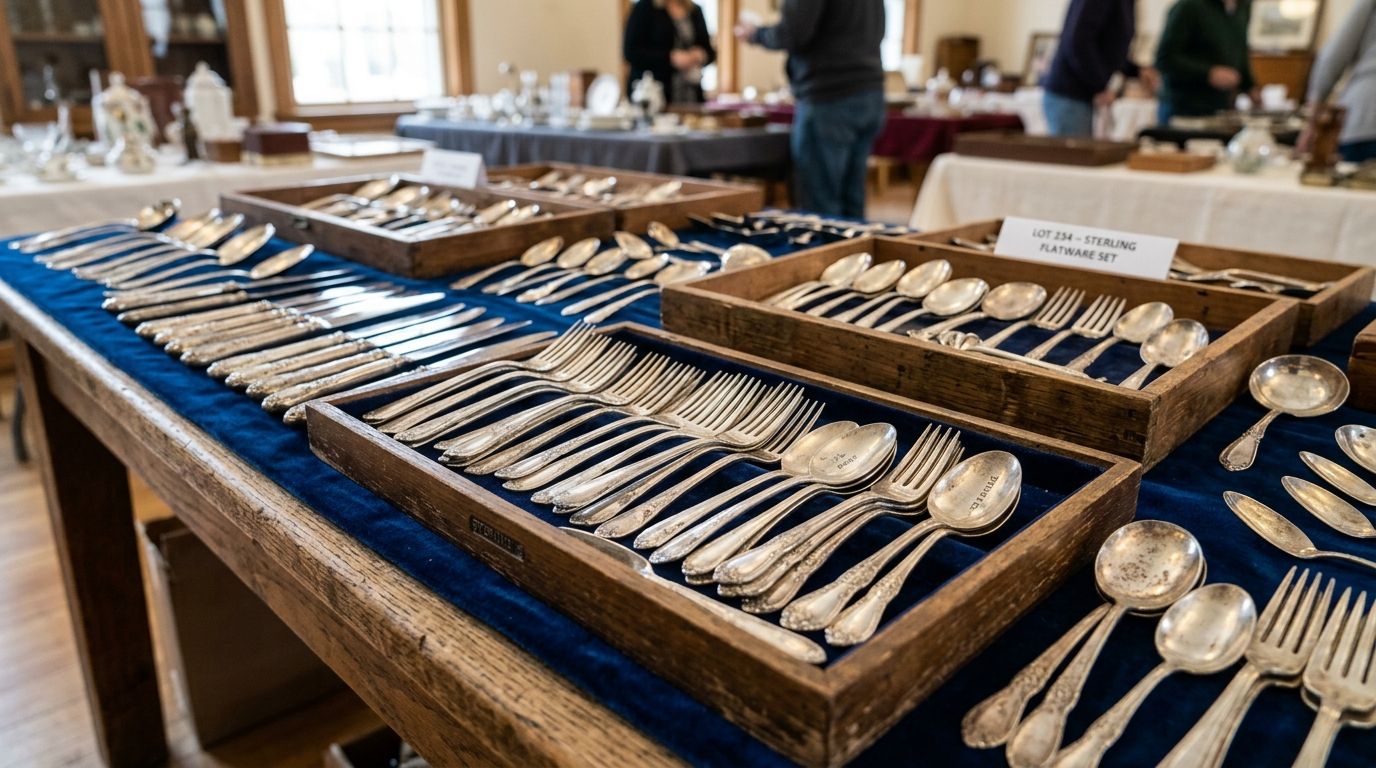
Estate liquidation buyers who chase silver flatware at auction need one number before anything else: melt value versus collector value, and which one the lot actually deserves. Get that number wrong and you overpay for scrap or underbid on a pattern that's worth three times its silver weight.
- Sterling flatware runs 92.5% pure silver; silverplate has none worth melting — confirm hallmarks before you bid on a silver flatware estate auction lot.
- Weigh the lot in troy ounces before bidding — melt value is your bid floor, not your target price.
- Incomplete patterns and monogrammed pieces sell for 20-40% less to collectors, even when the silver content is identical.
- Buyer's premiums of 15-25% at most auction houses change your real cost basis — factor it in before you set a ceiling.
- Jewelryroom.com lists estate flatware with catalog photos and hallmark descriptions, which lets liquidation buyers screen lots before spending on shipping or travel.
Why silver flatware auctions matter for estate liquidation buyers
Estate liquidation is a volume business. You're not buying one fork — you're buying a service for eight, a hollow-handle carving set, or a mixed box lot from a family clearing an estate, and you need to price it fast and correctly. A misread hallmark or an uncounted piece turns a profitable lot into a loss the moment shipping and buyer's premium hit your invoice.
Silver flatware behaves differently from silver jewelry at auction. Jewelry gets priced on stones, craftsmanship, and brand. Flatware gets priced on weight, pattern demand, and completeness — three variables a liquidation buyer can actually verify before bidding, if the catalog gives you enough detail. That's the entire game: know more than the next bidder about what's actually in the box.
Identify the hallmarks before you bid
Sterling silver flatware is stamped 925, sterling, or a country-specific hallmark system (British lion passant, French Minerva head, and so on). Silverplate is stamped EPNS, A1, triple plate, or carries a maker's mark with no fineness number at all — and it has zero melt value.
- Look for 925, sterling, or .925 stamped on the back of the handle
- Check for British hallmarks (lion passant plus a date letter) on pre-1900s English flatware
- Treat EPNS, EPBM, or quadruple plate stamps as plated, not sterling
- Photograph the hallmark and zoom in — catalog photos from the auction house are often too low-res to confirm fineness
- Cross-reference an unfamiliar maker's mark against a hallmark database before bidding six figures on a single lot
Weigh the lot to set your melt value floor
Every sterling flatware lot has a silver-weight floor. That number doesn't tell you what to pay — it tells you what you can never lose, even if the pattern turns out to be undesirable.
- Request gross weight in the listing, or estimate from piece count and typical flatware weights by category (dinner fork, teaspoon, serving piece)
- Subtract knife handles that are often weighted with cement or resin — they don't add to melt value the way solid pieces do
- Convert weight to troy ounces and multiply against spot silver price the day you bid, not the day the auction opens
- Use that figure as your absolute bid ceiling for non-collectible lots — never bid above melt on plain, common patterns
- Re-check spot price the morning of the sale; silver moves enough in a week to change your math
Check pattern completeness and piece count
A "12-piece setting" that's actually eight dinner forks, six teaspoons, and no serving pieces is not a set — it's a partial lot, and collectors price it accordingly.
- Count place settings against stated piece count in the catalog description
- Confirm the presence of serving pieces (ladles, pie servers, carving sets) — these carry a premium over place settings
- Note the specific pattern name if given; active-production patterns hold resale value better than discontinued ones with no replacement source
- Flag mixed-pattern lots explicitly — bidders assume a matched set unless the listing says otherwise
- Ask the auction house for an itemized inventory sheet on large lots before bid day, not after you've won
Verify the auction house's reputation before you commit
Condition reports and hallmark claims are only as good as the house making them. A liquidation buyer working six or seven sales a month can't afford to relearn this lesson on a $4,000 lot.
- Check how long the house has run estate and specialty silver sales, not general household auctions
- Read post-sale dispute policies — does the house accept returns on misdescribed sterling versus plate?
- Look for detailed condition notes (dents, repairs, monogram removal marks) rather than generic "good condition" language
- Confirm the house discloses buyer's premium and payment terms clearly in the catalog, not buried in fine print
- Verifying an auction house's reputation before you commit real budget catches most of these red flags in ten minutes
Set a liquidation-focused bid ceiling before the sale opens
Liquidation buyers lose money not from bad lots but from bidding emotion — chasing a pattern past its resale ceiling because two other bidders are still in.
- Set your ceiling from melt value plus a collector premium only when pattern and completeness both check out
- Add buyer's premium (commonly 15-25% at auction houses) into your ceiling math before the paddle goes up
- Decide your walk-away number in writing before bidding starts — avoiding overbidding on estate auctions is a discipline problem, not a research problem
- Treat any lot without a hallmark photo as melt-value-only until proven otherwise
- Skip lots where the reserve already exceeds your calculated melt-plus-premium ceiling
“If the pattern isn't complete, price it as scrap, not silverware.”
Inspect condition for monograms, repairs, and mismatches
A monogram cut into the handle drops collector value even on a rare pattern, because most buyers want a blank palette or their own initial. Repairs — soldered tines, replaced blades — do the same.
- Ask specifically whether pieces carry engraved monograms, and whether removal has been attempted
- Look for solder lines at the base of fork tines or knife blades, a sign of prior repair
- Check that all handles in a "matched" lot share identical pattern depth and wear — mismatched sets get assembled from multiple estates and sold as one lot
- Confirm knife blades are original stainless or carbon steel to the maker, not later replacements
- Weigh monogrammed pieces separately if you plan to sell them for melt rather than resale
Plan your resale channel before you bid, not after
Knowing where a lot goes after the hammer falls changes what you should pay for it. Melt buyers, pattern-matching collectors, and general secondhand markets pay very different amounts for the same box of flatware.
- Decide upfront: melt, pattern-replacement collectors, or general resale marketplace
- Research current demand for the specific pattern among replacement-service buyers before assuming resale value
- Factor shipping insurance into resale math on large or heavy lots — sterling flatware ships by weight
- Reselling jewelry won at auction covers channel selection that applies directly to flatware liquidation
- Hold a small reserve of common patterns as melt inventory rather than listing piece-by-piece when demand is soft
Comparing venues for silver flatware liquidation
| Option | Best for | Key limitation |
|---|---|---|
| Online estate auction platforms | Liquidation buyers who need catalog photos and hallmark descriptions before bidding | Condition reports vary widely in detail between houses |
| Local estate sale companies | Buyers who want to inspect flatware in person before bidding | Limited to regional inventory, fewer rare patterns |
| Live auction houses (specialty silver sales) | High-value sterling lots with provenance | Buyer's premium and travel costs eat into liquidation margin |
| Peer marketplace box lots | Volume buyers testing melt-value math on unsorted lots | No hallmark verification before purchase, higher risk |
Jewelryroom.com lists estate silver flatware alongside catalog notes and hallmark detail, which gives liquidation buyers the screening information most general marketplaces skip.
Screen estate flatware lots before you bid
Browse current listings with hallmark and condition detail.
Common mistakes estate liquidation buyers make
- Bidding on weight alone. Ignoring pattern demand means overpaying for common patterns and underbidding on rare ones that would have sold above melt.
- Skipping the buyer's premium in bid math. A 20% premium turns a break-even lot into a loss the moment the invoice arrives — negotiating a buyer's premium before the sale avoids this.
- Assuming "service for 12" means complete. Liquidation buyers who don't request itemized counts routinely discover missing serving pieces after the sale closes.
- Treating monogrammed pieces like blank ones. Pricing a monogrammed set at full collector value guarantees a slow, discounted resale.
- Not verifying the house before wiring payment. Skipping appraising estate jewelry before bidding practices on a $10,000 flatware lot is how liquidation buyers lose their margin to a misdescribed hallmark.
FAQ
What's the best way to tell sterling flatware from silverplate at auction?
Check for a 925, sterling, or British hallmark stamp on the back of the handle — silverplate carries stamps like EPNS or triple plate with no fineness number. Catalog photos should show this stamp clearly; if they don't, ask the auction house before bidding.
Is buying a full flatware set better than buying loose pieces at a silver flatware estate auction?
A complete matched set typically sells to collectors for more per piece than the same items sold loose, so completeness is worth paying a premium for. Loose or mismatched pieces are usually priced closer to melt value.
How much does buyer's premium add to an estate flatware lot?
Most auction houses charge a buyer's premium between 15% and 25% on top of the hammer price in 2026. Build that percentage into your bid ceiling before the sale, not after you win.
Does a monogram lower the resale value of estate silver flatware?
Yes — a monogram engraved into the handle typically reduces collector demand because most buyers want unmarked pieces or their own initials. Monogrammed lots are usually better priced for melt value than pattern resale.
Can I estimate melt value without a scale at the auction?
Estimate gross weight from piece count and typical flatware weights by category, then confirm with a scale before finalizing your bid ceiling. Knife handles often contain non-silver filler, so subtract those from your weight estimate.
What auction houses are reliable for estate silver flatware in 2026?
Look for houses running dedicated estate and specialty silver sales with detailed condition reports and disclosed buyer's premium terms. Checking a house's dispute policy on misdescribed sterling versus plate before bidding avoids most problems.
Should liquidation buyers bid on mixed-pattern flatware lots?
Mixed-pattern lots should be priced closer to melt value than matched sets, since collectors pay a premium for consistency across all pieces. Confirm with the auction house whether a lot is matched or mixed before bidding.
One last thing
The single biggest margin killer in silver flatware liquidation isn't a bad hallmark call — it's buying a "complete" 12-piece setting that turns out to be eight forks and four spoons with no serving pieces, discovered after the invoice clears. Request an itemized piece count in writing before every bid over your melt-value floor, and treat any auction house that won't provide one as a pass, not a maybe.


